Patron Preview: Spelljammer in Eberron
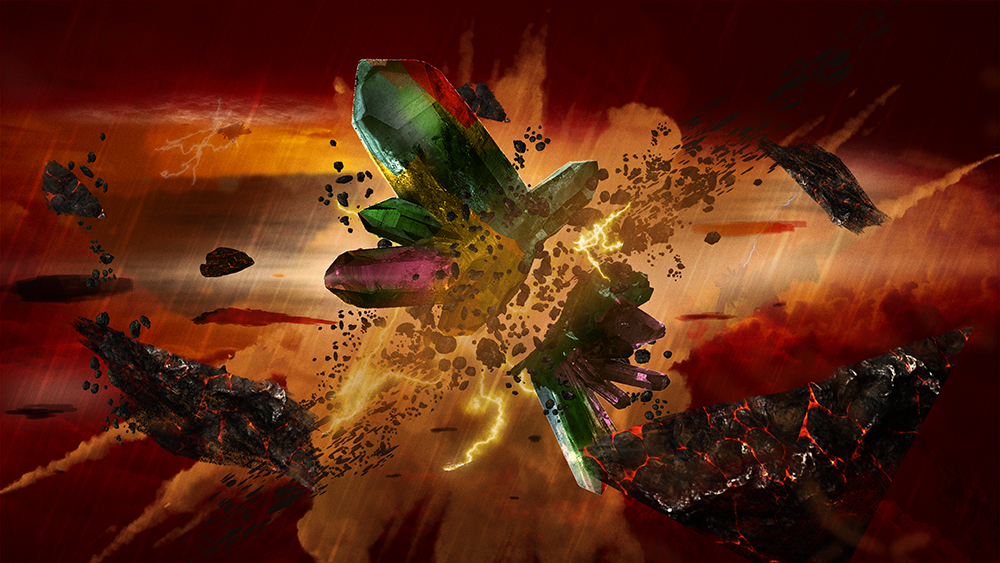
The warforged captain stared at the great orange orb ahead of them. “This is it, my friends. We are about to be the first people to set foot on Olarune. Thanks to your courage and your tireless efforts, we will bring honor to Breland—and Sovereigns willing, profit.”
“Captain, ship ahead!”
“Impossible. “ The captain adjusted his ocular lenses. “We’re a day ahead of the Karrns—”
“It’s not the Blade. It’s an unknown design, sir. And it’s ascending from the surface.”
The deck crew ran to the rails. The approaching ship was like nothing they’d ever seen on Eberron; it looked like a great oak uprooted and cast into the air, with tapestries of rainbows spun between its branches. In its own way, it was beautiful. But as it drew closer, the crew of Intrepid heard the sounds coming from it—the howls of hungry wolves.
Spelljammer intertwines fantasy and magic with spacefaring adventure. This dynamic setting has come to fifth edition, giving players the opportunity to set course for WIldspace and distant realms. What does this mean for Eberron? What’s the best way to take your campaign to the skies and beyond?
Exploring Eberron suggests that Eberron is the only planet in its material plane—that the stars are in fact glittering points on a crystal sphere, surrounded by the vast astral void. This is tied to the assertion that the material plane of Eberron is an artifact; whether or not the myth of the Progenitors is literal truth, Eberron and its planes were created and were intentionally cut off from the wider multiverse. In blending Eberron and Spelljammer, the question is whether you want to merge the two directly and make Eberron one more realm in the wider multiverse (let’s call it Siberspace)—or whether you want to us the basic idea of Spelljammer while still keeping Eberron isolated from the other settings of the multiverse.
EBERRON IN ISOLATION: THE SPACE RACE
Spelljammer blends classic tropes of space opera and exploration with fantasy and magic. I’m most interested in telling that story within Eberron itself, as opposed to throwing my adventurers into Realmspace and dealing with questions like how clerics of the Sovereigns interact with the gods of Toril or what Xoriat has to do with the Far Realms. I’d rather add depth to my Eberron—to develop the Ring and the moons, to considering the impact of spelljamming on the nations of Eberron—than leave the setting behind.
With this in mind, what I’d do in MY campaign is to keep the core ideas of Spelljammer—mystical ships, battles in space, exploring strange worlds and meeting unknown species and civilizations—but to keep it all within Eberron’s cosmology. Beyond this, I’d emphasize that this is all happening right now. Rather than presenting spelljamming as a long-established part of the setting, I want to use spelljamming to reinforce the fact that in Eberron, arcane magic is a form of science and that science evolves. The adventurers aren’t just the latest recruits in a vast, well-established spelljamming fleet; they are among the very first humanoids to venture into wildspace and to reach the moons of Eberron. In addition to the excitement of going where no one has gone before, I’d emphasize the conflict between nations. Consider the television series For All Mankind. Not only are the people of Eberron competing to get into space, they will be actively competing as they explore and as they seek to establish outposts and alliances on the moons. As the campaigns open, the spelljammers are primarily concerned with their national interests… but in their expeditions they could well unleash threats that will require them to set aside their petty bickering and work together.
Who’s Going To Space?
In developing a Spelljammer campaign based on the space race, a key question is who’s in the race? There’s many possibilities, but my preference is to focus on the Five Nations. Following the Mourning, the Five Nations are in a cold war. No one won the Last War, but even Aurala is afraid to continue the fight lest it unleash a second Mourning. Just as in our world, the space race can become a proxy for this conflict, driven by national pride and the determination not to let another nation secure a tactical advantage in space. The Treaty of Thronehold still holds, and it would take intense provocation to cause an Aundairian ship to open fire on a Brelish ship—but the nations are bitterly competitive and will do anything short of war to get an edge over their rivals.
So with this in my mind, I would focus on three primary forces. The Dragonmarked Houses are willing to work with every nation, but this is also a chance to explore the growing division within House Cannith, suggesting that each of the three barons are backing a different nation and that the rivalry between these three is almost as strong as the cold war between the nations.
Aundair: The Dragonhawk Initiative
Aundair dares, and that motto certainly applies to its spelljamming program. Rather than pursuing the established path of elemental binding, this branch of the Arcane Congress is blending cutting edge arcane science with Thelanian wonder. The Brelish say that Aundair traded an old cow for a spelljamming engine, and while that a mocking exaggeration, it’s not entirely untrue; the ir’Dalan line has a long association with the archfey known as the Mother of Invention, and the Magister Asta ir’Dalan has brought wizards and warlocks together in a unique alliance. The current Aundairian ships are the fastest and most maneuverable of the three main powers, and unquestionably the most beautiful. A few key notes about the Dragonhawk Initiative…
- Romantic Explorers. The Dragonhawk Initiative is a branch of the Arcane Congress; it’s a scientificprogram rather than a military operation. While there’s a chain of command, discipline is far less intense than on a Karrnathi vessel. Dragonhawks love the story of being explorers into the unknown and embrace the romance of the adventure more than their counterparts—as befits a ship built in alliance with the fey. Dragonhawks are determined to prove Aundairian superiority and to seize strategic objectives, but they also are the most likely to be distracted by intriguing mysteries and shiny objects, and to embrace exploration for its own sake. Dragonhawk crew have relative freedom when it comes to personal expression, and Karrns often sneer that Dragonhawks are dressed for a gala rather than for space. As scientific vessels, Dragonhawks have the lightest armaments of the three powers but the greatest investment in divination magic and other research tools.
- Arcane and Fey. Dragonhawk ships rely on a blend of concrete science and on improbable Fey magic. A side effect of this is that each ship is unique. Dawncatcher uses a sail that catches “ethereal winds”, while the flagship Dragonhawk has actual wings of wood and gold that animate as it flies. Each ship has a fey spirit who’s part of the ship itself, much like a dryad is tied to a tree; this spirit can’t manifest independently as a dryad does, but it monitors the condition of the ship and its mood affects the vessel’s performance. Dragonhawk ships have a number of lesser fey that work directly with the spirit and maintain its systems; these are effectively chwinga with the mending and prestidigitation cantrips. As such, a Dragonhawk vessel has a chief wizard who maintains the arcane wards and other scientific systems, and a counselor—a warlock who has a pact with the spirit of the ship itself. The counselor is effectively an engineer, encouraging the ship when needed to boost performance and commanding the chwinga. However, counselors are also expected to serve as diplomats when required. The explorers expect to face unknown dangers, and who better to handle first contact with alien beings than someone trained to negotiate with the fey?
- Wondrous but Unpredictable. Each Dragonhawk vessel is unique. Their current ships are the fastest in the skies, but it’s possible the next ship the produce will be a clockwork dragon turtle that is slow but extremely durable. An unavoidable side effect of this is that each vessel can have its own unexpected problems. It’s just possible that Dragonhawk’s wings will melt if it gets too close to the sun, or that Dawncatcher will run into an unexpected ethereal storm. Another way to look at this is that Dragonhawk vessels are ultimately stories. If the story of an expedition is exciting enough on its own, the ship will be fine… but if a tale starts to lag, something will happen to add drama to the story.
As scientific vessels, the crew of a Dragonhawk ship will focus more on arcane sophistication and on skill than brute force. Every ship will have at least one wizard and one warlock. An eldritch knight could be appointed as security chief, but a battlemaster or barbarian would be an unlikely addition to the crew. Baron Jorlanna d’Cannith isn’t as closely involved with the Dragonhawk Initiative as her rival barons are with their nations, but Cannith West is involved in manufacturing the Aundairian spelljammers and could become more actively involved in the future.
Breland: The King’s Argosy
The Argosy is a branch of the King's Citadel, formed in close alliance with Zilargo, Cannith South under Merrix d'Cannith, and House Lyrandar. Where the Dragonhawk Initiative is scientific and the Blade of Siberys is a branch of the military, the King’s Argosy is ultimately a commercial enterprise; its mission is to seek profit in the heavens, to secure unique resources and opportunities that can benefit Breland and its sponsors. Argosy ships rely on the established principles of the elemental binding; they are essentially bulkier, overpowered elemental airships, including the need for a Lyrandar pilot. Compared to the Dragonhawks, Argosy ships are ugly; but they are sturdy, and thanks to Breland’s industrial capacity the Argosy has the largest fleet of the Five Nations. A few core principles of the King’s Argosy…
- Pragmatic. The Brelish aren’t here to enjoy beautiful alien sunsets or to get lost in the wonder of exploration. This is a job, and potentially a very lucrative one; every Argosy crewmember has a small stake in any whatever profits come from their voyage. An Argosy captain is empowered to negotiate for the Brelish crown, but each Argosy ship has an Optech—an opportunity technician—from the Twelve, whose job is to identify opportunities and exploitable resources others might overlook.
- Industrial and Elemental. Brelish ships aren’t beautiful; they’re bulkier, chunky airships. The fact that they’re using an existing form of science has given Breland a head start, and the Argosy currently has the largest fleet. However, this quantity comes at the expense of quality; the drawback of using the existing tool is that it’s not necessarily the best tool, as it’s not designed specifically for the challenges of space. Due to the alliance with Merrix d’Cannith, Argosy ships also make liberal use of constructs. In addition to warforged and autognomes (see the sidebar below), Argosy ships often have tiny prototype constructs that serve a similar role to the Dragonhawk chwinga.
- Scrappy. Argosy ships may not be as elegant as their Dragonhawk counterparts, but the Brelish excel at coming up with creative solutions to problems, which is good because there almost always are problems that need to be solved. Brelish ships share a common hull and basic design, but each has unique modifications implemented by the ship’s artificer. Think of an Observatory ship as the Millenium Falcon—it may seem like it’s constantly on the edge of breaking down, but you never know when it’s going to surprise you.
Argosy crews place a strong emphasis on skill expertise and versatility; there’s always a few jacks of all trades ready to step into the shoes of a fallen specialist. Brelish ships always have at least one warforged or autognome; a Lyrandar pilot; and an artificer, who could be Brelish, Cannith, or Zil. It’s worth noting that while the King’s Argosy is works closely with the Twelve, the two are still ultimately independent. By allowing an Optech on board, the Argosy maximizes the chances of forging profitable arrangements. But the Optech is an adviser who has no actual authority on the ship. And should Aundair or Karrnath come into possession of a valuable resource, the Twelve would negotiate with them. Breland is making business and industry the focus of its mission in space, and thus has encouraged a strong role for the Twelve, but it’s not an exclusive arrangement.
Karrnath: The Blade of Siberys
Where the King’s Argosy hopes to profit from the stars, the Blade of Siberys seeks only one thing: victory. An alliance between the Karrnathi crown and Cannith East (under Zorlan d'Cannith), the Blade is certain that there will eventually be a war in the stars—and when that comes to pass, Karrnath will hold the winning hand. Vital resources? Strategic positions? Alien weapons or allies? The Blade wants them all. A few details about the Blade of Siberys…
- Aggressive. The Karrns aren’t here for gold or adventure; this is about the conquest of space. The Karrns are proud of their discipline and their martial skills; they consider the Aundairians to be soft and the Brelish decadent. Blade captains view anything unexpected as a potential threat, and Karrns are ready to fight any threat.
- Warships. The Blade of Siberys is a branch of the Karrnathi military. Martial discipline is enforced at all times and insubordination will not be tolerated. Blade vessels are armed with arcane artillery, mundane weaponry, and dedicated marines—usually supplemented by a squad of Karrnathi undead. Blade vessels aren’t fragile, but they rely on devastating offensive power over heavy armor. Argosy ships are more durable and Dragonhawks are faster, but were it to come to a sustained firefight neither could match the Blade of Siberys.
- Necromancy. While the crown has officially broken its ties with the Blood of Vol, it hasn’t given up on the military potential of necromancy. Every Blade ship carries a squad of Karrnathi undead. Beyond this, Zorlan d’Cannith has devoted his life to finding new ways to harness the energies of Mabar and unexpected industrial applications of necromancy. Blade vessels are literal ghost ships, with moaning engines surrounded by a whirling morass of ectoplasm. Even the necromancers who maintain them don’t entirely understand the science involved; and the destruction of a Blade warship can unleash hungry shadows.
Every Blade vessel has a necromancer-engineer, and could have an oathbreaker paladin in charge of marines. While there are Karrn necromancers who aren’t part of the Blood of Vol, this could be a case where Seekers are given positions—a major opportunity to repair the relationship between the crown and the Blood of Vol. In general, the Karrns are more concerned with martial force than diplomacy, and strength over finesse. It’s important to keep in mind that the conflict between the Five Nations is still a cold war; with their heavy armament the Blade is prepared for that to change, but as things stand an attack on one of the other nations would be a political catastrophe. But that could always change, and even if it doesn’t, you never know what enemies might be waiting among the moons.
Other Forces
In this campaign, Aundair, Karrnath, and Breland are the three major powers in the space race; it takes the resources of a nation to get off the ground. However, over the course of the campaign other groups could make their way into space. Most of these would be operating on a smaller scale, with one or two ships rather than building up a fleet, but they could still pose unexpected challenges or become useful allies over time.
- The Aurum can't match the industrial capacity of the King's Argosy, but a wealthy concordian could outfit a single ship to pursue their own pursuit of opportunities in space. This could be an excellent opportunity for a traditional rag-tag group of adventurers who aren't bound to any one nation—essentially, Firefly.
- Thrane isn't part of the space race to begin with, but they could be a late entry. An engine powered by the Silver Flame could be maintained by the faith of its crew; it could be that they're the only force the celestials of the Ring will deal with.
- New Cyre doesn't have the resources to support a space program. But what if Cyre and Eston were working on a spelljamming program BEFORE the Mourning? What if there's a hidden underground facility that has two powerful spelljamming vessels—or possibly even a ship that can shift between the forms of a spelljammer and a warforged colossus? If such a thing exists, a team of Cyran adventurers could be sent into the Mournland to find this base and recover these ships for Cyre. Of course, the Lord of Blades is also looking for these vessels...
- Droaam is often underestimated, but given time they could have a unique entry into the space race. The core systems are developed by the Venomous Demesne, harnessing planar energies instead of elemental power; the first Droaamite spelljammer holds the essence of a pit fiend of Fernia. For the hull, the Demesne are working with the changelings of Lost to magebreed a unique, colossal facade—the massive mimics that serve as the buildings of lost. In addition to being able to regenerate damage, this living ship could shift its appearance to mimic a ship of another nation!
- Riedra may be content with its dominion over Sarlona. On the other hand, it's possible there's a fleet of crystal ships just waiting to be launched.
- Aerenal hasn’t bothered with spelljammers and has instead focused directly on Pylas Var-Tolai and the colonization of the Astral Plane, as described in this article.
THE CANNITH AUTOGNOME
The Treaty of Thronehold specifically forbids the creation of warforged and the use of the creation forges, but it places no further restrictions on the creation of sentient construct. Over the last two years, Merrix d’Cannith has been working closely with the brilliant binder Dalia Hal Holinda to develop a new form of construct fused by an elemental heart. Over the last year this work has born fruit, but so far the bound heart can only sustain a small form; this is the origin of the autognome.
As of 998 YK, there are approximately 43 autognomes in existence. Each autognome is a hand-crafted prototype, and every one of them is unique; Merrix and Dalia are still experimenting, changing materials, designs, and technique. One autognome might have arcane sigils carved on every inch of its bronze skin. Another might be made with chunks of Riedran crysteel, which glow when the autognome is excited. What all autognome designs share is an elemental heart—a Khyber shard core inlaid with silver and infused with the essence of a minor elemental. This serves both as the heart and brain of an autognome, keeping it alive and also serving as the seat of its sentience. The minor elementals involved in this process aren’t sentient as humans understand the concept; but through the process of the binding, it evolves into something entirely new.
In creating an autognome character, begin by deciding the nature of your elemental heart. You may not remember your existence as a minor elemental, but the nature of your spark may be reflected by your personality. Are you fiery in spirit? A little airheaded? Do you have a heart of stone? What was the purpose you were made for, and how is this reflected in your design? Which of your class abilities are reflected by your physical design, and which are entirely learned skills? And most of all, what drives you? Are you devoted to your work, or are you driven by insatiable curiosity or a desire to more deeply explore your own identity?
Autognomes aren’t widely recognized and may be mistaken for warforged scouts. If their existence becomes more widely known, will anyone will seek to amend the Code of Galifar to protect all constructs? Will the Lord of Blades see autognomes as allies in the struggle, or deny any kinship to these elemental constructs?
Siberspace: The Realm Above
In simplest terms, Khyber is the underworld, Eberron the surface, and Siberys the sky; as such, the crystal sphere containing Eberron and its moons is typically referred to as Siberspace. Korranberg scholars maintain that Berspace would be a more accurate term; “Ber” is thought to be an ancient word meaning “dragon” or “progenitor,” and as such Berspace could be seen as The Realm of the Progenitors. However, beyond Korranberg the idea was dismissed because people felt ridiculous saying “Brrr, space.”
So what awaits in the Realm Above? Compared to the endless expanse of the Multiverse, it may seem relatively limited, but there’s many opportunities for adventure.
The Ring of Siberys
The first step into the sky is the Ring of Siberys, the glittering belt of golden stones that’s wrapped around Eberron. Legend has long held that the Ring of Siberys is comprised entirely of Siberys dragonshards; to the great disappointment of the King’s Argosy, this is only a myth. There are Siberys shards spread throughout the Ring of Siberys, but the bulk of the ring is comprised of massive chunks of stone and ice surrounded by fields of smaller shards.
The Ring of Siberys is suffused with arcane energy, which has many effects. It overloads divination magic, mirroring the effects of nondetection across the ring. This makes it difficult to locate Siberys shards or other valuable mineral deposits, and allows ships to hide in the cover of the ring’s field. The Dragonhawk Initiative is working to overcome this interference, and they may be able to find a way—perhaps enhancing the rituals with Siberys shards, allowing them to penetrate the fiend bit at a greater cost. This is another thing I’d use to reflect the ongoing evolution of the race. The ability to perform divinations in the Ring would be a great advantage to explorers. But it might come slowly and in pieces—first just detect magic, then all 1st level divinations, then all 2nd level divinations, and so on. The breakthrough could involve a rare resource, such as a previously unknown mineral only found in the Ring; deposits of this mineral would quickly become be important strategic objectives. This field also blocks all forms of teleportation, preventing anyone from teleporting to or from the surface of Eberron, or teleporting beyond the Ring; you can't teleport directly from Eberron to one of the moons. Short-distance teleportation effects can be used within the Ring itself, but cannot be used to leave it entirely. As with divination. this is a restriction that could be overcome in time as people study this effect and improve their magic. House Orien can't set up a teleportation circle in the Ring TODAY, but given enough time they could develop a focus item that makes it possible.
The magic of the Ring has other effects. Some of the larger stone shards have some combination of gravity, breathable air, safe temperatures, or even fertile soil (though based on other conditions, it might be impossible to grow typical crops of the world below). Often these features are only found on the interior of a sky island; it’s barren and airless on the surface, but if you find a passage there’s a hidden oasis within. Again, these would be exceptional discoveries for exploring spelljammers, but there’s a complication: the Five Nations aren’t the first civilizations to explore the Ring. Some of the larger shards—shards the size of Lhazaar islands—contain ruins of civilizations that died long ago. Some hold stasis fields or extradimensional spaces, waiting for an explorer to deactivate the ward or unlock the space. These can contain powerful artifacts or priceless arcane secrets… or they could contain magebred beasts, ancient plagues, or even entire outposts held in stasis. Consider a few possible origins for such things…
- Dragons. The dragons colonized the Ring back in their first great age of expansion following the Age of Demons. But even held tight by Siberys, they couldn’t escape the influence of the Daughter of Khyber. The colonies were destroyed or abandoned, but explorers could find a forgotten dracolich, or the degenerate remnants of those corrupted by the Daughter of Khyber.
- Giants. Both the Cul’sir Dominion and the Group of Eleven established outposts in the Ring. These were crippled when Xen’drik was devastated by the dragons. Adventurers could find empty ruins; giants that collapsed into savagery but have built new (non-spelljamming) cultures in the ruins of their ancestors; or an outpost perfectly preserved in stasis—an outpost of ancient giants who remember the fall of Xen’drik as if it was yesterday, who hunger for revenge on Argonnessen, and who could still have access to the same magic that once destroyed a moon.
- Celestials. It’s always been said that Khyber spawned native fiends and that native celestials were born from the blood of Siberys. The couatl are known as the children of Siberys, and sacrificed themselves to create the Silver Flame. But there could be other celestials that never descended from the sky to assist the mortals below. I’d personally be inclined to emphasize such spirits disinterest in the mortal world. They might be incarnations of celestial ideals, but they could well see the people of Eberron as hopelessly corrupted, possibly even defiling the Ring with their presence. Forging an alliance with one or more native celestials would be quite a coup for explorers.
- Humans. Perhaps the magi of Ohr Kaluun managed to teleport an entire war maze into the ring to escape the Sundering. Maybe there was a human civilization entirely unknown to the scholars of the present day, whose history can only be found in the ring.
Personally, I’d be inclined to say that native fiends don’t have a strong presence in the Ring of Siberys. The overlords are part of the architecture of Khyber. They might be able to influence people in the Ring, as with the Daughter of Khyber corrupting dragons; but there are no overlords bound in the ring itself.
Overall, the Ring of Siberys is the first frontier. It is vast—it stretches around the entire world, and has room for countless city-sized shards. Mineral deposits and stasis caches are tempting treasures, and a habitable oasis would be an invaluable foothold in space. However, the block against divination limits the ability to swiftly locate these things… and that’s where adventurers come in.
The Mysterious Moons
The people of the Five Nations have never reached the moons of Eberron, and there are many theories about them. Some assert that the moons must be airless, arid chunks of rock. Others say that the moons aren’t actually physical objects, but rather massive planar gateways—that a ship that tries to land on Vult will actually find itself in Shavarath. In my campaign, the answer lies between these two options. The moons are essentially manifest worlds. Each moon is closely tied to a particular plane, and the entire moon has traits that are typically associated with manifest zones of that plane. All of Sypheros is blanketed in Eternal Shadows of Mabar, while Barrakas has the Pure Light trait of Irian. The moons have atmosphere and gravity. Vegetation varies—Sypheros and icy Dravago are quite barren, while Barrakas and Olarune and lush and overgrown. While each moon is suffused with planar energies, these are concentrated in specific spaces. All of Eyre has the Deadly Heat trait of Fernia, but there are only a few places regions with the Fires of Industry trait—and those spaces would be quite desirable as outposts. However, it’s quite possible that these valuable locations have already been claimed. The moons support life, and it’s up to the DM to decide exactly what’s already there. I don’t want to go into too much detail, because this is where the exploration comes in. Here’s a few general options…
Savage and Untamed. There’s no civilization on this moon, but there is life—powerful and dangerous life. Any nation that hopes to establish an outpost or to explore extensively will have to deal with any combination of deadly monsters, supernatural hazards, dramatic weather effects, and more. It’s quite possible that one or more of these effects are so dangerous that it’s essentially impossible to maintain an outpost or establish a colony on the moon. If Zarantyr has the Constant Change or Chaotic Time traits of Kythri it could be very dangerous to remain there for long, while Olarune could be like the Titan’s Folly layer of Lamannia—any attempt to impose order upon the natural world will be overcome.
Lunar Empires. A moon could be home to one or more powerful civilizations. Perhaps the Giff have an imperial civilization on Vult, with fortresses spread across the moon. The moons are smaller than Eberron, so even a powerful lunar civilization will be limited in scope; but this is still an important opportunity for first contact and ongoing diplomacy. These societies could have technology or magic unknown on Khorvaire. If the Giff are on Vult, they could have their faithful firearms! A crucial question is whether these lunar civilizations have spelljammers of their own, or if they are landbound. The fact that none of these nations have made contact with Eberron suggests that they don’t have space travel, but it’s always possible that they have limited spelljammers that can cross between moons but can’t get past the Ring. This would allow the Giff of Vult to be engaged in a bitter war against the Plasmoids of Zarantyr and for the spelljammers of Eberron to get caught up in this conflict and to engage in battles in space, but this conflict can’t reach Eberron… at least for now!
Small Civilizations. A moon could have one or more civilizations that could interact with explorers, but that aren’t so vast and advanced as to truly dominate their moon. Perhaps there’s a few clans of Hadozee on Olarune—each carrying a different form of lycanthropy! Each claims a region within Olarune, and explorers will need to negotiate with multiple clans… being careful to learn and respective their dramatically different cultures! This sort of division could also lead to the different nations finding different allies on the same moon. On Olarune, the Blade of Karrnath could forge a bond with the powerful Wolf clan, while the King’s Argosy negotiates with the Tigers and Bears.
Planar Extensions. Personally, I want the moons to be unique worlds that are influenced by their associated planes, but that are distinctly different from what you’d find in those planes. I’d rather have Vult have a Gith empire than to just make it another front in the war between the celestials and fiends of Shavarath. However, a moon could certainly have a region that is either a direct extension of a plane or that hosts the denizens of the plane. It could be that the Feyspires of Thelanis appear on Rhaan as well as on Eberron, and that explorers could find Pylas Pyrial waiting for them when they land. Or people could land on Aryth to discover a city inhabited by the ghost of their lost loved ones… but is it real, or some sort of deadly trick?
I don’t want to know all the answers; that’s why we have a journey of discovery. But there’s at least 12 moons to explore, and each one can present very different challenges and hold different rewards. Will the adventurers be drawn into intralunar wars? Will they engage in high stakes first contact with alien civilizations? Or will the greatest challenge be surviving an expedition?
Wroat, We Have A Problem…
The moons and the Ring are the main real estate, but the space race isn’t just about the destination—it’s all about the journey, and the many, many things that could go wrong in space. In my campaign, I’d want to emphasize that space travel is new. Every ship is a protoype, and the people of Khorvaire simply don’t know what threats are waiting for them in space. In addition to the hazards presented in Spelljammer content, adventurers could run across manifest zones, wild zones, or supernatural threats never encountered planetside. A Shavaran bloodstorm could induce homicidal aggression in humanoids that pass through it, while a Lamannian sargasso could bury its roots in any ship that draws too close. There's a giant Khyber crystal floating in space... is it a valuable resource or does it contain an incredibly dangerous spirit? And just in general, what do the adventurers do when something goes wrong with their ship? And do they think it’s just a legitimate malfunction—a lesson artificers can learn from—or is it sabotage? Is there a spy among their crew… or has an alien threat come on board?
What Lies Beyond
Even if you don’t involve the rest of the multiverse, there’s more to reality than the reality we know. This article presents my vision of the role the Astral Plane plays in Eberron. In my campaign, the first spelljammers won’t be capable of reaching the Astral; they’ll have to discover the limits of Siberspace and find out how to pass beyond it. This could be driven by encounters with Githyanki raiders, or require the adventurers’ patrons to bargain with Aerenal. As presented in the linked article, the astral takes the ideas I’ve suggested above and spreads them over infinite space, holding countless ruins, timelost hermitages, and outposts like Pylas Tar-Volai and Tu’narath. And if it is possible to reach other parts of the Multiverse, the path surely travels through the Astral Plane.
Playing With Time and Space
As I’ve said above, part of what I love about the Space Race campaign is the idea that it’s happening right now and that the action in space should have real consequences on the planet below. With this in mind, I’d personally play with the passage of time in a different way than in most of my campaigns.
- When the campaign begins, spelljamming is in its infancy. I’ve suggested that the King’s Argosy has more ships than the other powers; but that may mean that as the campaign starts, Breland has three spelljammers, the Dragonhawk Initiative has two, and Karrnath only has a single powerful warship. The first session might be that nation’s first mission to successfully reach the Ring of Siberys!
- While a particular mission might take more than one session to complete, between each mission I would establish a significant passage of time. I’d present the players with downtime options; these might just involve what their characters do on their time off, but they could also reflect what the adventurers’ organization does in that time. Do they focus on fortifying the outpost the adventurers established in the Ring, or do they devote their resources to building a new ship? Do they negotiate with one of the other spacefaring powers or attempt to sabotage their efforts?
- The opening of each new mission would thus involve a recap of how things have evolved between sessions. What’s become of the joint Brelish-Aundairian outpost? What’s the challenge we face in the effort to reach Zarantyr, and what’s it going to take to overcome it? Has the Dragonhawk Initiative found a way to overcome the divination-blocking effects of the Ring of Siberys? This is also where we could see latecomers to the space race; it might be around the sixth or seventh sessions that the Aurum or Prince Oargev manage to get a ship in the air.
- This could also lead to adventurers having a surprise land-bound adventure, as they’re called to participate in an international summit or sent on a mission to acquire a vital, rare resource! Depending on the outcomes of the missions, there could also be increasing tensions on the surface. How would the death of King Boranel affect the Argosy?
- If I wanted things to be REALLY dramatic, the endgame could involve an existential threat to Eberron itself. Perhaps the Mourning begins to spread, or multiple Overlords break their bonds—Eberron can’t BE saved, and the goal now is to lead an exodus into space! But which moon could support the survivors?
Another way to approach this would be to have each player make two characters—a member of the spelljammer crew and someone who’s involved in the diplomacy, administration, or research efforts on the ground. These planetbound characters might not be as combat-capable as the explorers, but they each have vital resources and influence; they’ll never actually get into a battle on a grid map, but they’ll be making the crucial decisions that determine the greater arc of the campaign. These could be people who are important but not the top decision makers, or they could actually be the central players; if you’re running an Argosy campaign, one of the players could be King Boranel, another Merrix d’Cannith, another the head of the Zil binders. Again, these characters wouldn’t actually have full stats and character sheets, but the players would have to play them in negotiations and decide what they commit to during downtime—does Merrix support the colony or does he devote his resources to building a better autognome?
Other Paths
As I said, this is the campaign I want to run. But Spelljammer is designed to allow adventures across the multiverse, and if that’s the story you want to tell, tell it! There’s nothing wrong with having your spelljammers crash land on Krynn. If you want to retrofit the two together, you could say that Galifar had a long-established spelljamming fleet with outposts in the Ring of Siberys; during the Last War, the Ring seceded and now exists as its own independent force that protects Siberspace from outside threats and continues to explore the multiverse. There are some cosmological questions you’ll have to resolve, but again, if that’s the story you want to tell, there’s always answers!
That’s all for now. THIS IS A FIRST DRAFT OF THIS ARTICLE, so please ask questions and share your thoughts in the comments; I will share the final article publicly in a week. I won’t have time to answer every question, but it’s good to know what you’d like to see more of; there may also be dramatic changes once I’ve, y’know, READ THE SPELLJAMMER BOOK. Thanks for your support!