Patreon Exclusive: Hektula, the First Scribe
It was I who wrote the first word, I who first bound time to my will. While my brethren struggle to shape the future, I lock down the past with chains of ink and blood.
Hektula
The Library of Ashtakala contains books far older than humanity, books bound in dragonhide and written in mortal blood. It was in just such a tome that Hektula the Scribe recorded the first secret. The overlord Sul Khatesh knows countless secrets mortals would kill to possess, but that information is bound within the labyrinth of her immortal mind. It was Hektula who first committed these words to ink—created a prize that anyone could claim. In many ways, this is the purpose of Hektula. She is a taunting presence, a promise of wonders that could be yours but which never will be. The books are there waiting to be read. Whatever it is you wish to learn, whether it's an arcane technique or the truth of your ancestry, it's surely held within one of the tomes of Ashtakala. The answers to your problems exist, the information is just a book away... and yet you will never be allowed to read it.
Hektula calls herself the First Scribe. She claims to have given mortals the gift of language; Hektula says that it was she who taught the loredrake Ourelonastrix the meaning of the simplest arcane sigils, and that Karrn the Conqueror dictated his Analects of War to her during his bloody campaign. Such claims are often used to taunt mortals; the implication is you cannot trust your own history, because I am the one who wrote it. Surely this is an exaggeration; Hektula cannot have personally taken the place of every chronicler and scribe. And yet, it is possible that she recorded some of the most crucial accounts and defining works of human history—that she has steered the course of human history not by manipulating the Prophecy to shape the future, but by adjusting records to distort the path. What if things we take for granted are in fact fables crafted by Hektula? We know the daelkyr attacked the Empire of Dhakaan without provocation, but how do we know that? No one has living memory of these events, and it's all a matter of record. Could Hektula have altered every record? Could there be another story to the Xoriat Incursion? If so, how would Hektula benefit from hiding it—or is her only motive the joy of burying the truth and leading mortals into ignorance? This same principle could apply to any modern story. While Hektula herself rarely takes a direct hand these days, she could have cultists and warlocks hidden within House Sivis and other major publishing houses, agents willing to record the truth as she sees it; or perhaps she has a team of ghost writers—spirits that can temporarily possess mortal writers, making the tiniest shifts to manuscripts and using modify memory so even the writer doesn't notice the change. Where Rak Tulkhesh has been called out as using the chronicles of the Five Voices to sow outrage and hatred among the people of the Five Nations, Hektula's work is more subtle and can go unnoticed; her signature move is changing accounts of the past, slowly and systematically extinguishing key truths. It's up to the DM to decide just how effective she's been at this. Are there aspects of the Five Nations' understanding of history that are in fact completely wrong, thanks to Hektula's manipulations? Has she buried truths about the War of the Mark, about Galifar the Dark or the war between the elves and the giants? Or is this just something she likes to brag about to sow paranoia, when in truth she lacks the reach to accomplish such a thing? It's certainly the case that there are forces that could correct such errors—there are dragons who were alive during the War of the Mark, not to mention the Undying Court or the Dominions of Syrania. But do any of these sources of knowledge actually care about what's written in the history books of the Five Nations? If the DM decides to use this plotline, these immortal or ancient forces would be the possible ways for adventurers to confirm the actual truth. But again, just because a dragon was alive during the War of the Mark doesn't mean they took an interest in it!
Who is Hektula the Scribe?
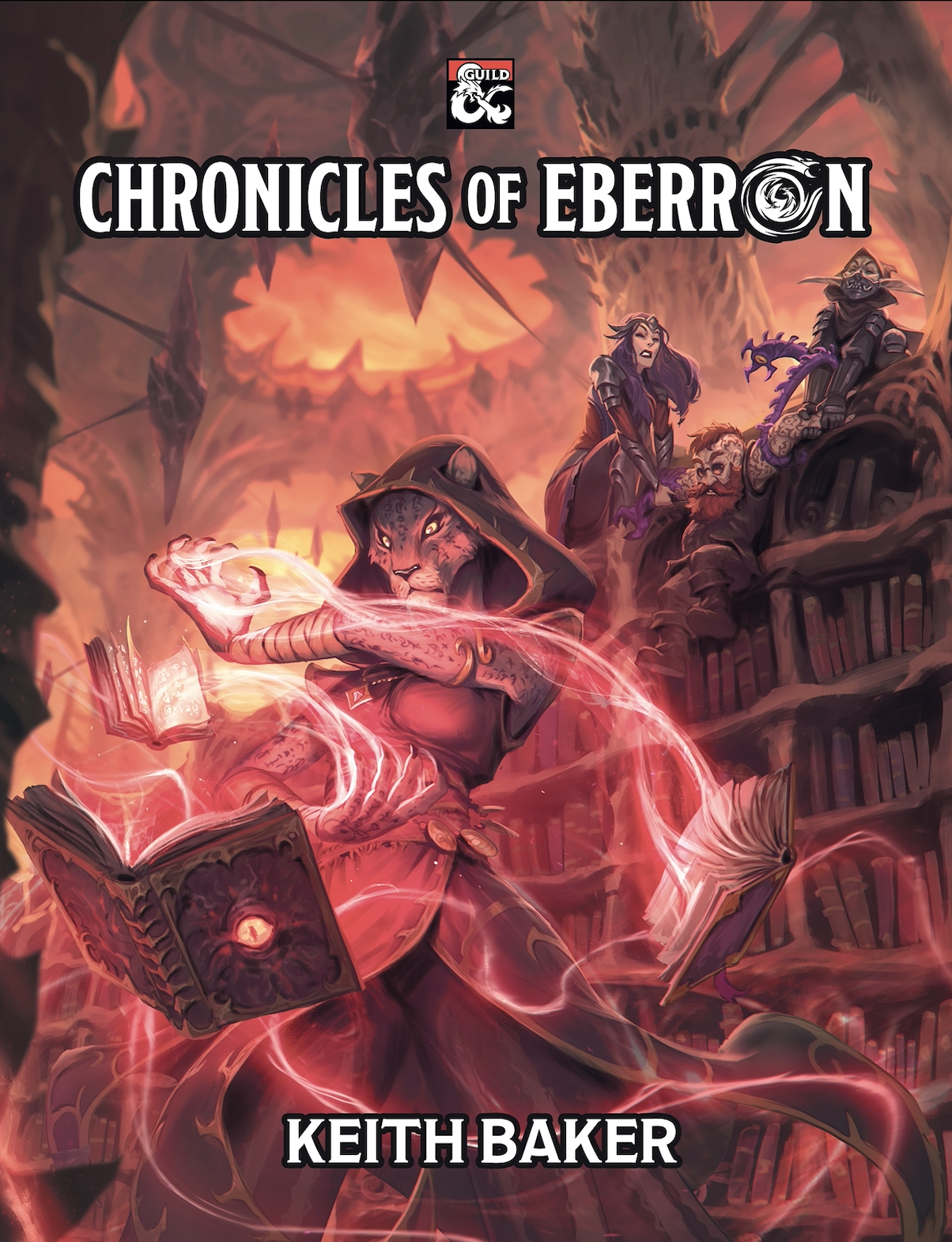
Hektula is a native fiend, one of the most powerful to freely roam across Eberron. She has the basic form and abilities of a rakshasa. Rather than the stripes of a tiger, Hektula's fur is covered with arcane sigils; she is her own spellbook. Like most rakshasa, her Innate Spellcasting trait reflects intrinsic powers that are tied to her immortal essence. However, where most rakshasa never manage to go beyond these intuitive gifts, Hektula has devoted her existence to studying arcane science. Her curse is that—like many immortals—she is largely incapable of innovation. She cannot create entirely new spells, and her personal talents haven't ground over the eons. But she has watched mortal spellcasters of countless cultures and recorded the revelations of the finest wizards throughout the ages... and she has also recorded the whispered secrets of Sul Khatesh, secrets that lie beyond the bounds of mortal knowledge. So while Hektula may not be inventive, she has recorded rituals created by the finest Qabalrin necromancers, she knows the war magic of the Cul'sir giants, and she has even preserved the first spells written the dragon Ourelonastrix. So she knows powerful spells that have long been lost to any mortal culture—as well as dangerous rituals revealed to her by Sul Khatesh (which could use some of the Forbidden Magic Costs presented on page 86 of Chronicles of Eberron).
Hektula tends the Library of Ashtakala. In addition to hoarding the arcane lore of every civilization, the Library holds Hektula's personal accounting of the course of history. If Hektula has indeed been corrupting the recorded history of the Five Nations and other cultures, Ashtakala may be the only place where people can find the true history of Eberron. On the other hand, it's possible that her claims of shaping history are just a bluff... and that she's planted false tomes in the Library precisely so they can cause chaos and doubt when they fall into the hands of mortals. Imagine adventurers manage to acquire a scroll from the Library of Ashtakala that reveals that King Jarot ir'Wynarn was secretly a lycanthrope and was murdered on the orders of the Keeper of the Silver Flame. Is this a shocking and true revelation that was successfully covered up by the Church? Or was it left for the adventurers to find precisely with the intent of causing chaos and uncertainty?
While she may sow disinformation among mortals, Hektula herself is a devoted historian and a vital source of knowledge for the Lords of Dust. As the Librarian of Ashtakala, Hektula typically makes her skills available to all of her fellow prakhutu. In addition to sharing her knowledge of history and arcane lore, she often serves as a mediator and helps to maintain cordial relationships between the members of the Bleak Council; one Lord of Dust may ask Hektula to negotiate with a rival on their behalf. While this work may not directly serve her overlord Sul Khatesh, it means that Hektula possesses the secrets of many of her allies—and Sul Khatesh thrives on dangerous secrets.
Why Does This Matter?
While most of the Lords of Dust are driven solely by the interests of their overlords, Hektula truly is devoted to the acquisition of knowledge and of arcane lore. Consider the following ideas.
- The Demonomicon of Hektula could have the same powers and serve the same role as Iggwilv's book in other settings. Likewise, Hektula could be the author of Eberron's version of The Book of Vile Darkness.
- A warlock could serve Hektula directly rather than Sul Khatesh; the Great Old One is a reasonable option for the First Scribe. Hektula provides her agent with mystical gifts and invocations, and charges them to learn secrets. Such a character could hold the opinion that Hektula is like Prometheus—that there are no secrets that should remain forever hidden, and that whatever knowledge Hektula helps them uncover will ultimately benefit their friends and their nation. But what happens if they learn secrets that could harm their friends or allies? Or learn a secret tied to the release of an overlord? Will they have to find a new patron, or will they stand by their believe that all secrets should be free?
- Hektula has created an unusual, epic curse. When she marks someone with this ritual, every word they write will be replicated in a tome in the Library of Ashtakala. This is part of how she keeps the Library up to date; she identifies the most promising wizards and scholars of the age and marks them, receiving copies of their lifes' works in Ashtakala itself. If a player character sage or wizard learns they are carrying this curse, can they find a way to remove it (this is epic magic, and remove curse alone won't be sufficient)? Do they choose not to create new work until they've gotten rid of the curse? Or do they try to somehow use this curse against Hektula, somehow seeding an arcane virus into Ashtakala through this link?
- Tied to the above, Hektula is convinced that a player character wizard is going to be the greatest wizard of their generation, that they will create spells that have never been seen before. How will Hektula help this wizard? Is she serving as a direct patron or is she carefully providing hidden assistance? Are the spells the wizard will eventually create simply interesting or are they somehow central to the eventual release of Sul Khatesh... and if so, might the wizard end up being targeted by the Chamber? If they learn the truth, will the wizard choose not to unlock their full potential—not to create the spell that will release Sul Khatesh, even though it will also revolutionize arcane science—or will they continue with their work, confident that they will be able to defeat or contain Sul Khatesh should she escape her bonds?
- A wizard is given a scroll by Hektula—a powerful spell from a fallen culture (The Group of Eleven? The Qabalrin?). Do they destroy the scroll to copy the spell into their spellbook, even though it's far above their current level of spellcasting? Or do they hold onto the scroll so they could use it in a single moment of need, even if it will be lost forever once used?
- The adventurers acquire a book that reveals a buried secret about the history of Khorvaire—something Hektula has managed to erase from public records. Why does it matter, and can they set the record straight? Is it possible that the adventurers are being duped, and the revelation itself is the lie?
- A local cult—this could be the Court of Shadows, or it could be a unique force—begins using powerful scrolls they couldn't possibly create. An arcane historian could recognize these spells as being tied to fallen civilizations. Why is Hektula arming this cult with spells from Ashtakala?
- The adventurers need something—a spell or a secret—that can only be found in the Library of Ashtakala. Can they steal a scroll from the First Scribe? Or will they make a bargain with Hektula? She is the most conciliatory of the Lords of Dust; it could be that there's an agreement that can in fact be mutually beneficial.
Facing Hektula
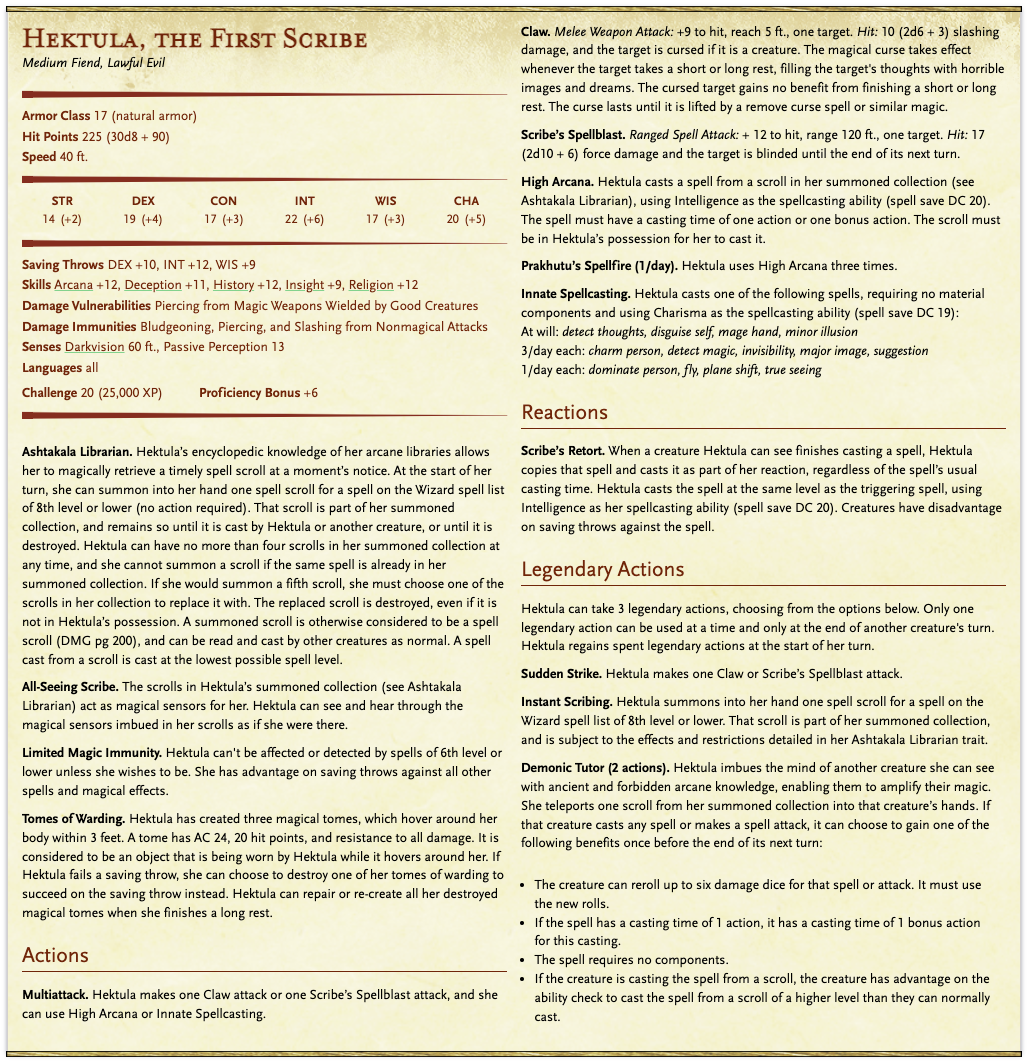
The adventurers plan a brilliant heist targeting the Library of Ashtakala... and something goes wrong. They find themselves face to face with the First Scribe, and it's time to roll initiative. What are Hektula's capabilities? Here's a stat block for you to work with, courtesy of Chronicles of Eberron designer Imogen Gingell!
Hektula has the core abilities of a rakshasa. She's a fiend with limited magical immunity and innate powers of enchantment and illusion. She is a brilliant mystic who knows more about arcane science than almost any mortal, but she doesn't cast spells as a player character does. Instead, she casts rituals and scribes scrolls. Her library is the source of her power. She can summon scrolls from the Library of Ashtakala, either invoking the power of the scrolls herself or given them to allies. Her High Arcana ability allows her to use any scroll in her possession; she never has to worry about spell mishaps. She maintains a connection to any scroll she has touched, and this allows her to monitor agents who carry her scrolls. It could be that her scrolls are perfectly safe aside from this monitoring; on the other hand, the DM could decide that Hektula has the ability to remotely trigger the scrolls she's scribed... so if an agent could innocently carry a delayed blast fireball scroll into a royal audience only to have it activated by Hektula.
Like most rakshasa, Hektula has the ability to plane shift. She can freely use this to reach one of two locations: the Tower of Shadow, the heart demiplane of Sul Khatesh (described on page 148 of Exploring Eberron) or Ashtakala, which is itself a heart demiplane that projects into the material plane. While it is possible for her to travel to other planes, it requires careful preparation and isn't something she can do casually. If Hektula is slain, she will typically reform in the Tower of Shadow in 24 hours. However, the Prophecy can reveal ways to make her death last longer; if she's killed in such a Prophetic manner, her resurrection could be delayed by months or even years.