IFAQ: The Shulassakar
Eberron often takes an unusual approach to familiar things. In Eberron, you can find gnoll demon-hunters, r gnome assassins, and dine on troll sausage. When developing the setting, we decided that couatls were the primary native celestials of Eberron. With this in mind, the 3.5 ECS has this throwaway line in the description of the Talenta Plains...
Krezent: This ancient ruin is all that remains of a couatl city from ages past. The halflings tend to avoid the site, since it is home to a tribe of benevolent yuan-ti who honor and revere the couatl and the Silver Flame.
This is the only mention of these beings in the ECS. It's a random idea: yuan-ti are evil serpent-folk, but what if there were feathered yuan-ti devoted to the light? I loved the idea, so I expanded upon it in an early Dragonshard article, which gave these beings a name: the Shulassakar. This article also answered the seeming contradiction of the original quote: if these feathered yuan-ti were benevolent, why did the halflings of the Plains avoid them?
Over time, the shulassakar appeared in a number of places. We determined that there were shulassakar among the people of Khalesh in ancient Sarlona, and that they were targeted in the Sundering. Shulassakar were presented as an option for player characters in City of Stormreach...
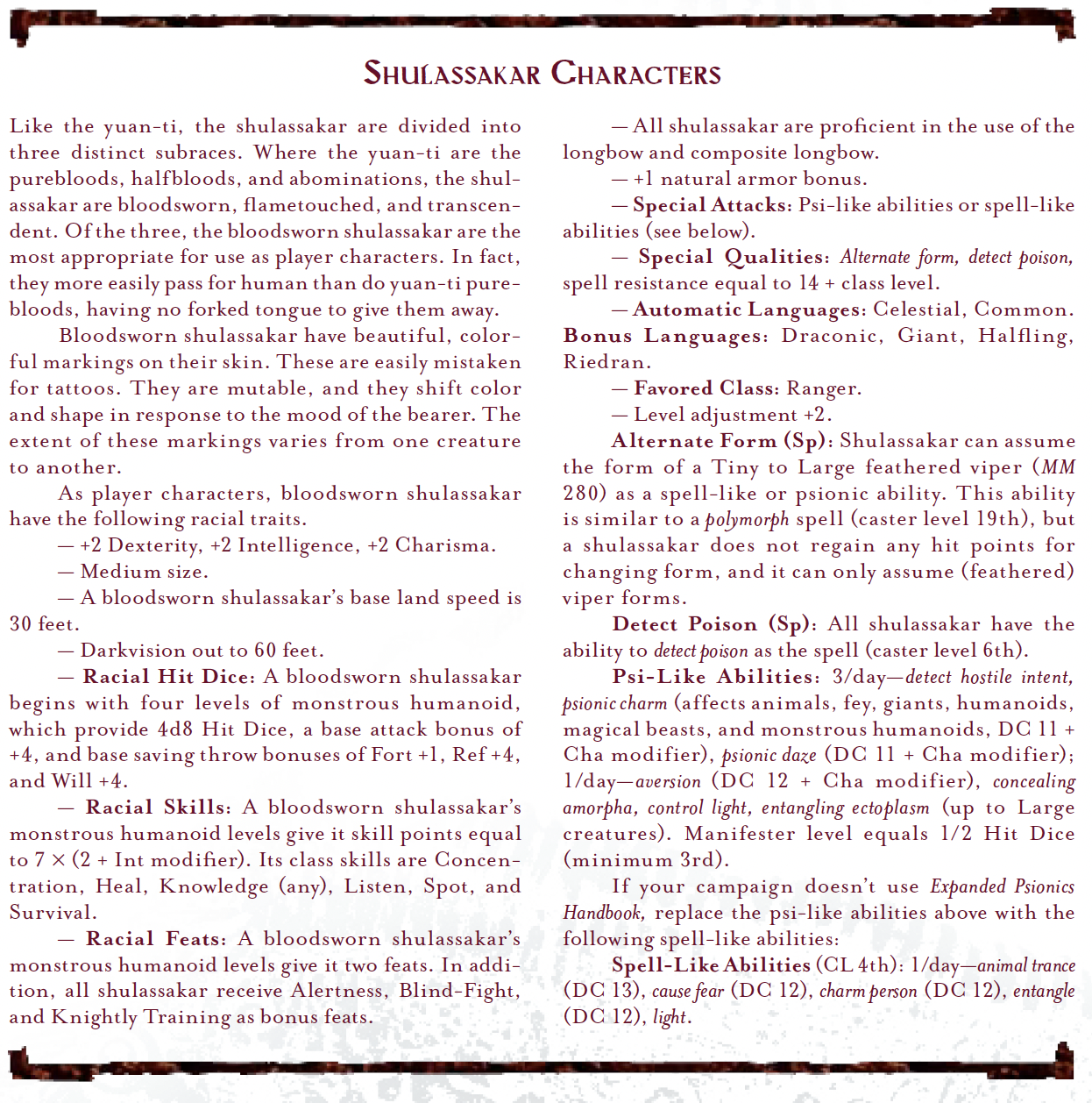
With that said, the shulassakar haven't received much attention—in part because they are supposed to be rare and reclusive. They were never intended to be a central part of the setting, but rather an exotic element that could surprise players used to thinking of yuan-ti as evil.
When I have time, I like to answer interesting questions posed by my Patreon supporters, and this month there were a few questions about the shulassakar.
Do shulassakar have similar roles in their society/culture to the anathema (big hulking multiheaded divine figures) of yuan-ti culture?
The original shulassakar article notes that the shulassakar refer to purebloods as "servants," halfbloods as "flametouched," and abominations as "transcendent," adding that they believe in reincarnation and that the three different forms of shulassakar represent this spiritual growth.
The shulassakar equivalent of an anathema is a Choir. This is formed when a group of transcendent shulassakar willingly sacrifice themselves in a ritual based on the original couatl sacrifice, which fuses body and spirit to create a gestalt entity possessing great power. Choirs are physically immortal—they don't age and are immune to the effects of hunger and thirst—though they aren't true immortals and can be killed. The ritual that creates a choir isn't somehow instinctively known to all shulassakar, and thus different shulassakar sects have discovered it and employed it for different reasons. There could be a shulassakar choir hidden somewhere in Khalesh, the last remnant of the ancient servants who merged together to survive the Sundering. Adventurers could find a shulassakar monastery whose anchorites chose to join together in the ultimate communion. Or a choir could be found guarding a post that required an immortal sentinel. The fusing of spirits gives a choir an unusual detachment from mortality; choirs can meditate in isolation for centuries with no sense of boredom. The main point is that joining a choir does mean sacrificing one's individual identity. It's not something most shulassakar aspire to and they aren't inherently rulers of shulassakar; they are created for a purpose, whether to guard a position, to gain the power needed to survive, or in the case of the monks, the pursuit of a truly transcendental state.
What do the shulassakar do for food? Are the snake-people of Krezent engaging in agriculture?
As noted in the quote above, Krezent is a RUIN and the Shulassakar are guarding it. It's not a Shulassakar city, it's a job; the guardians of Krezent come from a fortress-city in a demiplane they claimed long ago. Beyond this, Krezent is a COUATL RUIN, which is to say, a place built by celestial beings at the height of their power. So the guardians don't need to farm or hunt; Krezent has divine tools that replicate the effects of create food and water for those who know how to use them.
What is the attitude of the shulassakar to the troubles of the people around them? what would drive a shulassakar adventurer?
The canon answer can be seen in the Talenta Plains, in which the halflings AVOID Krezent. This tells us that the Shulassakar aren’t running around trying to help the halflings with basic everyday problems. They aren’t mediating tribal disputes or helping when there’s an outbreak of plague. Beyond this they are completely unknown in the Five Nations; there isn't a council of shulassakar in Thrane. This ties to a general principle of Eberron, which is that powerful NPCs aren’t going to show up to solve your problems. Personally, I’d attribute this to three factors: there are very few shulassakar, likely speaking to a low fertility rate. Shulassakar who act too openly may well be targeted by agents of the Lords of Dust. And finally, there’s the Shavarath principle: they believe that the things they are doing are MORE IMPORTANT than whatever troubles the people around them are dealing with. Yes, it’s very sad that you’re dealing with a plague, but that plague is in fact a natural occurrence and that’s how the world works… whereas if someone releases the fiends of pestilence we’re keeping bound, THAT’S going to be a serious unnatural problem. Also consider the line from the original article: “A shulassakar always prefers to solve a problem on its own or to call in a more powerful servant to handle the problem.” They don’t work WITH other people; they’re going to solve your problems for you, and likely you’ll never know. This ties to why the halflings fear the Shulassakar; “They fight against darkness with ruthless efficiency and will make any sacrifice necessary for the greater good, including the lives of innocents.”
So looking to shulassakar PCs, the question is WHY they are getting involved in other people’s problems and working directly with non-shulassakar adventurers. The simple answer is that it’s because they have been assigned a divine mission (either by a shulassakar superior or by a divine vision) and thus they’re following the dictates of their faith and culture in doing what they’re doing; it’s their SACRED DUTY to pursue their quest. The other alternative is that they are rebelling and following a path that THEY feel is more important than their sacred duties, in which case they would likely be censured by their people.
Have you every used the Shulassakar in your camapign? If so, share the story in the comments! As always, thanks to my Patreon supporters, who make it possible for me to write these articles. If you have infrequently asked questions of your own, pose them on Patreon!