IFAQ: Dunamancy, Fey Changelings, and Quori Dreams
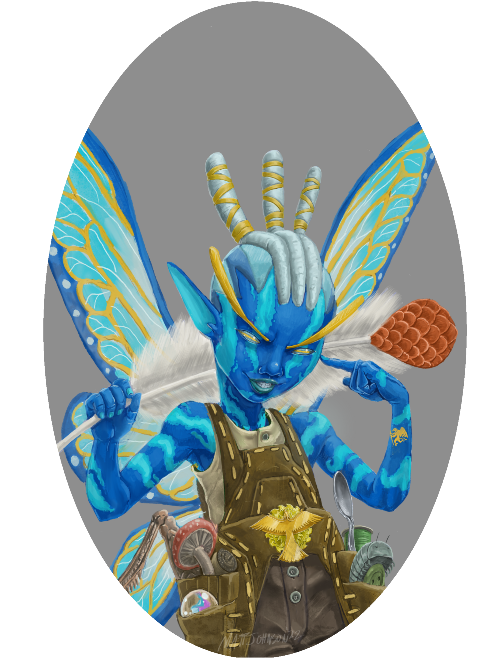
It's been a busy month. In addition to all of my usual work, I've been putting together a Spelljammer in Eberron campaign I'll be running for my Threshold Patrons; that's taken up most of my D&D energy. But I do try to answer questions from my patrons when I have time, and here's a few that have come up this month.
In your Eberron, how would you introduce and incorporate the Dunamancy school of magic from Explorer’s Guide to Wildemount ?
There's two approaches I'd consider. The Wildemount sourcebook says "Dunamis is the primal magical energy of potentiality and actuality, an anticipatory arcane force that helps shape the multiverse and might very well be what holds its elements together, like an infinite web of unseen tethers... Those who study to control and tap into this near-invisible power can subtly bend the flow of time and space by controlling the forces of localized gravity, peering into possible timelines to shift fate in their favor..." One possibility this brings to mind is the Draconic Prophecy, which is a power that shapes reality and the path of the future. On the other hand, it doesn't really map well to the actual effects of Dunamancy. I don't see why the Prophecy would allow you to specifically manipulate gravity, and while the Prophecy can allow you to anticipate the path of the future, it's not generally associated with alternate timelines or, for that matter, time travel; it's the force that establishes the future, not a force you use to travel between possibilities.
So with that in mind, I'd actually say that the source of Dunamancy in my campaign would be Xoriat. As I discuss in Exploring Eberron, Xoriat exists beyond time and is the vantage point from which you could travel through time or visit alternate realities (the other rats in the Maze of Reality). I could easily see a Dunamancer as drawing a duplicate or other aspects from one of these alternate Eberrons... and when it comes to gravity, Xoriat is all about bending natural law; the idea that you use the power of Xoriat to make gravity perform in illogical ways is entirely reasonable. With all this in mind, I could see there being a strong bias against the use of Dunamancy, on the fear that it has the potential to destabilize reality—if you keep reaching across and drawing power or elements from alternate Eberrons, one day you might trigger a cascading effect that shifts that an alternate with the prime material. Keep bending gravity and you might just break it! I wouldn't make it something where a player character would be persecuted for practicing dunamancy, but I could see it being either forbidden or at least highly restricted in Arcanix; to learn it, you'd have to find a rare mentor or sneak into the restricted stacks in the library.
So, I'd tie Dunamancy to Xoriat. But there's another point, which is that dunamancy doesn't have to be dunamancy. Let's take the Echo Knight archetype for fighter. The default lore is that they are "using dunamis to summon the fading shades of unrealized timelines to aid them in battle." But the practical effect is that they summon an echo to fight alongside them... and there's lots of interesting ways to explain that depending on the nature of the character.
- Thuranni Shadowdancer. An Echo Knight with the Dragonmark of Shadow could tie their echo to their mark, literally calling their own shadow into battle. To give it more depth, I'd probably tie this tradition to a particular family—let's say Thuranni—and say that they use it both for art and assassination; there's a specialized form of performance that essentially involves dancing with yourself. Any elf with the Mark of Shadows could learn these techniques; it's just that it's a Thuranni tradition, and Thuranni is where you'd find the masters of the art.
- Quori Nightmare. Previous editions presented the idea of the Quori Nightmare, a kalashtar tradition that manifested an ectoplasmic shroud resembling the kalashtar's quori spirit. You could easily represent the same idea with a Kalashtar Echo Knight; it's just that instead of the echo resembling YOU, it's a shadowy depiction of your quori spirit. If I went this path, I'd say that there are Inspired who use a similar technique, just to have a fun Echo Knight vs Echo Knight fight at some point in the campaign.
- Revenant Blade. Tairnadal champions seek to channel their heroic ancestors; perhaps a truly gifted Tairnadal can draw an echo of their ancestor to fight alongside them. With the player's permission, I'd assert that the echo can't be forced to perform an action that goes against their nature; if the patron was known for their mercy, the echo won't strike a helpless foe. If the player was willing to accept this limitation, I might balance it by saying that the echo sometimes displays skills the player character doesn't actually have; it's not their echo; it's their inspiration.
These are just a few possibilities. Perhaps the Knights Phantom of Aundair can conjure phantom echoes as well as phantom steeds. Maybe there's a tradition among the Blood of Vol that allows a champion to manifest their Divinity Within. I wouldn't personally add all of these concepts into the same campaign, just because it would end up with too many Echo Knights—I'd pick one or two options, focusing on the best story for the player who wants to play an Echo Knight. So you can add Dunamancy to Eberron—but you don't have to work Dunamancy into a campaign if all you actually want is to play an Echo Knight.
How would the lore of Changelings change, if at all, if I wanted to use the new races from “Monsters of the Multiverse” (mostly about being a fey)?
Rues change, and I'm fine with using the new changeling rules from Monsters of the Multiverse—but in my campaign, I'm not changing anything about changeling history or culture because of it. If this is the path you want to take, one option is to use the new rules and simply to ignore the change that makes them fey. On the other hand, FEY AREN'T ALL FROM THELANIS. In the lore as described, changelings are literally defined by a mythical story—the tale of Jes and her bargain with the Traveler—and it's entirely plausible to say that as a species they began as NATIVE FEY. I'd say they are super-grounded compared to most fey—that the Fey type is largely a legacy of their origin—but I don't have a problem with it. On the other hand, I also have no trouble with the idea that changelings' fluid nature causes magic to interact with them differently that it does for most humanoids—IE, they REACT TO MAGIC the same way as fey creatures, but they aren't actually true fey. Essentially, the question is if you want changelings to be immune to Charm Person but vulnerable to Magic Circle. If so, use the MotM rules as written, with the idea that they're distantly native fey or that it's tied to their chaotic nature; if not, ignore that particular change. I don't have an issue with the fact that MotM allows them to impersonate small creatures; now they can have fun in Zilargo and on the Talenta Plains.
On the other hand, I’m happy to say that there are ALSO changelings who DO come from Thelanis. These could be mortals of other species who were taken to Thelanis as children and altered by this supernatural sojourn, or they could be members of the supporting cast of Thelanis—spirits who by their nature change form to fit the needs of a story—who have somehow been cast out of Thelanis to find a story of their own. Such changelings would be extremely rare in Eberron—basically, they’re all player characters—and they would have no ties to the native changelings; with this in mind I’d give each one an entirely different natural form, based on their backstory. They aren't a SPECIES as the native changelings are, they're exotic individuals.
Quori are described as spirits of nightmares, but hashalaqs are spirits of pleasure and kalaraqs are spirits of pride; aren't those usually associated with pleasant dreams?
It's an oversimplification to say that quori are "nightmare spirits." Quori are evil dream architects. A hashalaq quori isn't an embodiment of pleasure; it knows how to use and manipulate pleasure. It has no interest in actually giving you a pleasant dream, unless it serves a malefic purpose; in this it's like a succubus or incubus, a fiend that uses pleasure as its tool. Exploring Eberron describes hashalaq quori as "seducers and deceivers, feeding on doubt and desire." Likewise with the kalaraq: pride is the tool they use to manipulate mortals. So a hashalaq may very well give you a pleasant dream, if that dream steers you down the path the Dreaming Dark wants you to follow. The kalaraq specialize in pride and ambition, and kalaraq dreams urge dreamers to seize power, to start revolutions, to kill a brother and claim their crown... because gosh darn it, you deserve it. Hashalaq weave dreams to tempt you to fall in love with the wrong person, to choose pleasure over duty, or to doubt yourself. Quori-inspired dreams don't have to be what WE would consider nightmares; they can create whatever dream best suits their purposes.
What we've said about quori is that they excel at evoking particular emotions and that on some level they feed on those emotions. But any quori can create any dream. Quori have the ability to cast the dream spell, and there's no limits on what they do with this. Tsucora specialize in fear, and I've suggested that they may have even more specific talents. Exploring Eberron describes a tsucora who "wove dreams of gothic horror, playing on her victims’ fears of death and the undead." That's what she LOVES—but if she wanted to, she COULD create a dream of evil clowns, she just LIKES gothic horror. It's the same way that an amazing Jazz musician CAN play a piece of classical music straight as written; it's just not going to take full advantage of their skills and won't be as remarkable a performance as when they are playing what they love. Quori can create whatever dreams are required by the task at hand; but they'll always be more effective when they're doing what they love. If I was actually using the Dream spell mechanics for a particular quori dream, I might give the victim disadvantage on the saving throw if the quori they're dealing with specializes in the subject of their dream—such as when Lurashtai weaves a dream of gothic horror. While on the other hand, if the quori is making a dream that's the opposite of what it loves to do—a du'ulora create a dream about miserable apathy—I might give the victim advantage on that saving throw. Of course, keep in mind that most quori dreams don't involve saving throws; it's only if they're trying to trigger a dramatic effect (blocking rest and/or inflicting psychic damage) that saving throws come into play.
That's all for now! Feel free to discuss these in the comments, but I don't answer questions on IFAQs; if you want to ask me questions like these ones, check out my Patreon!