IFAQ: Galifar - One Nation or Five?
As time allows I like to address shorter questions raised by my Patreon supporters. This one comes from Mariamow: I would love to see a breakdown of the fashion of the nations! Specifically how things were pre-last war mostly all being a single nation, how it evolved and why it evolved in that way.
A full nation-by-nation breakdown of fashions is a significant topic; I'll put it on the Patreon topic poll for June. However, I wanted to take a moment to address the second half of the question: As pre-war Galifar was a single nation, how and why did the Five Nations evolve as they did?
Galifar wasn't a single nation: it was a united kingdom. Two thousand years ago, the warlord known as Karrn the Conqueror sought to bring the nations of central Khorvaire under his control and failed. A thousand years later, Galifar I succeeded. But unlike Karrn, he didn't seek to crush these nations and impose Karrnathi culture onto them. Galifar was a diplomat as well as a warrior, and he achieved victory through compromise. He rallied the Dragonmarked Houses to his side with the Korth Edicts. He gained the support of the goblins with the promise of freedom. And with a notable exception, he won acceptance for his rule by respecting the traditions of his defeated enemies. He appointed his children as governors of the conquered nations, and he did rename the nations after them. His homeland of Karrnath remained unchanged, but the nation of Thaliost became Aundair; Daskara became Thrane; Wroat became Breland; and Metrol became Cyre. But his children took local nobles as their spouses, and for the most part local leaders who swore fealty to Galifar and accepted his laws and edicts were allowed to keep their positions and lands. Rather than crushing the cultures of the nations, he largely embraced them and sought to harness their strengths for the greater good. Notably, each nation was granted one of the major institutions of Galifar—something that built on their existing strengths but which also served as a cultural anchor and point of pride moving forward.
- Aundair had the strongest system of general education (later used as a model for all of Galifar) and the greatest expertise in wizardry and artifice. The was chosen as the home of the Arcane Congress, Galifar's center for mystical research and education.
- Breland became the seat of the King's Citadel, service both as the strong shield of the ruler and as their eyes and ears. Beyond this, Breland would also evolve into a major center for commerce and industry. All of these were supplemented by its close ties to Zilargo, which remained culturally independent but under the general jurisdiction of Breland.
- Karrnath had the oldest and strongest martial tradition. Rekkenmark was both the most prestigious military academy in Galifar and the secondary seat of military administration.
- Thrane was known for its devotion to the Sovereign Host, and was the seat of the Grand Temple of the Host. The temple was devastated during the Year of Blood and Fire; following the sacrifice of Tira Miron, the majority of the people of Thrane converted to the faith of the Silver Flame, and the Grand Temple was replaced by Flamekeep.
- Cyre was the exception to the rule of maintaining the existing culture. Here Galifar displaced the existing nobility and built a nation that would be a model for the kingdom as a whole—drawing on the cultural strengths of all five nations to and creating something new. This was a source of pride for the new Cyrans, but a bitter pill for the displaced nobles of Metrol (largely granted new lands in what is now Valenar)—and in general, there was a lingering resentment that Cyre's prosperity was built with the sweat of the other nations.
So people considered themselves to be citizens of Galifar, but they still thought of themselves as Cyrans, Brelish, or Aundairian. The sourcebook Forge of War includes a map of Galifar before the war, and again, it's not one nation: it's five.
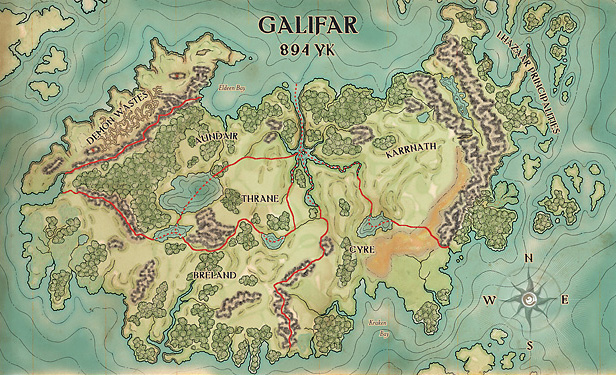
Galifar was a metropolitan society. Part of the point of spreading its major institutions across the continent is that people would go to Aundair to learn magic or to Karrnath to study war and then return to their homelands. So the nations weren't isolated, and Cyre in particular strove to draw inspiration from all of the nations. Nonetheless, Karrns were the most likely to serve as soldiers and Aundairians the most likely to become scholars or wizards.
So while the cultures of the Five Nations have deep roots in the pre-Galifar nations, the traits most associated with them today—Aundair's arcane strength, Thrane's devotion—developed under Galifar. In the previous article I mentioned that the soldiers of the Five Nations started from a common base for their uniforms, because the ARMY was the army of Galifar; but the soldiers within the army had always thought of themselves as Brelish, Aundairian, etc and when they changed into civilian clothing it would reflect their local culture.
All of which is to say that there's certainly room for a longer discussion of the cultures and fashions of the Five Nations when I have time to write about them! Until then, in dealing with the Five Nations the key point is to remember that while they have only been independent nations for a century, they Five Nations have traditions and cultural identities that go back far longer than that.
Thanks as always to my Patreon supporters for keeping this site going! As determined by the poll on Patreon, the my next major article will concern the moons and the potential for a space race in Eberron.