IC Exclusive: A Look At Threshold
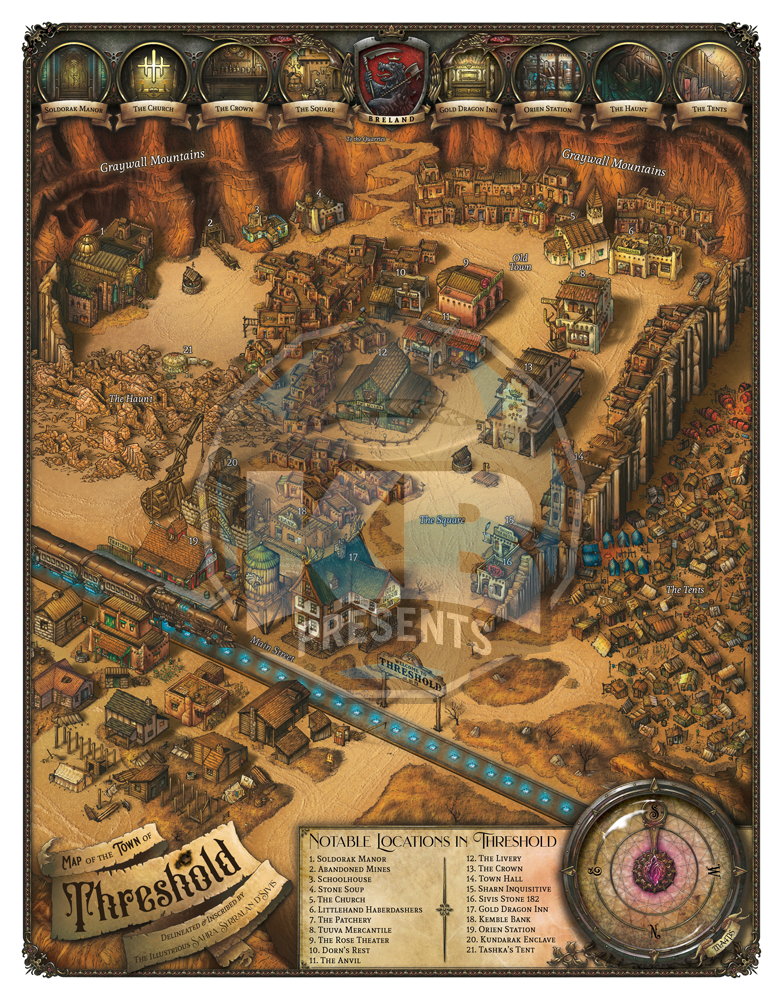
Approaching Threshold, first thing you see is the wall. Over forty feet tall, the color of dried blood, emerging from the cliff face as though it was a part of the mountain. No surprise the first settlers built their homes against it; that wall’s older than Galifar and stronger than the towers of Sharn. But seeing it, you can’t help but wonder… it’s only PART of a fortress wall. What kind of power could have torn down the rest of it?
—Tragomir Narathun, scholar
There’s a number of crucial elements that shape daily life in Threshold, and that have made the town what it is today.
Population and Demographics
Threshold is home to approximately 1,400 people. At least a hundred of these are temporary residents, in town while conducting business in the region or just passing through. Over four hundred people live in the shantytown known as the Tents; some of these people are just waiting for their permanent residences to be built, while others are dwelling in squalor while hoping to find a path to fortune. The vast majority of the people are Brelish, with the typically diverse Brelish makeup; slightly less than half of these residents are humans, while the rest are a mix including gnomes, haflings, dwarves, elves, half-elves, and goblins. While other species are exotic—there’s only a handful of shifters in town, and currently no resident tieflings—the people of Threshold are used to just about anything. In 997 YK a clan of kobolds moved into the Tents, and while there are some who shun the kobolds—notably Brelish veterans who fought on the western front during the war—today kobold musicians perform at the Crown inn and the Rose Theater, and Littlehand Haberdashers have adopted some kobold fashions.
The population of Threshold continues to grow, and the town is struggling to keep pace with the new arrivals. The communities and cultures found in Threshold are discussed in more detail later in this chapter.
Quickstone, The Stone Chanters, and Byeshk
Quickstone is an unusual substance that can be encountered in three forms. Soft quickstone is a soft, red material similar in consistency to sandstone, though surprisingly lightweight. Wet quickstone, often called the quick by miners, is a blood-red material with consistency of soft clay; it maintains its fluid consistency even when exposed to heat. Fixed quickstone is rust-brown in color, like dried blood; it’s considerably harder than granite. In the mountains, quickstone can be found in its wet or soft forms. What makes quickstone remarkable is how it responds to arcane energy. Using arcane rituals, it’s possible to shift quickstone back and forth between its wet and soft forms. Another ritual transforms it into fixed quickstone—though once it is fixed, it can’t be changed again. So many of the buildings in Threshold have been sculpted from quickstone, but as they are fixed they can’t be remolded. The sculpted houses of Threshold are broadly similar in appearance to adobe structures, though the fixed quickstone is far more durable than adobe.
To date, quickstone has only been found in the Graywall Mountains. Its origin is a mystery; it’s too widespread to be the result of a manifest zone. The Dhakaani goblins of the region used quickstone in their structure, and it was the dar who first established the quarries above Threshold. Some might wonder that the quarries weren’t mined out long ago; it’s almost as if the quickstone grew back over the course of thousands of years.
The quarries and the town have plenty of work for miners and masons with strong arms, people who can excavate the stone and move it where it needs to go. But there’s also a specialized form of magewright that’s a vital part of this process. Stone chanters learn the rituals that allow them to shift quickstone between its three forms, and also learn a specialized form of the mold earth cantrip that they use to shape wet quickstone when building large structures. Threshold isn’t the only town that has stone chanters or quickstone—there are other, older mining towns further south along the Graywall Mountains—but it’s still a specialized tradition that’s only just now becoming known further east as quickstone is being exported. In theory, anyone could learn to perform the stone chanter rituals with enough time and practice, but certain people in Threshold seem to have a knack for it; these chanters often say they can hear the stone whispering to them. In Threshold, about one in ten miners is a stone chanter.
While quarrying quickstone is the primary industry in Threshold, there is a second rare resource in the Graywall Mountains: the purplish metal known as byeshk. The people of the Five Nations have little experience with byeshk, and are still learning its properties and value. There is a network of old byeshk mines in and below the mountains south of Threshold, but unlike quickstone, byeshk doesn’t grow back and these upper mines are largely played out… as well as being infested with cockatrices and other dangerous creatures. However, Threshold resident Honoria Soldorak has bought these mines from Count ir’Blis and wants to have them fully explored. If significant byeshk deposits remain, they could be of great interest to both Soldorak and House Cannith.
The Lightning Rail and Travelers
House Orien connected Threshold to the lightning rail in 997 YK, extending the line from Ardev. This is a boon for the town, dramatically increasing commerce with the east and increasing the ability to ship quickstone. It also means that Threshold is the stepping stone for people taking the rail from the East to get to Droaam, or anyone traveling from Droaam to the cities of the east. At the moment the train only runs three days a week, which means that people traveling east may have to wait a few days. As a result, Threshold sees a steady stream of interesting travelers: merchants and diplomats from the east who have dealings with Droaam and its warlords, but also mercenaries or immigrants from Droaam who are heading east. It’s always an interesting evening when a troop of Znir gnolls passes through town!
While House Orien is still negotiating with warlords and the Daughters of Sora Kell, it has already begun work extending the line toward Droaam. To assist with this work, the house has employed the Khaar’paal, a clan of Graywall kobolds who’ve settled in the shantytown known as the Tents. These kobolds have a natural affinity for working with lightning, as well as a resistance to electrical damage; thanks to these traits, they are able to excel at this work, and Orien’s made it worth their while to relocate to Threshold. The Khaar’paal are discussed later in this chapter, but they are largely employed by Orien to work on the westward expansion.
Smugglers and the Three Faces of Coin
As described in Chapter 2, the Three Faces of Coin are a Sovereign mystery cult driven by the principle that anyone can prosper and that people should always be able to get the things that they desire. Within the major cities of the Five Nations members of this cult tend to be secretive, but adherents of this faith—generally referred to as “Coins”—played an important role in establishing the town of Threshold. Some were honest merchants who saw opportunity on the frontier and wished to practice their faith more openly. Others were smugglers, who realized that standing on the threshold between these two nations would let them profit from both.
In Threshold, “smuggler” has three meanings: someone who deals in materials that are illegal under Brelish law; someone who deals in legal goods, but who avoids the King’s Assessors and Droaam’s informal “tax collectors”; or someone who deals in goods that are rare and dangerous to acquire and can’t be purchased through normal markets. Most of the smugglers in Threshold fall into two or more of these categories; the point is that there are “smugglers” whose goods aren’t actually illegal—they’re just unusual.
Chapter 4 includes more details about the larger business of smuggling—goods that are smuggled in large quantities, the role of the King’s Assessors, and more. Now that the Count has official representatives in town, as well as the dragonmarked houses, the business of smuggling has shifted somewhat. But Threshold largely exists because of smugglers, and especially in Oldtown there are a great many people devoted to the Three Faces of Coin and who still believe that people should always be able to get the things that they desire.
Refugees and Veterans
The Mourning brought a flood of Cyran refugees into Breland, and King Boranel pressed his nobles to find places to direct them. Count ir’Blis agreed to let a force of refugees settle in the lands around Threshold. At the same time, he also granted land around Threshold to many of his own veteran soldiers… Allowing him to disband the bulk of his army while simultaneously fortifying the western border. If the refugees proved to be a problem or if tensions escalated, at least his soldiers would be right there.
Both of these communities are discussed in more detail later in this chapter. But their presence shapes the tone of the town—especially in the shantytown known as the Tents, where most of them live. Many of the refugees are still struggling to find a path forward, and many of the veterans aren’t thrilled to be sharing their new home with people who until recently they considered their enemies. There are voices of reason on both sides who seek to defuse these tensions, but for now, the tension—and the threat of violence—remains.
Remnants of the Past
Thousands of years ago, a sturdy fortress occupied the land where Threshold now stands. Today, the only obvious remnants are segments of the massive exterior wall, and the jumbled mass of ruins and rubble now known as the Haunt. The town draws water from a system of ancient aqueducts. The people of the town and the region have a variety of stories that explain these ruins. The most popular one is that the Threshold fortress was built by Breggor Firstking, founder of Wroat—the pre-Galifar nation that preceded Breland. A more fanciful tale suggests that this fortress was built by the Sovereigns in the days when they walked the world and fought demons; this is especially popular with the patrons of the tavern known as Dorn’s Rest. History checks or divination magic will confirm that the fortress was in fact a relic of the goblinoid Empire of Dhakaan; the brutalist style of architecture is distinctive, as is the design of the aqueducts. However, many locals refuse to accept these facts; after all, if the goblins could build something like this, why aren’t they building them today?
Regardless of this, the region is filled with relics of the Empire of Dhakaan and the conflict that destroyed it. The quickstone quarry in the foothills was established by the Dhakaani, as were the mines that stretch down below the mountains. While exploring, you might find a fragment of a shattered statue or stumbling across evidence of a long-forgotten battle. It’s up to you to decide how your character responds to these things. Are you an avid student of history, always keen to learn more about the ancient empire of Dhakaan? Or do you have other beliefs you hope will be confirmed by the evidence you uncover in your travels?
The Role of Monsters
Threshold is a Brelish town established by Brelish settlers, and there’s more humans than any other species among the inhabitants. But just as there’s a steady stream of merchants and envoys traveling west to do business in Droaam, nearly every day there are some travelers coming from Droaam. Many of these are mercenaries working with House Tharashk, and these bands often have a Tharashk liaison to help them adapt to Brelish customs. Others are immigrants seeking opportunity in the Five Nations, or citizens of Droaam with business in the east. So while there’s only a handful of so-called monsters who reside in Threshold, there’s nothing unusual about an ogre wandering down the street or a squad of gnolls sharpening their weapons while they wait for the lightning rail to arrive. There are certainly people in Threshold who are afraid of these creatures, and many of the Brelish veterans—who fought such monsters on the western front—actively despise them. But any creature found in Droaam could be found in Threshold, and even those who don’t like them will generally just avoid them.
THE SHAPE OF THE CITY
Threshold is set up against the very edge of the Graywall Mountains. The southern edge of town is a cliff face, with a path leading up to the quickstone quarries that are Threshold’s primary industry. The town is built on the site of an ancient fortress, which fell long before the rise of Galifar. The primary remnant of this is the western wall—a section of quickstone wall, approximately forty feet high and ten feet thick, that merges directly into the cliff face to the south. The first settlers used the cliff and the wall as the foundations for their quickstone homes, and were able to restore the ancient underground aquaducts that supply the town with water. As new waves of settlers have come to Threshold, the town has been expanding to the north. So the old town in the south is largely simple, sculpted quickstone while the dragonmarked outposts and the newer homes in the region known as Main Street are designed to appeal to the sensibilities of travelers and tourists.
Threshold is expanding as quickly as it can. Currently demand outstrips the pace of production, and there are hundreds of people living in the shantytown known as the Tents. It’s a small town; the entire population of Threshold barely matches that of a single district in Sharn. Small as it is, it’s broken into a number of sections that are distinct both geographically and culturally. It may only take a few minutes to walk from Oldtown to Main Street, but which part you live in says something about you.
Oldtown
The first quickstone miners built their houses against the cliff face. The next wave of settlers expanded out to the north, spreading along the western wall and building a dense cluster of quickstone houses. The Crown, Tuuva Mercantile, the Patchery and all of the first businesses of Threshold were established at this time. This area is known as Oldtown, and is distinguished both by the quickstone buildings and the fact that many of its residents have been in Threshold since the beginning. Oldtown is thus home to a blend of hard-working miners, scoundrels and smugglers, and merchants who now fear that the dragonmarked houses may move in and drive them out of business. The newest residents of Oldtown are mostly Cyran refugees. Oldtown is continuing to expand to the west, but new dwellings are small, stacked quickstone structures—so it’s cheap housing for people who can’t afford to live on Main Street.
The structures of Oldtown are all sculpted quickstone. Fixed quickstone has a rust-brown color, though some people paint their houses to add color to the town. Most of these homes are small and simple, with dwellings built one atop the other. Oldtown generally supports a modest lifestyle, though the eastern tenements are poor quality and there are a handful of comfortable homes.
The people of Oldtown see themselves as the foundation of Threshold. They’re the ones who built the town from nothing. Many in Oldtown resent the new-money developments of Main Street, the increasing presence of the dragonmarked houses, and the greater attention of Count ir’Blis and the King’s Assessors. Most of the people of Oldtown aren’t actually CRIMINALS, but most support the Coins and have a strong independent streak.
The Square
The corners of the town square are defined by the Livery, Town Hall, and the Sharn Inquisitive office. It reflects the attention and the gold invested by Count ir’Blis and Honoria Soldorak. The region known as “The Square” encompasses the town square and the strip of houses that extends from the square to the east, separating Oldtown and Main Street. Its buildings are quickstone, but most are painted and some have decorative engraving on the exterior walls. Homes are generally larger than those in Oldtown. The Square is on the edge of modest and comfortable lifestyles, with options for both.
The Square is a small region, with fewer than a hundred residents. The people of the Square are largely former Brelish soldiers. Many are miners or pursuing simple trades, but they are loyal to ir’Blis and respect the laws of Breland. They generally see the people of Oldtown as scoundrels; the people of the Square may not have the wealth of Main Street, but they have integrity.
Main Street
Main Street is the area around and to the north of the lightning rail line. It’s anchored by the grand outposts of the dragonmarked houses—Orien Station, the Gold Dragon Inn, and the Kundarak enclave—and it reflects the both the gold and the arrogance of the houses. In many way it’s the heart of a new town, built not for miners but for merchants and diplomats. Currently there’s only a few businesses in Main Street, but it’s assumed that as other houses and powerful people come to Threshold, they’ll build here.
The builders of Oldtown seek to capture the typical feeling of Brelish architecture. Most buildings are made from wood or traditional stone bricks, though in some cases this is a façade over quickstone. The homes in Main Street are the largest in Threshold, built for members of the houses and people of wealth and quality. It’s still a frontier town, but Main Street supports a comfortable lifestyle, with a few structures of wealthy quality.
The people of Main Street see Threshold as a backwater they must endure, at least until they can transform it into a REAL town. They tolerate the people of Oldtown, but most are positively horrified by the Tents.
The Tents
The Tents is a shantytown extending to the west from the western wall; some call it the wrong side of the wall. Over two hundred Cyran refugees live there, along with Brelish veterans and other people who’ve come to Threshold hoping to find their fortune on the frontier. It is a chaotic sprawl of tents and temporary structures. Those who are familiar with the Tents can identify “neighborhoods” based on families, nationalities, religions, and more; however, given the temporary nature of the structures, the layout is always shifting. There are three stable regions within this chaos.
- The Grizzly Camp is occupied by a group of Brelish veterans. This is maintained as a military camp, with latrines and well-ordered rows of tents. Their tents are military surplus and dyed Brelish blue, causing some to call it “The Blue Tents.” While all the Grizzlies are Brelish veterans, not all veterans live in the Grizzly Camp; some want nothing to do with this ongoing imposition of military order. The Grizzly Camp is on the northern edge of the Tents, close to the wall.
- The Khaar’paal Camp is occupied by a clan of kobolds, who are mostly employed by House Orien. The Khaar’paal are camped on the southern edge of the camps, and use distinctive leather tents with an armadillo design. The Khaar’paal are nomads, and have a well-established, efficient camp.
- The Vermishard is the core of the mass of Cyran refugees, named after the great spires that encircle the lost city of Metrol. In general, the refugees are disorganized and group together based on other connections, but the Vermishard is where the leaders of the Mourner community can be found, and where supplies are distributed. The Vermishard is in the center of the Tents, and the refugee tents radiate out around it.
Outside of these three points, the Tents are always changing. Some people in the Tents are just waiting for permanent homes to be constructed. Others are travelers just passing through Threshold, who choose not to stay in the inns. And some may just decide to move on—or may be forced to relocate based on feuds with their neighbors.
Life in the Tents is dangerous and difficult. The three main camps largely sustain a poor lifestyle, but many in the Tents live in squalor. Sheriff Constable doesn’t have the resources to monitor the Tents or enforce order within them; the three camps have their own guards, but in the surrounding chaos theft and violence largely go unaddressed. Fugitives passing through town may camp in the Tents, where it’s easy to avoid notice. It’s not entirely lawless; someone who carries out an ongoing crime spree may trigger a response from one of the main camps or from the Sheriff. But it takes something truly significant to draw that sort of attention—and, of course, someone has to actually report the crime.
The people of the Tents are divided into distinct cultures—such as the Grizzlies, the Mourners, the Khaar’paal. So the folk of Oldtown and Main Street alike may look down their nose at “tent scum,” but the Tent-dwellers don’t have a sense of common identity.
The Haunt
The ancient fortress that once stood where Threshold now stands has been almost completely lost to the passage of time. Only two relics remain: the chunks of the massive wall that once surrounded the fortress, and the ruins now called the Haunt. There are remnants of walls and some ancient structure in the Haunt—perhaps a keep?—but it also contains chunks of shattered fixed quickstone, dumped in the region as successive waves on inhabitants cleared the wider area. So today it’s hard to actually make out the original shape or purpose of it. So those who delve into the Haunt may be able to find partially intact chambers and halls, and some people say that there’s intact passages under the Haunt but it’s all surrounded by a treacherous morass of shifting rubble. Beyond that, it’s common knowledge that the Haunt is haunted. Whatever is in there—Ghosts? Shadows? Ghouls?— doesn’t come out to trouble the rest of the town, and so far the townsfolk have just left it alone.
While the townsfolk shun the Haunt, fugitives could take shelter there, or foolish explorers could go prying. It’s understood that if you go into the Haunt and don’t come out, no one is going to come after you. Recently, a medusa named Tashka—an ambassador from Cazhaak Draal—has set up her tent on the edge of the Haunt. Some assume the medusa is more terrifying that whatever lurks within the ruins, while others believe that Tashka’s pride will eventually be the end of her.
SERVICES
You’re not going to get the same services in Threshold that you might be used to in Sharn. Sovereigns above, Threshold itself is smaller than the Bazaar of Middle Dura! So don’t expect to find someone to teleport you or anything like that out here.
Communication. Sivis Stone 182 has a speaking stone, which connects Threshold to the rest of the Five Nations… in theory. Stone 182 is currently experiencing arcane difficulties, and the stone isn’t working. However, the Orien post can deliver letters at a cost of as low as a single copper piece for delivery within Threshold, with prices up to 10 gold pieces or more for more distant cities. If you absolutely need to speak to someone right away, the Stonespeaker at Stone 182 may be able to perform a sending.
Education and Research. Threshold doesn’t have a grand university or a temple to Aureon. The largest library—it has a whole bookshelf filled books!—is the Schoolhouse in Oldtown. The schoolteacher, Ink Narathun, might be able to help you with arcane research or the history of the region. Town hall has an archive of local records, but you’ll need to get permission to gain access to these.
Entertainment. If you’re looking for a show, there’s always something going on at the Rose Theater. If you just want a little music, try the common room of the Crown… As long as you’re not to fancy to be drinking in Oldtown.
Healing. Feeling down? Daff d’Jorasco at the Patchery can help you get back on your feet. If you feel that prayer is the only answer to your problems, talk to Vesper at the Church. No need to ask which church—there’s only the one!
Shopping. You can find basic goods at Tuuva Mercantile, and thanks to the lightning rail they can fill special orders in about a week or two, though it may cost you extra. The Anvil is your source for armor, weapons, and other metalwork; occasionally Jury has something magical she’s working on. The Livery will look after your mounts or sell you a new one, and Daff at the Patchery can sell you healing potions, though they may taste funny.
Spellcasting. You can talk to Jury d’Cannith at the Anvil, or Ink at the Schoolhouse. If prayer will do, see Vesper. If they can’t do what you need, it’s possible that Brogan at the Crown knows someone who can help… Though you might have to pay a few crowns for the introduction.
Travel. The lighting rail runs twice a week from Orien station. Coaches and caravans are more common; there’s usually at least one a day. If you’re looking to hire a steed or even a carriage, talk to Gavrin at the Livery.
Greetings, Patrons! This is a quick preview from Chapter 3. It hasn't gone through editing, and I'm sure there's typos and other errors; it WILL be edited and I don't need that sort of feedback now. Likewise, this is a simple overview of the town. Other sections of the book go into far more detail about the inhabitants and businesses of Threshold. With this in mind, I won't be answering questions, as most questions will be answered elsewhere in the final text. Enjoy the preview!