House Sivis and the Mark of Scribing
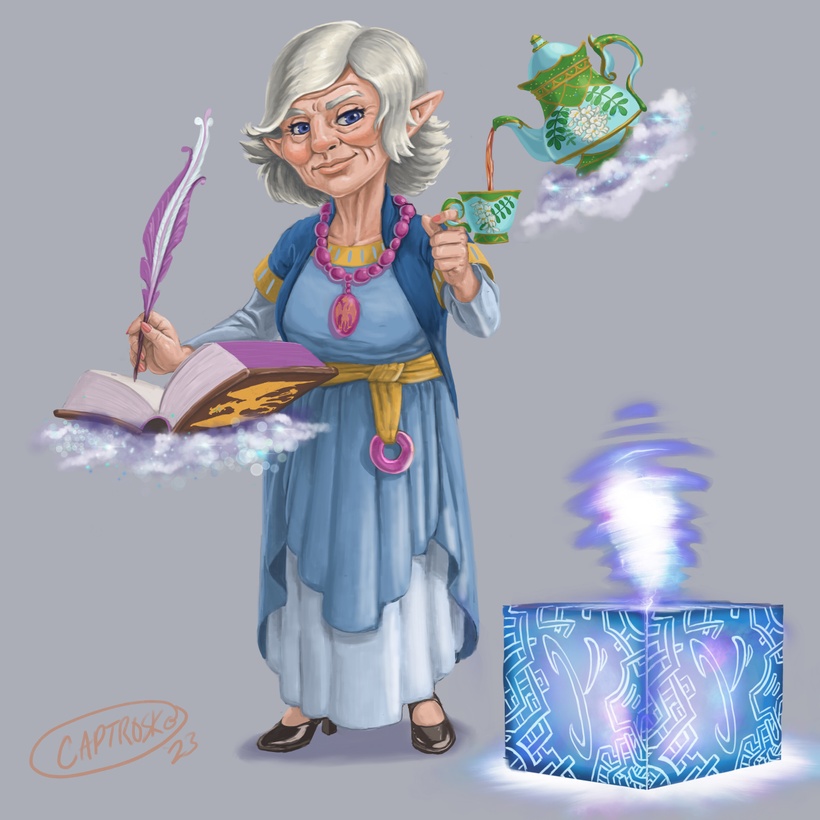
Members of the jury, the case before you is clear. This is no simple accident, no story of a merchant unwittingly purchasing faulty goods and passing them on. Benn Grennel performed the ritual that charged his tokens with an aura that could deceive simple divination, making the coins appear to be properly enchanted. But this isn’t a simple case of fraud, no. If Grennel’s tokens were supposed to protect the bearer from evil spirits or bad luck, we might just urge the buyer to beware. But Grennel was selling feather tokens, and now five people are dead. The defense may argue that ‘Sharn Chicken’ is a dangerous pastime, that those who participate inherently accept risks. But this argument falls flat when it reaches those innocents killed and injured when the Telrin brothers fell from the sky. The Telrins may have been fools. But it was Benn Grennel who set these tragic events in motion when he chose to sell false feather tokens. The dead cry out for justice, members of the jury, and only you can see it done.
For those who carry the Mark of Scribing, language is a dance. Whether spoken aloud or written on the page, there is a beauty to the way that words fit together. Every conversation is delightful, and there is joy to be found simply in writing a sentence. Consider the paths typically chosen by Sivis heirs. The barrister delights in crafting an argument, in finding the words that will see justice done. The translator takes the words that are keeping people apart and builds a bridge to bring them together. The stonekeeper sends words whistling across the world, carrying knowledge to people in distant cities.
All Sivis heirs love language, but most have an innate affinity for either written or spoken words. Those who prefer speech love to be around other people, to have a chance to engage in conversation. There’s a popular stereotype of the Sivis heir who never stops talking, who feels a need to fill every moment of silence with new words, and this has some basis in reality. But there are also Sivis heirs who love to listen as well as speak; such an heir will happily sit in a crowded room and never say a word, enjoying the conversations of those around them. On the other hand, heirs who prefer the written word are often solitary, preferring the company of books and scrolls to people. Among these heirs, some love to read and delight in the endless knowledge waiting to be discovered. Others prefer to write, bringing new words into the world—whether creating stories to entertain, recording facts to enlighten, or working with numbers and balancing books. When making a Sivis character, consider where you fall on this spectrum. Are you a gnome who likes to talk to a gnome who likes to talk? Are you working on the great Khorvairian novel, or recording facts for the benefit of future generations?
House Sivis is best known for facilitating communication. Speaking Stones are a crucial part of everyday life, playing a vital role in commerce, politics, and civilian life. But Sivis heirs do far more than just operate Speaking Stones. The arcane mark of a Sivis Notary is the standard for assuring the authenticity of a document. Sivis accountants count coins across Khorvaire. Sivis mediators and barristers settle disputes, whether through conversation or in court. And as bearers of the Mark of Scribing, House Sivis has long driven the publishing industry. If a business deals with words, there’s likely a Sivis heir tied to it somewhere.
House Sivis helped establish the structure that most of the Dragonmarked Houses have adopted, the system of baron, viceroys, senseschals, and enclaves. For Sivis heirs, bureaucracy is a delightful puzzle to play with. Because of this, the structure of House Sivis is more complex than any other House. The Sivis guilds, families, and enclaves all have countless small positions and honors that can be easily gained or lost; competition over these titles is a delightful game. The exact rules of this game are hard for outsiders to follow, and it’s up to the DM and players to decide exactly what titles a Sivis adventurer is eligible for and what they must do to maintain them. Just keep in mind that every Sivis heir is part of a greater game, and know that the stonekeeper taking your message isn’t just a stonekeeper; that’s Lord Canto Corralyn d’Sivis, Second Stonekeeper of Ardev, Gilded Listener and Keeper of the Month for five months running. Lord Canto isn’t a Wordsmith yet, but he’s really trying to make fetch happen!
As a House that regularly handles the secrets of others, it is vital for House Sivis to maintain its reputation for neutrality, integrity, and security. House Sivis doesn’t share the contents of the messages it sends. For a little extra gold, you can work with a stonekeeper trained to forget your message as soon as it’s been sent. Of course there’s conspiracy theories—House Sivis preserves every message ever sent! They can even spy on messages YOU send when you cast your own Sending spells! They’re just a front for the Trust—or, it’s the Trust that’s a front of House Sivis! But over a thousand years of service, House Sivis has managed to maintain the public’s confidence in the confidentiality of its services. There’s no proof that Sivis is tied to the Trust, but the house arm known as Oversight fills much the same role within the House itself. Oversight protects Sivis secrets from all threats, protecting the House from prying eyes and swiftly dealing with any Sivis heir who threatens the reputation of the House!
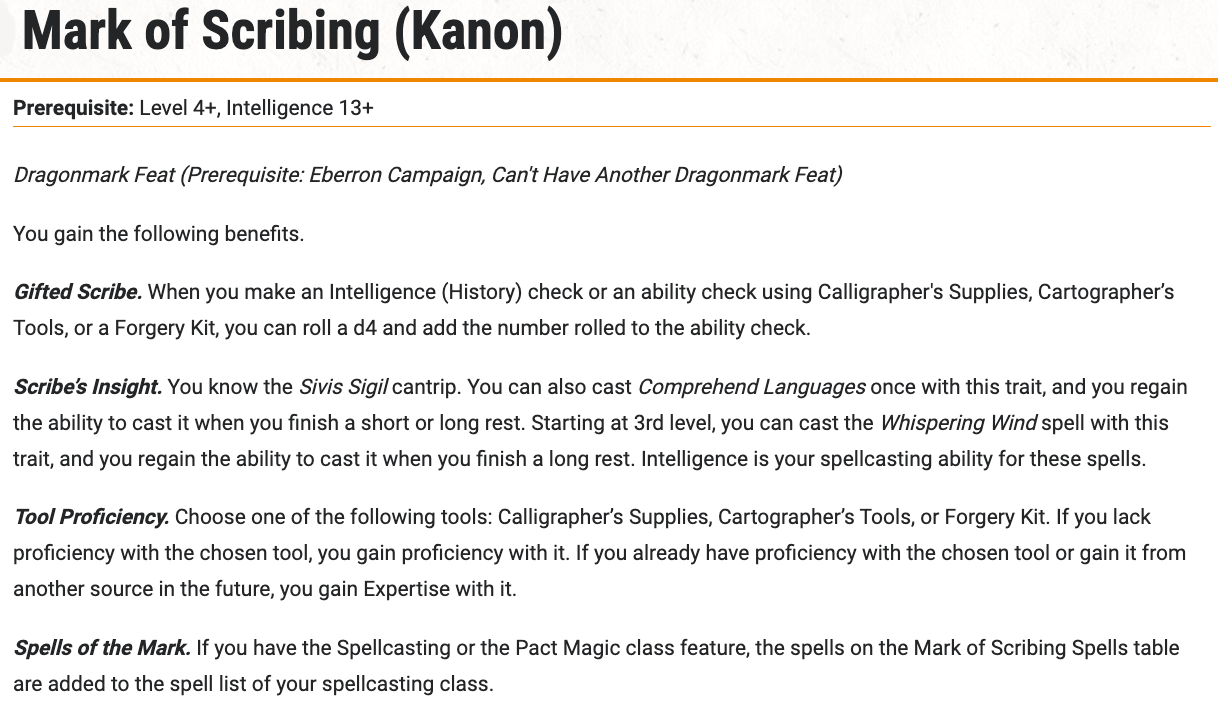
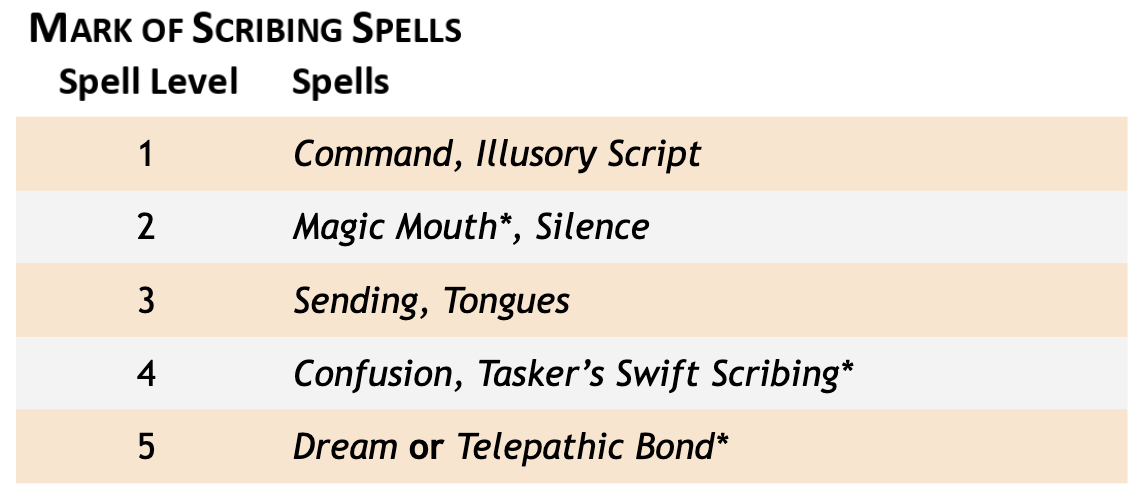
Note: The version of the Mark of Scribing presented here differs from what's presented in Forge of the Artificer. This is the version I am using in my campaign, but it is not official! My reasons for these changes are described later in this article.
While this Dragonmark is called the Mark of Scribing, a more accurate term would be communication. Comprehend Languages is the most basic gift of the Dragonmark, and the one that is typically used during the Test of Siberys. Any bearer of the Mark of Scribing can cast Comprehend Languages as a ritual; given time, any word will surrender its meaning to a Sivis heir.
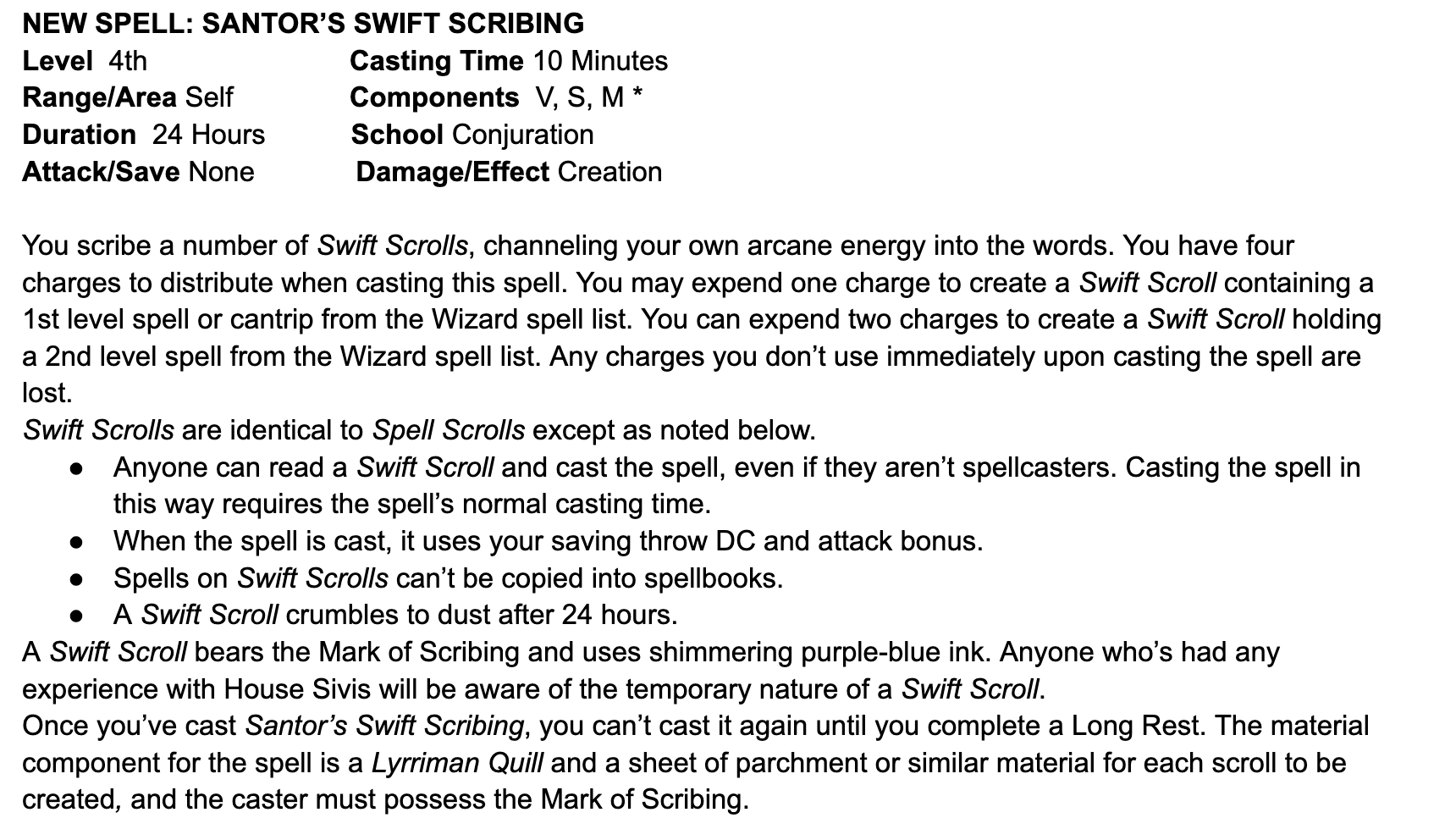
Scribing is a key element of the Dragonmark. Everyone who carries the Mark of Scribing has the ability to inscribe a mystical sigil on any surface. This arcane mark is as unique as a fingerprint. The heir doesn’t choose the design of their arcane mark; they touch the surface and draw on the power of the Dragonmark, and their arcane sigil appears. House Sivis keeps a record of the arcane mark of every known heir, so documents can be tracked. After mastering their arcane mark, Sivis heirs learn who to imbue writing with arcane energy. The simplest trick is the explosive rune, an unstable glyph that immediately explodes in a burst of energy. By working more carefully, an heir can weave stable, safe illusions onto a page, creating Illusory Script. Those with a talent for this work become scroll scribes, crafting permanent Spell Scrolls. However, even those who can’t produce permanent scrolls can learn to temporarily bind magic to ink. Known as Santor’s Swift Scribing, this gift allows a Sivis heir to jot down exactly the spell needed for a difficult situation.
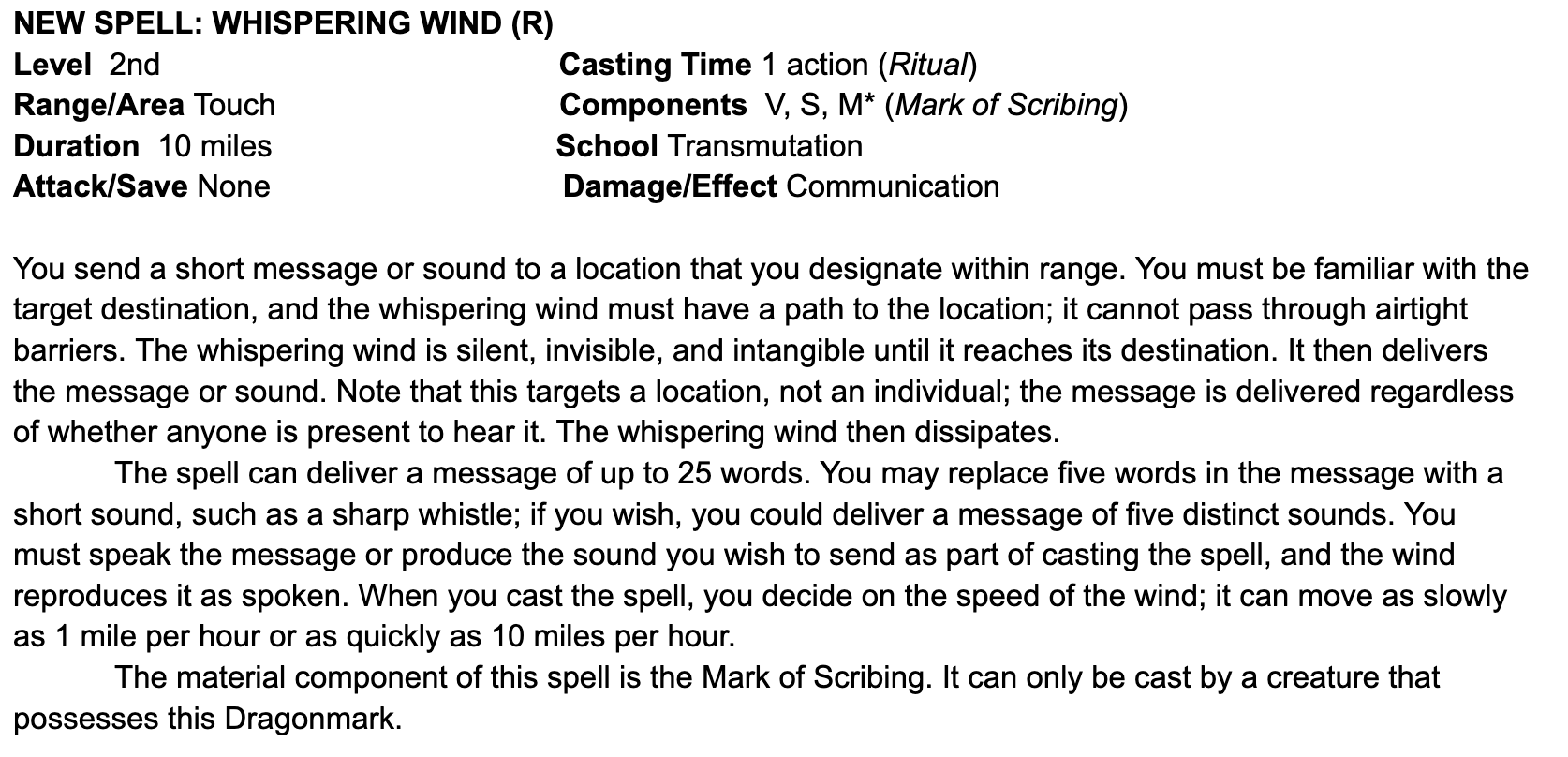
Beyond scribing, the Mark grants a range of powers associated with the spoken word. All those who carry the Mark of Scribing have the ability to cast their words onto the wind, sending a message to any location within ten miles. This is the fundamental principle harnessed by the Speaking Stone. The Stone allows messages to be sent much faster and farther, but it draws on that key power of Whispering Wind. This power played a crucial role in the Last War; while Speaking Stones aren’t extremely mobile, scouts accompanied by a Sivis heir could use Whispering Wind to report back to their commanders. Heirs with the Lesser Dragonmark gain the gift of Tongues; not only can they understand any language, they can speak to any creature. Silence reverses this, allowing a Sivis heir to prevent communication within their sphere of influence. And then there is the remarkable power of Command. When using this, a Sivis heir draws on their Dragonmark and speaks a single word—a word in a language that no one knows, yet everyone understands. Sivis scholars believe Command allows the caster to momentarily speak the language of the Progenitors themselves; it resonates on such a primal level that the creature targeted by the word is compelled to obey.
The most dramatic powers of the Mark of Scribing go beyond mere words. Sending allows the caster to instantly transmit a message over any distance, while Telepathic Bond lets an heir forge a mental link between a group of individuals. Both of these gifts bypass language, allowing the recipients to directly understand meaning. Some Sivis heirs are able to reverse this, scrambling a creature’s internal communication and blocking their ability to understand their own thoughts; this manifests as Confusion. While Telepathic Bond is the power most often associated with the Greater Mark of Scribing, there have been a handful of individuals throughout the history of House Sivis who have instead learned how to communicate with others through the medium of dreams. Because of the rarity of this gift, it has never been incorporated into the services offered by the house, but Tasker’s Dream is always searching for heirs with this ability.
Kanon vs Canon. In general I prefer to work with existing canon, but it’s important to me that the Dragonmarks feel consistent and support the role of the House within the world. House Sivis was built on two spells that don’t exist in Fifth Edition. Arcane Mark drove the idea of Sivis notaries, while Whispering Wind was the foundation for the Speaking Stones—with the idea that the Speaking Stone carries the message faster and farther, but it’s still working off the basic effect of Whispering Wind. Beyond this, the canon Mark of Scribing feat feels significantly more limited than many others. Compare Scribing to Sentinel. Sentinel gets bonuses to Insight and Perception, two consistently useful skills; Scribing gets History and Calligraphy. Sentinel gets Shield, a spell that’s useful in almost every adventure; Scribing gets Comprehend Languages and Magic Mouth, again both very situational. So, looking at key changes…
- I’ve expanded Gifted Scribe to include Cartography and Forgery, and added Tool Proficiency with one of these. They’re all situational, and compared to Making having a bonus with ALL Artisan’s tools, it feels reasonable to me.
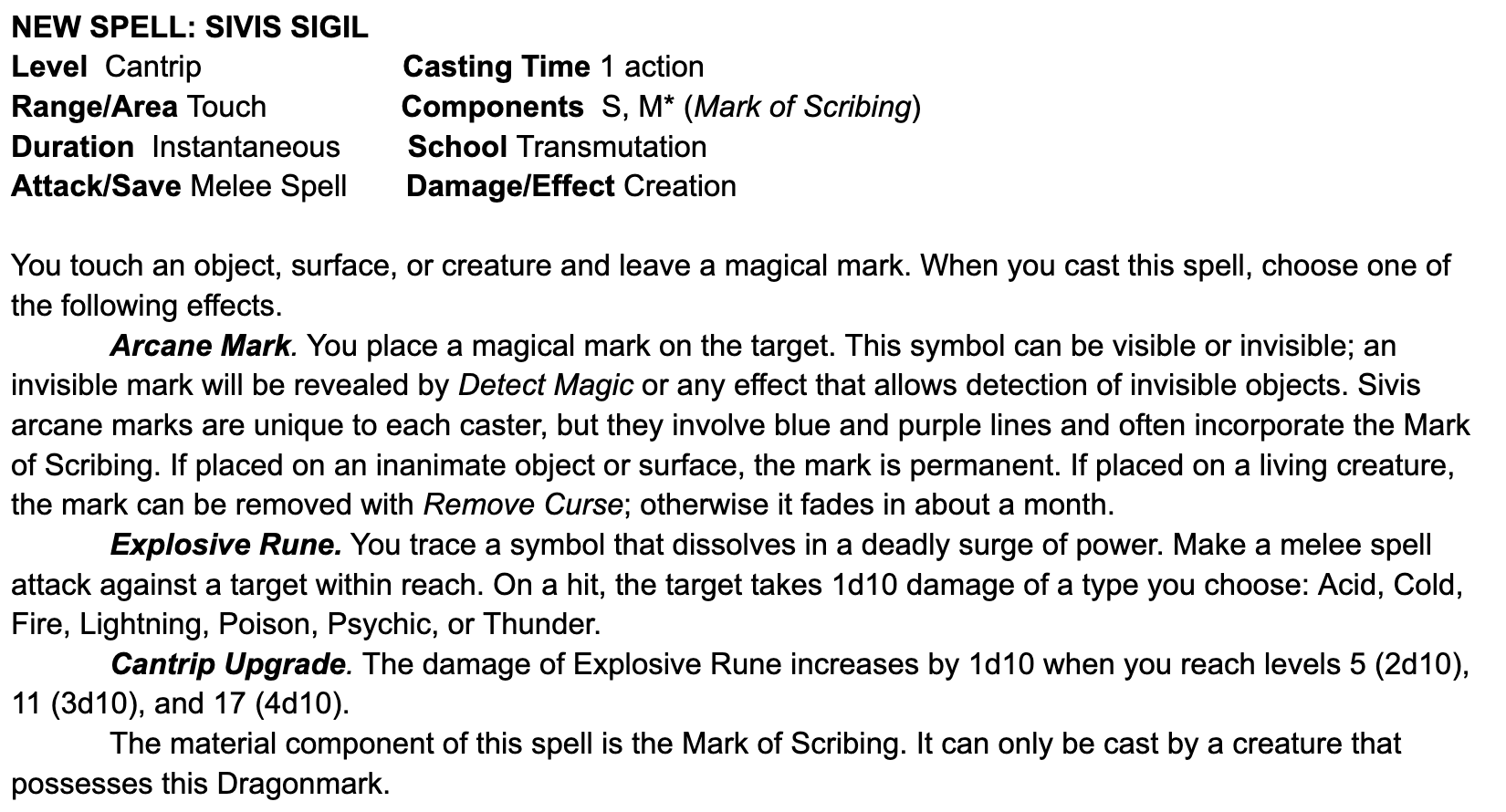
- I replaced Message with Sivis Sigil. While I like Message, I feel that Arcane Mark is an iconic part of Sivis; and I added the Explosive Rune element to give it a little practical punch.
- In the base feat, I replaced Magic Mouth with Whispering Wind, and replaced Animal Messenger with Magic Mouth on the Spells of the Mark list. Animal Messenger is something that makes sense for the Mark of HANDLING. Whispering Wind has specific elements that mirror its expansion by the Speaking Stone: a short message delivered to a particular location. This further means that with the base feat, any Sivis Heir can notarize (Sivis Sigil), translate (Comprehend Languages), or send a message over a distance (Whispering Wind).
- In the Spells of the Mark, I replaced Arcane Eye with Santor’s Swift Scribing. I don’t see what Arcane Eye has to do with words. Swift Scribing gives a Sivis heir a fun, versatile effect that is driven by the act of SCRIBING. It’s inspired by Tasha’s Bubbling Cauldron and Rary’s Mnemonic Enhancer.
- Finally, I added the option of Telepathic Bond at 5th level, with the idea that it’s the standard gift of the Mark. Dream is interesting, but assigning it as the sole power of the Greater Mark is problematic on many levels. If Sivis had access to Dream as a standard ability of the Mark and had it for thousands of years, I’d expect it to play a major role in the House and in history, and we’d need to sort out how Sivis dreamshapers had interacted with the quori. I like it as a rare gift and interesting new development, but Telepathic Bond is a simpler spell that fits well with the other gifts of the Mark.
FOCUS ITEMS
The Speaking Stone is to House Sivis what the Lightning Rail is to House Orien—a vital tool that drives the core business of the House. But Sivis has developed a number of tools associated with communication. A few examples…
- A Listening Stone appears to be a standard spellshard. However, when activated by a creature with the Mark of Scribing, it records conversations as words on the shard. When activating the shard, the user decides whether it will record all speech that originates within 10 feet of the stone, or just the speech of the creature holding the stone.
- A Sivis Slate is a sheet of metal. If a creature uses a Lyrriman Quill or a Scribes Pen to write on the Slate and then places the Slate on a sheet of paper or similar material, they can take a magic action to duplicate the contents of the slate on the page below. They can also use a magic action to clear the current contents of the Slate.
- A Wordbinder is a pillar of metal and engraved wood. When a Sivis Slate is placed on the Wordbinder, it can be used to transfer the contents to multiple pages simultaneously; this is the basis of Sivis printing.
- The Sharn enclave has been experimenting with Echoers. A central Singer works off the premise of Whispering Wind, but rather than directing sound to a single location, the Singer produces multiple gusts that deliver the sound to nearby Echoers, which serve as repeaters transmitting the sound to additional Echoers. In addition to drawing on the Mark of Scribing, the Singer relies on the manifest zone of Sharn to amplify the winds; currently the system is limited to the City of Towers.
Here’s a few additional items.
Calculating Lenses
Wondrous Item, Common
These spectacles allow a Sivis heir to apply the principles of Comprehend Languages to numbers as well as words. While wearing these glasses, a creature with the Mark of Scribing can take a Magic item to perfectly perform basic mathematical operations involving numbers they can see. The Lenses can hold a small range of numbers on the surface of the crystal lenses, allowing the wearer to retain the results of calculations until they can be transferred to another surface.
Lyrriman Quill
Wondrous Item, Uncommon
If you possess the Mark of Scribing, you can use this pen to write on any surface; it draws vivid, purple-blue lines reminiscent of a Dragonmark. You decide whether the writing is visible or invisible, but any creature with the Mark of Scribing can always see the writing. Any creature with the Mark of Scribing can use a magic action to touch invisible writing created with a Lyrriman Quill and render it visible. If you use the quill to write on a living creature, the writing fades after 7 days.
If you use a Lyrriman Quill while creating a Spell Scroll, the time required to create the Scroll is cut in half.
Windcaster
Wondrous Item, Uncommon
A Windcaster is an amulet that bears a small Siberys shard. When made, a Windcaster is bound to up to twelve Wind Stones, engraved stones the size of a chestnut. While a creature with the Mark of Scribing is wearing the Windcaster, they can take a magic action and speak a message of up to 25 words. Any creature carrying one of the linked Wind Stones can hear the message and immediately respond with a 25 word message of their own, which is heard only by the wearer of the Windcaster. A Windcaster has a maximum range of one mile.

THE HISTORY OF HOUSE SIVIS
During the golden age of the Empire of Dhakaan, the region south of the Howling Peaks and west of the Seawall Mountains was a seat of knowledge. The city that preceded Korranberg was the site of the Imperial archives and the greatest college of the Duur’kala. This area was hit especially hard during the final days of the Daelkyr incursion. While Dyrrn the Corruptor prepared the ritual that would destroy the Dar bond to the Uul Dhakaan, two other Daelkyr unleashed devastating linguistic assaults on this area. Belashyra released a curse that caused written words to evolve, every document twisting into its own unique cypher. And the Crawling Queen, Valaara, released wasp-like creatures the Dhakaani named volaaganti, “word eaters.” The venom of the Volaaganti infects the victim with a new language that replaces all previous languages known by the victim. Every Volaaganti queen possesses a unique language—unique to each queen, not just to her lineage—so as the word-wasps spread across the region they broke down the common language of the Empire and created countless lesser tongues. Even as the Kapaa’vola broke the bond that united the Dhakaani, the word eaters destroyed the shared language of the Seawall Dar and the shifting script severed them from their records. Amid this chaos, the forces of Xoriat butchered the bulk of the Dar population of the region. When the Gatekeeper seals bound the Daelkyr in Khyber, most of their creations retreated into the depths with them. But all that remained of the Dar were ruined cities and vaults full of twisted words.
This is what the gnomes inherited—the foundation of what is now Zilargo. During the Age of Dhakaan the gnomes hid in the depths of the Shimmerwood Forest and dark corners of the Seawall Mountains. In the centuries following the downfall of Dhakaan, the gnomes emerged and laid claims to the Dar ruins. Three distinct city-states rose in the region, each one an alliance of powerful houses. In Korranberg, House Sivis held Raat Tohesh, the subterranean facility that had once been the college of the Duur’kala. The vaults of the Raat Tohesh held countless precious secrets, but all were warped by the shifting script of Belashyrra. The wordsmiths of House Sivis had three specialities. On one side, Sivis translators picked apart the endless ciphers of the shifting script so scribes of the House could duplicate anything of value. And on the other side, Sivis interpreters and mediators worked together to facilitate communication in a region scarred by the word eaters. While the gnomes managed to exterminate the Volaaganti, the struggle left every house and many families speaking languages with no common roots—languages shaped by Xoriat rather than natural evolution. Skilled translators and interpreters were in high demand, and the gnomes of House Sivis had a remarkable gift for linguistics.
House Korran was the greatest power within Korranberg; they had claimed the ruins of the Imperial Archives, which Dorius Alyre used as the foundations of his legendary library. Sivis and Korran had long been involved in a linguistic arms race, each digging deeper into their Dhakaani vaults in search of valuable secrets. When Loran Lyrriman Sivis developed the Mark of Scribing, it was thought to be a singular wonder—the influence of Syrania or a blessing from one of the Thousand Gods. Then Sahra Syrralan Sivis manifested the Mark of Scribing, soon followed by Magys Magan. As soon as it was confirmed that the Mark could be passed on, House Korran desperately sought to make matches with House Sivis in order to inherit this blessing, but they were too late. House Sivis recognized the treasure that had fallen into its lap, and had no intention of sharing. Sivis was happy to sell the services of its scribes to the great houses of Korranberg, but they jealously guarded their remarkable gift. Sivis interpreters had long been considered to be the best in service; now they were invaluable. It was a dangerous road, to be certain. The other houses of Korranberg were jealous, and more than once an alliance of families contemplated the destruction of House Sivis. The leaders of House Sivis were able to deflect this by emphasizing their own absolute neutrality and lack of ambition—declaring that they wished to be useful to all, while holding dominion over none. With that said, many scholars believe that Sivis interpreters may have used their positions to carefully exacerbate conflicts among the other Houses, ensuring that they’d focus hostility on these perceived enemies rather than the neutral Sivis. It’s a hard thing to prove, however, as most historical documents from that time were recorded by Sivis scribes…
So House Sivis flourished, but there was always the lingering fear that the jealousy of their peers would boil over into deadly action. It was at this time that the news of other Dragonmarked families began to trickle in. Gnome merchants brought news from Aerenal of the rise and fall of the Line of Vol, and soon after that the Phiarlan elves came to Khorvaire. Tarlian sages were fascinated by the mystery of the Dragonmarks, while the Lyrrimans saw a value in allying with other Dragonmarked before they too suffered the fate of the Line of Vol. Sivis envoys traveled across Khorvaire, seeking out other Marks. They quickly formed an alliance with Cannith and Deneith. The Twelve wouldn’t be formally recognized until after the War of the Mark, but the Lyrrimans established the blueprint for the alliance—as well as convincing the leaders of Deneith and Cannith to follow their example and restructure themselves as Houses. Sivis continued its aggressive outreach program, drawing in Orien, Jorasco, Lyrandar, and Ghallanda. It was also in this period that Sivis enacted its most ambitious project yet: the development and dissemination of the Common tongue. Blending elements of the trade language of the Sarlonan immigrants with a handful of the House languages of the gnomes and some entirely artificial structures, House Sivis created a language that was remarkably easy to learn and spread. Sivis heirs taught Common across Khorvaire. With the aid of Deneith, Canith, and Ghallanda, Common spread quickly—first as a trade language, but steadily taking root and edging countless regional languages which are now all but forgotten. Today, almost everyone in the Five Nations speaks Common; few have any idea that it was a Sivis invention.
The next chapter in the history of House Sivis has been expunged from the annals of history. Accounts of the period 600 to 700 years before the rise of Galifar go into great detail about the leadership of Vown and Denieth, the families that rallied the Houses to fight the War of the Mark. But these chronicles—copied and spread by Sivis scribes—say remarkably little about the actions of House Sivis in this time. The details have been buried, but a scholar who carefully studies the record can see the shape formed by the absences and draw a simple conclusion: House Sivis was responsible for the War of the Mark. Sivis leaders believed the Houses needed a shared enemy to cement their alliance, and concluded that by vilifying the Aberrant Dragonmarks they could also cast the House Marks as the “True” Dragonmarks. It was Sivis that promoted the idea that the House Marks were blessings of Siberys while Aberrant Marks were the curse of Khyber. Aberrant Dragonmarks are dangerous, and many of those carrying such marks endured tragedy before mastering their powers. A handful of cases were truly horrific; the Lady of the Plague was responsible for thousands of deaths. Sivis seized on these stories, exaggerating them and spreading them, turning legitimate fear into deadly panic. During the War of the Mark, most commoners gladly helped Deneith forces track down Aberrant forces, because they truly believed the Sentinels were protecting them from a terrible threat… and that is the work of House Sivis.
It’s possible the leaders of House Sivis didn’t realize what they were setting in motion. Perhaps they only meant to bolster the reputation of the “True” Marks. Certainly, it was Cannith and Deneith that outfitted the Sentinels and initiated hostilities. What is certain is that it was House Sivis that set events in motion, and that they felt a need to expunge the record of their actions. It’s up to the DM to decide if the leaders of House Sivis buried their deeds because they were ashamed of the outcome—or if they were proud of their work and simply wished to conceal the extent of their influence. There’s no obvious parallels to this whispering campaign in the subsequent history of House Sivis, so it’s possible that they truly were horrified by what they’d done and swore never to take such an action again. Certainly, the subsequent history of House Sivis has no obvious parallels to this terrible action. Throughout the history of Galifar, House Sivis was known for its absolute reliability and neutrality, showing no signs of ambition. House Sivis has been a helpful partner to many other Houses. It played a key role in bringing House Kundarak and House Tharashk into the Twelve. Sivis has been closely aligned with House Kundarak since its inception, but every House employs Sivis scribes and accountants. Likewise, Sivis is so trusted that commanders and kings used its services for secret communications during the Last War. Most people believe that House Sivis is absolutely dedicated to its work. And perhaps this is the case. Perhaps the War of the Mark is a single shameful moment in history, one that drove the House to a better place. Or perhaps they’ve simply gotten better at concealing their manipulations, and they simply haven’t left such obvious footprints with their subsequent actions.
While House Cannith loves to take the spotlight, House Sivis has played a vital role in ensuring the prosperity of the Twelve. House Sivis has always sought ways to improve the fortunes of all Houses, and Sivis mediators are always working to resolve disputes between Houses and enclaves. House Sivis has also long sought to learn more about the Dragonmarks themselves. While it’s House Cannith that builds most focus items, Sivis sages play a crucial role in research and theoretical development. House Sivis is known for its constant internal intrigues, but it has been a solid, reliable partner to the other Houses in the Twelve… or so it seems.
Looking to recent history, the most crucial date in the history of House Sivis is the 3rd of Olarune, 783 YK. This is the day that Tasker Torralyn d’Sivis tested the first pair of Speaking Stones, dramatically amplifying the range and speed of a Sivis heir’s Whispering Wind. Six years later, House Sivis opened its first message stations; some say that the world became a smaller place that year. In 998 YK Speaking Stones are an important part of everyday life, and the Sivis think tank known as Tasker’s Dream is working to find a way to do for Sending what Tasker did for Whispering Wind.
House Sivis remained scrupulously neutral throughout the Last War. While Zilargo was a strong ally of Breland, there’s no evidence that House Sivis showed any special favor to the Bear. Most major fortifications of all nations maintained Sivis message stations, and Sivis Whisperers could accompany scouts, using Whispering Wind to send reports back to a command post. But Sivis leadership has no love of war and harbors no doubts that it will prosper in peacetime, and the House celebrated the signing of the Treaty of Thronehold.
What Happens Next?
House Sivis has always been a stable house that takes pride in the reliability and security of its services. Traditionally, it channels its love of intrigue into internal rivalries—but those rivalries are friendlier than those seen in House Cannith, and heirs are careful not to threaten the overall stability of the House with their schemes. But there’s always the possibility for adventure; here’s a few seeds to work with.
- The Rival. The heirs of House Sivis are always competing for titles and honors within the House. If an adventurer is part of the House, they should work with the DM to develop their nemesis—a Sivis heir they’ve been competing with since childhood. This rival doesn’t want to hurt the adventurer, but they want to embarrass them or to outshine them. Any meeting should be a duel of words and wits; who said it best? In addition, the DM could drop secondary goals into an adventure that are irrelevant to anyone except the heir. If the adventurers are exploring a Dhakaani ruin, the Sivis heir might know that there’s a standing bounty on any records of unknown Duur’kala songs. If the heir can find any songs, they’ll earn recognition in the House. But their rival also wants this honor! Might the rival show up in the ruin themselves? Will they try to steal whatever the adventurer finds? Or might they have even planted a fake song in the ruins that will embarrass the adventuring heir if they turn it in without noticing? An important element here is that however bitter it might get, this is still a friendly rivalry. Neither rival wants to actually hurt the other; if the rival was to die, the game would be over!
- Language is a Virus. Working with House Vadalis, a member of Tasker’s Dream manages to recreate the Volaaganti. Anyone stung by a Volaaganti has all of their known languages replaced by a single new language. When the Volaaganti breaks free from containment, chaos ensues. Adventurers arrive in a small town to find that all of the inhabitants are speaking an alien language; if there’s multiple strains of Volaaganti, there could be competing languages within the populace. Can the adventurers find a way to contain the Volaaganti? Can the effects of their venom be reversed? What happens if the adventurers themselves are stung by different Volaaganti and divided by language?
- The Bond. Tasker’s Dream pays one of the adventurers to field test a new form of Telepathic Bond—a version of the spell that should last for a week. The adventurer has a telepathic bond with a Sivis sage, who will provide commentary and advice over the course of an adventurer. Initially, this may be annoying or useful; the sage has expertise in History and Arcana and could provide helpful advice. The twist is that the sage is kidnapped by a Cult of the Dragon Below who intends to twist the Telepathic Bond, using it to spread Dyrrn’s corruption. The adventurers have to rescue the sage before it’s too late. But they have no idea where the cult is; to find it, they must decipher the clues the Sage can send through the bond.
- Here There Be Demons. Sivis cartographers are always eager to fill in blank spaces on their maps. Adventurers could be hired to explore a dangerous region Sivis has yet to fully explore—part of the Demon Wastes, the Watching Wood of Droaam, the Black Pit of Breland, or somewhere equally dangerous. Adventurers might have to defend a team of cartographers accompanying them into danger. On the other hand, Sivis could provide the adventurers with a scrying focus that allows the cartographers to study and record details of the adventurers’ surroundings without endangering the gnomes.
- The Fugitive. House Sivis takes the security of its clients very seriously, and never abuses the secrets entrusted to its messengers. But an heir of the House has gone rogue, and they know a host of dangerous secrets that could be used to blackmail important people across Khorvaire and embarrass House Sivis. The rogue heir is prepared to deal with Oversight and agents of Sivis—and so the House turns to a small band of capable adventurers to track down the fugitive. The key question: what does the fugitive want? Are they just seeking wealth and power? Or are they negotiating with Sivis, holding the secrets hostage until their demands are met? Could this entire thing be about who gets to be the Keeper of the Eighth Word?
- The Mark of Demons. Throughout its history, House Sivis has always been driven by curiosity. It was Sivis explorers who discovered House Tharashk and House Ghallanda, and even today there are agents of the House searching for new revelations about Dragonmarks or language. Today, a Sivis explorer wants to investigate rumors of a new Dragonmark that’s manifested within a Carrion Tribe in the Demon Wastes. The House considers this ludicrous and dangerous and won’t support an expedition—so the explorer needs to work with a team of adventurers. Could there be a new Dragonmark in the Wastes, and if so, what does this mean? Is this new Mark replacing the Mark of Death? Or is the assumption that there can only be thirteen Dragonmarks entirely false? Or… could this “new Dragonmark” be a trick, a dangerous hoax created by Hektula the Scribe? What does the Mark do, and what will it take to work with those who carry it?
- Dangerous Dreams. Occasionally, an heir of the Greater Mark of Scribing develops the ability to manipulate dreams. Tasker’s Dream has been trying to harness this gift—but something has gone terribly wrong. A dreaming heir is in a coma, and the sages are concerned that their dream is expanding—pulling other sleepers in and leaving them comatose as well. Is this the work of the Quori or a curious Night Hag, or is it the dreamer themselves who seeks to craft an empire in Dal Quor? Tasker’s Dream needs adventurers to utilize experimental magic that should allow them to enter the dreamer’s nightmare—but no one knows how death in the dream will affect them!
- Keepers of the Word. The central enclave of House Sivis was once a college of Dirge Singers, and the vaults still hold Dhakaani lore hidden beneath Belashyrra’s shifting script. There’s something in those vaults that the Kech Volaar are desperate to recover—songs of Jhazaal Dhakaan that could grant great power to a Volaar Bard. How far will the Heirs of Dhakaan go to recover these ancient secrets? If the adventurers get involved, whose side will they be on?
- The Long Con. House Sivis has always been helpful and reliable, maintaining a neutral stance on all conflicts. It seems to have no grand ambitions beyond improving communication and acquiring knowledge. But what if it’s all a very long con? There are rumors that House Sivis is the true power behind the Trust and as such, that they are the de facto rulers of Zilargo. What if they’ve been manipulating the Twelve as well—controling the leaders of other Houses with blackmail and Telepathic Bonds? Of course, the key question in a campaign where this secret is revealed is what does House Sivis actually want? Perhaps they are striving to ensure the prosperity of the Twelve and the Houses—but in pursuit of that goal they seek to weaken the nations, and they in fact helped to cause the Last War! Or perhaps there’s something more sinister. Perhaps the leaders of House Sivis have always been servants of Tul Oreshka, the Truth in the Darkness. For thousands of years House Sivis has been using its influence to promote a particular path of the Prophecy. When Tul Oreshka is freed from her bonds, House Sivis will use its network to spread her terrible truths throughout the Five Nations, causing a wave of deadly chaos and terror.
HOUSE SIVIS AND LANGUAGES
By default, the Eberron Campaign Setting seeks to prevent languages from being an obstacle in a campaign. The widespread use of “common” languages such as Goblin and Common makes it easy for adventurers to interact with the people they encounter. Secondary languages can allow characters to have private conversations or to read inscriptions, but most adventures don’t make language an obstacle to progress. However, Comprehend Languages is a key gift of the Mark of Scribing, and in a campaign with a Sivis adventurer, it’s nice to feel like that gift is actually relevant. Consider the following options.
- Canonically the Five Nations don’t have unique languages; Common has displaced any languages of the individual nations. However, nothing’s stopping you from reversing this and adding these secondary languages. Merchants and travelers may speak Common, but if you go to Thaliost, a lot of the locals only speak Aundairian—which is a thing, now that Dariznu is trying to force everyone to speak Thrane!
- A lighter form of this is to introduce regional dialects. Someone who is familiar with the dialect can understand it perfectly, but an outsider might have to make an Insight check to understand the exact details of a statement.
- In general we focus on the accessibility of the Common languages, but there are certainly storylines where it makes sense to have no common tongue. An isolated tribe in the Demon Wastes, an unknown civilization in Xen’drik, a demiplane in Khyber—all of these places could have entirely unknown languages!
- Things like the Volaaganti or Belashyrra’s shifting script are ways to make language a unique obstacle to a particular adventure. Dealing with a Volaagant isn’t about having a particular proficiency; the language only exists in the Volaagant strain! Likewise, a crucial piece of Dhakaani lore could be hidden by the shifting script. In such cases, the DM may want to say that Comprehend Languages alone isn’t sufficient; perhaps the character also needs to make a Wisdom (Calligrapher’s Tools) check to unlock the full meaning!
- If you want to see a deeper exploration of this concept, check out Languages of Eberron by Nausicaä Enriquez on the DM’s Guild!

THE STRUCTURE OF HOUSE SIVIS
House Sivis loves bureaucracy; what is bureaucracy but a maze of words? Many Sivis heirs enjoy negotiation and debate, filling out forms in triplicate and making sure to check every footnote. Every aspect of life in House Sivis is at least twice as complicated as that of any other house. There are always forms to be notarized, clerks to be consulted, and if it’s a weekday in Olarune, you have to get that form in before the second bell rings. House Sivis has the same general structure as the other Dragonmarked Houses—indeed, the Twelve based this organizational blueprint on House Sivis—but it has more layers. The leader of House Sivis is the Doyen. Each nation has a Council of Viceroys, administrators who oversee operations in a particular region. The Five Nations have nine Viceroys apiece, while the other nations of Khorvaire each have three Viceroys. The Shadow Marches aren’t recognized as a Thronehold nation, but House Sivis conducts business there so it has Viceroys; likewise, three Viceroys have just been appointed to oversee Sivis operations in Droaam. The High Council of Korranberg is made up of the Lords Seneschal, who appoint the Doyen and guide the overall direction of the House. Each Viceroy Council appoints one Seneschal to the High Council, and each founding family appoints one Seneschal; at the moment, there are 26 Seneschals serving on the High Council of Korranberg. Every enclave has its own web of administration. Where a Cannith enclave will have a head cook with a team of assistants, in a Sivis kitchen an assistant cook might hold the title of Master of Spices or First Scullery. Such titles can always be stripped away, and this is part of what drives Sivis heirs to excel at their work; there’s always a rival angling to take your title! This can be a point of family pride. You may not think much of being First Scullery of Greentower, but my family has served in this kitchen for six generations and no Severin will take it from me.
Following the Test of Siberys, every Sivis heir serves a five year apprenticeship with the House guilds. If an heir has exceptional academic aptitude, this can be offset while the heir studies at the Library of Korranberg. Apprenticeship is an opportunity for the heir to hone their skills and find their niche within the guilds, and most heirs take a job with one of the guilds or the House itself after completing their apprenticeship. While many of the key services provided by Sivis require a Dragonmark, unmarked heirs can serve as clerks, bookkeepers, heralds, barristers, and more—any role that doesn’t involve translation, mystical scribing, or magical communication. A significant number of unmarked heirs end up serving as guild administrators. An unmarked heir can’t operate a Speaking Stone, but they can keep the books in order and manage the staff.
One unusual aspect of House Sivis is that its guilds are closely intertwined. Many heirs are licensed by both guilds. The typical Sivis outpost includes a message station where missives can be sent and received by Speaking Stone, but also offers notary services, translation, and the preparation of legal documents. In a small community the Sivis outpost may be run by one or two heirs. There’s quite a few villages where the two heirs running the local outpost are also the only licensed barristers. Large towns and cities usually have dedicated Sivis facilities tied to a particular guild: a law firm that only provides legal services, a scriptorum that’s dedicated to producing books or scrolls, or a communication hub with multiple stonespeakers and heirs capable of casting Sending.
Sivis Enclaves. While House Sivis enclaves aren’t identical in layout, they follow the same key principles. A Sivis enclave includes an inner area—the heart—that is surrounded by an outer region known as the circle. The heart is the population center where Sivis families live and train. Sivis enclaves have a higher population density than the enclaves of other Houses; most Sivis heirs enjoy being surrounded by friends and family and don’t mind small rooms and tight quarters. This is enhanced by the fact that the heart of a Sivis enclave is designed for Small humanoids. Medium creatures have to squeeze or crawl to move around a Sivis heart, and Large creatures can’t enter them at all. Meanwhile, the circle of an enclave is a place of business. Every Sivis circle includes a message station, offices for guild administrators, and facilities for one or more guild businesses. Sivis circles are designed to be comfortable for both Small and Medium creatures.
Because of the size and complexity of Sivis enclaves, they’re generally only found in major cities. The Sivis outposts found elsewhere are small and simple in design, and built to be accessible to both Small and Medium creatures.
The Notaries Guild
It’s often said that the Notaries Guild deals with anything associated with the written word, but its purview extends even further; accountants and cartographers are also licensed by the Notaries Guild. The guild takes its name from the service of notarization, which House Sivis has performed since its earliest days. Any Sivis heir with the Mark of Scribing can be licensed as a notary, in addition to their other specialties. Beyond that, the Notaries Guild has a number of different departments, including the following:
- Aureon’s Press. This corps of gifted scribes produces Spell Scrolls; they are the primary source of commercially available scrolls.
- The Atlas. House Sivis produces the most reliable maps in the Five Nations. Agents of the Atlas use divination magic and in-person exploration to confirm the accuracy of their maps.
- The Binding. The Binding is the primary publishing arm of House Sivis. The Binding focuses on the production of books and spellshards rather than the generation of content. House Phiarlan and House Sivis teach the art of writing; the Binding publishes the result.
- The Hidden Word. The scribes of the Hidden Word are expert cryptographers who specialize in concealing and unlocking the meanings of messages—something they achieve through both mundane and magical methods. They can craft messages that can only be read by specific individuals, or members of a single family. They can create codes for clients… or break them. If a client purchases a code system from Sivis and pays an ongoing subscription fee, the Hidden Word won’t share that system with anyone else; but they will happily break any systems used by factions they don’t recognize as clients.
- The Key. Any marked heir can cast Comprehend Languages. The scribes of the Key are dedicated linguists and translators who excel at capturing the tone and full intent of a text, looking beyond the blunt translation provided by magic. The Key works closely with the Binding to ensure the best possible translations of published material, and its finest linguists are often recruited by Tasker’s Dream.
- The Ledger. The accountants of the Ledger work magic with numbers. House Kundarak employs hundreds of Ledger scribes, and Sivis bookkeepers can be found working with businesses, Houses, and nobles across Khorvaire.
- The Quill. While the Binding produces books, the Quill brokers the services of scribes, including stenographers, secretaries, and people trained to prepare legal documents. Some believe that the Quill also has a stable of expert forgers; even if true, it’s possible they only use these skills to back up important documents.
In many ways, the Notaries Guild mirrors the Blademarks of House Deneith. The guild maintains dedicated facilities and outposts for the work done within the guild itself, like the Binding. But many Notaries are essentially mercenaries whose services are brokered by the guild. When such a Notary settles in a new community, they register with the local guild office, which connects them with prospective clients. An important aspect of this is that Sivis Notaries may be licensed by multiple branches of the guild. An heir with a knack for numbers and words may be licensed by the Quill and the Ledger, able to take assignments of either sort. Some heirs join together to form their own firms within a department; again, this is similar to mercenary companies and Deneith, and the Notaries Guild will direct potential clients to the firm.
Sivis sigils. The Mark of Scribing grants the ability to produce an Arcane Mark. An Arcane Mark generated by an heir to the Mark of Scribing is known as a Sivis sigil. This is a pattern of purple-blue lines, reminiscent of the Mark of Scribing, but every caster produces a unique sigil. When a Sivis heir is licensed as a notary their sigil is recorded in the archives of the House, allowing archivists to track the origin of any notarized document. When placed on inanimate objects, Sivis sigils are permanent and are clearly supernatural; if a living creature runs a finger along the lines of a seal, the sigil will shimmer.
The Speakers Guild
The Speakers Guild licenses a variety of trades related to the spoken word. As with the Notaries Guild, an heir may be licensed for more than one of these specialties. Here are the most notable branches of the guild.
- The Canon. House Sivis has the finest law school in Khorvaire. Barristers trained by the Canon study all of the systems of law known to Zilargo, including the customs of Aerenal, the Lhazaar Principalities, the clans of the Mror Holds, and even the Eldeen druids. There are even a handful of Canon barristers who are familiar with the legal systems of the Empire of Dhakaan. While none have put this knowledge to practical use, if a party of adventurers should somehow find themselves accused of a crime in Volaar Draal, there’s a Sivis heir ready to represent them! While House Sivis doesn’t have a universal monopoly on legal representation, it is well known that a Canon license is proof of a barrister’s expertise and impartiality, and in the Five Nations few people would work with any other lawyer.
- The Concord. The mediators of the Concord excel at negotiating agreements and settling disputes. Most members of the Concord are also licensed by the Canon, as an understanding of the law can be vital when negotiating agreements. However, there are Concord mediators who focus solely on settling interpersonal disputes as opposed to legal or business challenges; if you have a grievance with friends or family, a member of the Concord would be happy to sit down with all of you and talk things through.
- The Herald. With the prevalence of Common across Khorvaire, there’s not a huge demand for professional interpreters. However, the talents of a licensed Herald go far beyond Comprehend Languages. In addition to being able to cast Comprehend Languages and Tongues, Heralds often speak many languages themselves. But beyond that, Heralds study the customs of the cultures and subcultures of Khorvaire. A Sivis Herald can advise a client on the etiquette that applies to a situation, and can read between the lines—translating not simply what was said, but what was implied. Beyond that, Heralds are also trained to make formal proclamations and announcements.
- The Stone. Sivis message stations are the most widespread outposts of the House Sivis. Speaking Stones use the principles of Whispering Wind, but travel faster and farther than the standard spell. This is because messages travel along the network of stones, relayed from one to the next as they make their way to their final destination. The Stone maps out and maintains this network, and message stations are direct arms of the House. If a foundling with the Mark of Scribing acquired a Speaking Stone, they wouldn’t be able to use it unless they knew how to connect it to the network. The point of this is that Stonespeakers operate message stations, but they don’t own them; it is the house that maintains the network, and it’s the network that is the key to the business.
The Ninth College
While House Cannith is widely considered to be the authority on artifice in Khorvaire, there is one field of arcane science where House Sivis is unmatched: Sigilry, the art of producing Spell Scrolls and weaving power into glyphs and words. The Ninth College educates Sivis heirs in the science of Sigilry. Most graduates of the Ninth College go on to serve at Aureon’s Press or Tasker’s Dream, but some remain, conducting research to advance this arcane art. The most accomplished members of the Ninth College are called Unbound Scrolls. Whether they are Magewrights, Wizards, or Artificers, Unbound Scrolls are genius Sigilists who can perform miracles with quill and paper. The Ninth College is based in Korranberg, in a wing of the ancient Raat Tohesh. While its members are largely consumed with their studies, there are a few ways the Ninth College could play a role in a story. The college library is believed to have the largest collection of scrolls within any Thronehold nation, rivaled only by the Library of Ashtakala in the Demon Wastes. These include scrolls from fallen civilizations—giant scrolls recovered from Xen’drik, a scroll said to have been written by Jhazaal Dhakaan, scrolls from Ohr Kaluun and Khunan in Sarlona, and many, many more. Many of these scrolls contain spells that have yet to be mastered by any mage in the Five Nations. In some cases this is due to the scroll being damaged, requiring a brilliant wizard or artificer to fill in the missing pieces. In other instances, the scroll has never been read by a wizard with sufficient power to master it. If you’re looking for a way to place a new spell in the hands of a high-level player character, you could have them visit the Ninth College, and discover scrolls that only they have sufficient skill to master. Alternately, adventurers could be hired to rob the library of the Ninth College, or perhaps to recover a set of highly dangerous scrolls that have been stolen from it. Beyond this, the College is always eager to add new scrolls to its library; adventurers could be brought in to take part in an expedition to a ruined scriptorum in Xen’drik, or paid to steal a scroll from the collection of Sora Teraza!
Tasker’s Dream
Tasker Torralyn d’Sivis was a visionary. In addition to being the artificer who developed the Speaking Stone, Tasker was a brilliant linguist and created the language known as Stonespeech to help facilitate concise communication when using Whispering Wind or Sending. Never satisfied with his accomplishments, Tasker was determined to find ways to improve global communication. After Tasker’s death, the Torralyns established an institute that would carry his name and his work forward: Tasker’s Dream. Over the last century, Tasker’s Dream has studied dream manipulation and psionic telepathy, while working on focus items that can amplify the Sending and Telepathic Bond powers of the Mark of Sending.
The existence of Tasker’s Dream is no secret, and the institute regularly collaborates with the Twelve and House Cannith. However, it may be that Tasker’s Dream has a hidden agenda—that its true purpose goes beyond building a better Speaking Stone. It’s difficult for mortals to comprehend the patterns of the Draconic Prophecy. The Lords of Dust and the dragons of Argonnessen have been studying it for tens of thousands of years, and they rely on data collected over millennia to interpret new manifestations. But House Sivis has a tool no fiend or dragon possesses. The Mark of Scribing is part of the Prophecy, made to reveal the meaning of words and symbols. Prophecy Marks are symbols that mysteriously appear around the world. It’s possible that a person who carries the Mark of Scribing can draw out the deeper meaning of a Prophecy Mark, allowing them to piece together sections of the Prophecy without the resources of the Chamber or the Lords of Dust. It’s up to the DM to decide if Tasker’s Dream is investigating the Draconic Prophecy or if that’s just a rumor. If I were to go down this path in my campaign, I’d say that it’s an extremely recent development: that a Siberys-marked Sivis heir encountered a Prophecy Mark a few years ago and accidentally discovered how to tap into its meaning. If I went down this path, I’d say that House Sivis now knows about the First War and the ongoing struggle between the Lords of Dust and the Chamber, and how these forces have been manipulating humanoid civilizations. They would be working to find new Prophecy Marks and learn more about the Prophecy, while also doing everything in their power to hide their knowledge from the ancient forces. This would allow them to be the force that can tell player characters about their own potential roles in the Prophecy, or call on adventurers to help stop a dangerous branch of the Prophecy. For example, perhaps the Prophecy says that King Boranel needs to die on 11 Olarune 999 YK in order to prevent the rise of Rak Tulkhesh. There’s two ways Boranel can die that would satisfy this path: either the Chamber can destroy Wroat, or a particular adventurer can kill Boranel themselves. So to save the world from Rak Tulkhesh and to save the innocents of Wroat from dragonfire, the adventurers must murder Boranel. Will they shoulder this burden? Embracing this path would allow a Sivis adventurer to play a major role in the arc of a campaign, if they learn the secret of reading the meaning of Prophecy Marks!
Oversight
House Sivis carries the communications of kings. The House has maintained its reputation for impartiality and security for over a thousand years. How does Sivis guard against leaks from within or spies from without? Oversight. The security arm of House Sivis is modeled on the Trust; it’s an invisible guardian with eyes and hands spread throughout Sivis. Oversight prefers not to kill Sivis heirs, and a potential leaker will likely receive a stern warning before they cross a line. But Oversight is authorized to take any action it deems necessary to preserve the security and reputation of House Sivis, and people it deems to be unacceptable threats may simply vanish. Oversight has significant resources and talented agents, but it’s not the only force working to protect House Sivis. The House pays House Phiarlan and House Medani to reinforce its security and to deal with anyone who seeks to steal its secrets. Keep in mind that people know this. Ask a professional thief whether they’d rather steal from a Kundarak bank or a Sivis message station, and nine of ten will choose Kundarak. The House of Warding may have better security on the spot, but everyone knows stories of someone who robbed from Sivis, only to disappear along with their whole family a week later. Keep in mind that such stories are spread by Sivis and unquestionably exaggerated; this sort of informational warfare is another specialty of Oversight! But the practical effect of this is that few people try to challenge Sivis security.
There’s a number of ways that adventurers could interact with Oversight. The organization might hire a group of adventurers to deal with individuals Oversight has identified as threats, serving as agents who can’t be tracked back to the House; a question here is if it’s clear to the adventurers why they are dealing with the bad guys, or if they may never know the secret they are protecting. In such a situation, the adventurers could receive their missions through a particular message station, and late in the campaign they could discover that the scrawny Speaking Stone operator is actually a trained assassin. If one of the adventurers is a Sivis heir, they could be recruited by Oversight. As an agent, they would be given a Telepathic Bond to a handler. The agent’s primary job would be to gather information, but at any point they could receive a telepathic message with a mission to perform for Sivis (Recover a stolen codebook! Convince a wavering heir not to leak their secrets! Disrupt a plot to steal a cache of Sivis spellshards!).
SIVIS CUSTOMS
The heirs of House Sivis love words and wit. Sivis heirs love clever wordplay and delight both in well crafted poetry and in puns that others might consider to be deplorable; fortunately, most can read a room and save their finest puns for fellow heirs. Most Sivis heirs appreciate a good riddle, and riddling contests are one of the many valid forms of dueling in Sivis culture. Others include scholarly debate, mock trial, pun-offs, and cutting remarks. While such duels typically only injure the loser’s pride, there is a discipline in House Sivis known as The Sharp Tongue—a path that learns to harness the power of the Mark of Scribing to imbue a speaker’s words with bitter force. Sivis Wordsharps are able to cast Thunderclap, Vicious Mockery, and Command. While these spells are drawn from the Mark of Scribing, mechanically it would be represented by Magic Initiate (in which case Command could only be cast once per long rest) or by Bard levels (in which case Command uses spell slots). Insults flung by a Sharptongued Sivis heir cut deep, and a war of words between two acclaimed duelists will always draw a crowd in a Sivis enclave.
House Sivis instills a strong competitive streak in its heirs, but this is tempered by a broader bond between families and the House itself. Sivis heirs will clash over titles and seek to outshine other heirs with witty words or clever plans, but at the end of the day this is understood to be a game. The competition is a source of joy, not something that cuts too deep. As with Zil culture overall, outsiders are often puzzled by the degree to which Sivis heirs can be so fiercely competitive and yet, at the end of the day, laugh off a loss and share a cup of tal with a victorious rival; ultimately, this competition is more sport than better feud.
Just as Cannith heirs are often tinkering on some sort of artifice, a Sivis heir is almost always working on a personal project—but they work with words rather than steel or wood. In making a Sivis character, consider the form of wordplay that appeals to them. Are they a poet? A novelist? Are they working on the perfect riddle, or creating a new language they believe could someday supplant Common? These projects are typically a source of joy rather than being professional work; just because a Sivis heir loves poetry doesn’t mean they’re good at it, and the Binding publishes more novels written by Phiarlan heirs than by Sivis authors. But even if the heir doesn’t share their work with anyone else, they always have a piece of wordplay in the back of their mind, something they love to work on in quiet moments.
Another notable Sivis custom is the use of titles. In addition to the typical titles you might find in any organization, House Sivis will add a title for almost any piece of responsibility. As noted earlier, in a Sivis kitchen you’ll have the Chef, the First Assistant Chef, Second Assistant Chef, and so on; but divided among these you’ll also have the Master of Spices (who monitors supply and quality), the Overseer of Ovens (who holds the responsibility of ensuring the ovens are clean and functioning), and other similar offices. In creating a Sivis character, consider if there’s any logical titles they might carry tied to their duties. A few titles recognized throughout the House include Wordsmith and Word Keeper. The title of Wordsmith is granted to any Sivis heir who creates a new and valuable word or idiom—something that’s useful enough that it spreads to general use without coercion; in other words, it’s someone who makes “fetch” happen. Word Keepers hold heirloom words that are considered treasures of the House; it’s the duty of the Keeper to ensure that the word is remembered and to preserve its proper pronunciation and meaning. The proper form of address is Keeper of the Thirteenth Word. There are currently 523 words that the House has chosen to preserve in this way. Keeping a word is an honor and responsibility, generally granted in recognition of wit, talent, and service to the House. Any Viceroy can nominate a Sivis heir to carry a word or call for them to be stripped of the status of Keeper, but the ruling must be ratified by the High Council of Korranberg.
SIVIS FAMILIES
House Sivis began as an alliance of twelve families of gnomes: Corralyn, Dassakar, Jossalyn, Haskal, Lyrriman, Magan, Santor, Severin, Syrralan, Tarlian, Torralyn, and Wandaryn. Despite constant rumors to the contrary, there is no evidence that there was a thirteenth family that disappeared. On the other hand, Sivis prints the history books, so anything is possible! While many smaller families have risen over the centuries, these twelve families remain the pillars of the House today. As with many Houses, Sivis heirs may draw talented professionals into the House through marriage. It’s rare for non-gnomes to be welcomed in this way, but not impossible; in 997 Salia Syrralan d’Sivis married Quill, a warforged sage celebrated for their remarkable reinterpretations of many historic events. When two or more Sivis heirs wish to marry, there is a complex series of negotiations and challenges that determine both if the marriage will be approved and which family name the newlyweds will carry.
Each of the founding families is associated with one or more of the branches of the Sivis Guilds, and it’s the duty of that family to oversee the operations of that branch. While all of the families began in Korranberg and still maintain estates in that city, as the influence of the House and demand for its services grew, many of the founding families settled in other major cities. All of the founding families developed traditions and traits tied to their home and their business, and today these are evoked in common stereotypes—Torralyns are dreamers, while Tarlians are dull but reliable. However, all of these things are just that — stereotypes. The Torralyns are based in Zolanberg and known for their work with Tasker’s Dream, but Solirion Torralyn is the cunning Viceroy of Sharn, while Tyrin Torralyn runs a message station on the island of Dreadhold. The Wandaryn are legendary explorers, but the most adventurous heirs of other families take part in Wandaryn expeditions. The descriptions in this section reflect common traits of families, and they’re a reasonable starting point when you’re creating a Sivis character. But you can always make a Sivis heir whose personality, home, and business all differ from the traditional values of their family. Furthermore, House Sivis’s services are in demand everywhere. A family’s seat of power is where you’ll find its elders and its vaults, but Lyrriman barristers and Severin accountants are found across Khorvaire; you don’t have to go to Krona Peak to get a bookkeeper.
Corralyn
Guild Influence: The Concord
Seat of Power: Fairhaven
Common Traits: Conciliatory, Empathetic, Kind
If you’ve got a problem, there’s a Corralyn heir who would like to help you solve it. The Corralyn family places great value on empathy and compassion for others, encouraging its heirs to listen more than they talk. The Corralyns are the matchmakers of House Sivis, seeking to help Sivis heirs make romantic connections but also identifying business opportunities or beneficial alliances. For the most part, the Corralyns are truly driven by altruism; but when a Corralyn is in trouble, they usually have a host of favors they can call upon. The Corralyn family is the force behind the Concord, and their enclave in Fairhaven—Old Comfort—is a college that specializes in mediation and negotiation. Corralyns still engage in the inter-family intrigues common to the House, but they seek to act without malice and to extend a comforting hand to defeated opponents.
Beyond the Concord, Corralyn heirs are often found defending the innocent as barristers or working in message stations; Corralyns are always happy to help people make connections. A Corralyn adventurer might be a Bard who inspires allies with sensible advice instead of through song.
Dassakar
Guild Influence: The Herald
Seat of Power: Metrol (destroyed); Rukhaan Draal (as of 998 YK)
Common Traits: Polished, Polite, Precise
To a Dassakar heir, what you accomplish is less important than the manner in which you accomplish it. It’s better to fail at a task while observing proper form and etiquette than to succeed through sloppy, embarrassing means. Dassakar heirs are supremely comfortable in social situations. A Dassakar always knows the right thing to say, which fork to use, and when it is or isn’t appropriate to use Thaumaturgy to raise your voice. The Dassakar family maintains the Herald, the branch of the Speakers Guild that provides interpreters and heralds; they take pride in helping people communicate with one another and in ensuring that all parties in a conversation are aware of customs and etiquette. While Comprehend Languages and Tongues cover most of their needs, Dassakar heirs are encouraged to learn a wide variety of languages so as to limit their reliance on their magical gifts. Until recently, the Dassakar family and the Herald were based in the city of Metrol. Nearly two-thirds of the Dassakar line died on the Day of Mourning, including the elders of the family and the majority of its young heirs. In the wake of the Mourning, the survivors have regrouped in an unusual place: Rukhaan Draal, the capital of Darguun. While many people only know of the ruling Ghaal’dar, Darguun is a tapestry of different clans and cultures, many of which speak different languages due to the Volaaganti scourge. Dalia Dassakar d’Sivis saw this as an interesting opportunity and linguistic challenge, and led the effort to establish a Sivis enclave in Rukhaan Draal soon after Lhesh Haruuc established his capital. As one of the Viceroys of Darguun, Dalia is one of the most respected and influential heirs of the family to survive the Mourning, and she has helped to reform the Herald in her enclave. Dassakar’s aid has been invaluable as Lhesh Haruuc has worked to unite the diverse dar cultures, and the Darguul Dassakar are an expert source for anyone who needs to learn about Goblin etiquette.
Due to its losses on the Day of Mourning, the Dassakar are the smallest of the Sivis families. Due to their love of languages, Dassakar heirs who don’t serve with the Herald often work with the Key. A Dassakar adventurer might be charged to recover family relics from the ruins of Metrol, or they might be an expert in Dar customs who’ve helped broker alliances between small Darguul clans. If I was the DM, I’d allow a character with this concept to speak a number of the Volaaganti-derived languages of the Seawall clans as a cosmetic background detail; part of the point of these languages is that each one is only spoken by a single clan.
Haskal
Guild Influence: The Key
Seat of Power: Trolanport
Common Traits: Enthusiastic, Hyperfocused, Inquisitive
The Haskals have always been one of the smaller families, in part because they’ve never been that interested in the intrigues required to expand their influence within the House. Some like to depict the Haskals as absent-minded and eccentric, but the truth of the matter is that most Haskals are driven by a deep curiosity combined with an intense focus on the things that interest them. Harlus Haskal d’Sivis of the Ninth College spent twenty years developing the perfect one-word greeting; he claims to have succeeded, but he’s not yet ready to share his word with the world. Within the Notaries Guild, the Haskals maintain the Key—the branch that focuses on the translation of written materials. Many Haskals are deeply devoted to this work; the challenge is when a Haskal scribe falls too deeply in love with their work and becomes determined not to release it until it’s perfect.
While the majority of the family work with the Key, it’s the nature of the Haskals to chase whatever interests them and enthusiastic Haskals can be found in every branch of the Guilds. They may not be the best in their respective fields, but they’re always deeply devoted to everything that they do. A Haskal adventurer could be seeking the truth of a particular story, testing a new device or technique for the House, or just trying to get out into the world and get their new slang word into circulation.
Lyrridan
Guild Influence: The Binding
Seat of Power: Korranberg
Common Traits: Gloomy, Loyal, Reclusive
It’s said that the Lyrridan family only exists because of a clerical error—”Lyrriman” misspelled on an ancient document—which was engineered by the Lyrrimans long ago in order to double the influence of their family. Whether or not that’s true, the Lyrridans are closely allied with the Lyrrimans and typically support them in the High Council and all other matters of House business, largely because it means they don’t have to pay any real attention to House business. It’s often said that the Lyrridans prefer books to people, but it’s more accurate to say that they prefer the written word to conversation. Lyrridans are famously reclusive and tend to avoid social gatherings, but they are prolific correspondents and many maintain deep friendships through letters and Speaking Stone messages. Lyrridans are known for their loyalty, both to the Lyrriman family and to their personal friends; Lyrridans may be quiet, but they will fight for the people they care about.
The Lyrridan family oversees the Binding, producing books and assisting chronicles. Lyrridans also specialize in Library services, and Lyrridan librarians are found in most Sivis enclaves. A Lyrridan adventurer might be searching for a lost book or a legendary tome, or they could be working on the biography of one of the other adventurers!
Lyrriman
Guild Influence: The Canon, Oversight
Seat of Power: Korranberg
Common Traits: Charismatic, Manipulative, Strategic
The Lyrriman family is widely seen as the most powerful family in House Sivis. Lysse Lyrriman Sivis is the latest in a long line of Lyrriman Doyennes that have guided the House over the ages; only the Syrralans have consistently been able to challenge Lyrriman leadership. Of course, one reason the Lyrrimans have been able to hold on to power is because they wield it effectively. Lyrrimans are taught to be careful planners and strategic thinkers, and while they are unquestionably manipulative they generally use these talents for the good of the house. The family’s power is tied to the institutions it manages. The first of these is the Canon, the finest law school in Khorvaire; the Lyrrimans’ mastery of the law is mirrored in their ability to to manipulate the regulations and bylaws of the House for their benefit. The Lyrrimans are also responsible for funding and maintaining Oversight. In spite of this connection, Oversight is an independent agency that has taken action against Lyrriman heirs when they’ve gone too far; at the same time, many heirs believe that Oversight shares information with the Lyrrimans and helps them in other minor ways.
Lyrrimans are considered to be the finest barristers available. However, many Lyrrimans have a talent for arcane magic, and Lyrrimans have played key roles in the Ninth College and Tasker’s Dream. A Lyrriman adventurer might be a clever strategist who brought the party together; in this case, their adventures could somehow have a secondary benefit to current Lyrriman intrigues. Alternatively, a Lyrriman heir could be trying to redeem themselves in the eyes of the House after making a catastrophic mistake, or they could have fled the House in an attempt to escape the path their parents have planned for them—a tedious climb up the ladder of House administration.
Magan
Guild Influence: None
Seat of Power: Korranberg
Common Traits: Cheerful, Cozy, Domestic
While the other founding families worked to build a business, building an international empire driven by their powers of communication, the Magans were happy to stay home and keep the hearth lit. Rather than pursuing the business of the Guilds, the Magans focus on the domestic tasks that keep Sivis enclaves running. Magans are cooks, carpenters, masons, janitors and more, taking great pride in their work; the Magans believe that they are the foundation that allows the House to prosper. The Magans cheerfully abstain from the intrigues of the other families and make no effort to steer the course of the House itself; because of this, Magans often find themselves as confidants of gnomes of other families, as they can provide a truly impartial perspective on things. However, the Magans compete with one another within their own tiny kingdoms; the Second Scullery is always striving to be First! Despite this, a word often used to describe the Magans is content. Most heirs of the family love their domestic duties, finding joy in preparing a perfect meal or keeping the enclave pristine.
The Magans are the most widespread of the Sivis families, as Magan heirs can be found at every Sivis enclave. Most Magans love spending time at home and doing familiar things, and find the idea of adventuring to be horrifying. A Magan adventurer could be pursuing a remarkable recipe, or trying to find a missing relative. An odd option would be for a Magan adventurer to initially be present as a hireling; it’s unusual for Magans to sell their services outside of the House, but a Magan heir could be the personal chef and scribe of an adventurer with the Noble background.
Santor
Guild Influence: Aureon’s Scroll, The Ninth College
Seat of Power: Korranberg
Common Traits: Cerebral, Erudite, Mystical
While the Santors like to say that they invented the Spell Scroll, this isn’t exactly true. The giants of Xen’drik were scribing (very large) scrolls tens of thousands of years before the first Santor put quill to parchment, and both the Aereni and Dhakaani developed their own forms of Sigilry. Serutan Santor Sivis pioneered the form of Sigilry that’s now taught at Arcanix and used across the Five Nations, but Serutan developed their techniques after studying crumbling Dhakaani scrolls in the vaults below Korranberg. Nonetheless, the Santors have always had a talent for Sigilry. The Torralyns have shown a greater gift for general artifice and the creation of magic items, but no one matches a Santor when it comes to scribing a scroll. This talent is reflected by the Santors’ love of arcane lore and the intricacies of Sigilry and words of power. Most Santors enjoy nothing more than an hour spent discussing which inks are best suited to channeling different schools of magic or the source of the perfect quill. While arcane science is their greatest interest, Santors have a general love of history and philosophy; other heirs dread being caught in a scholarly debate between a Santor and a Syrralan.
The Santors maintain Aureon’s Scroll, and most of the Spell Scrolls produced by House Sivis are written by Santor scribes. The family also maintains the Ninth College, which is currently led by the Viceroy Kendal Santor d’Sivis, an accomplished Unbound Scroll. In contrast to the Torralyns, most Santors are content to work within the existing bounds of Sigilry and aren’t trying to push the envelope or develop new techniques. However, a Santor adventurer could be searching for scrolls made by other cultures in the hopes of discovering a new technique. Or perhaps a Santor adventurer could be a rare heir who hates Sigilry and arcane theory—a Gnome Fighter who just wants to hit something with a stick!
Severin
Guild Influence: The Ledger
Seat of Power: Korunda Gate
Common Traits: Calculating, Greedy, Sharp
Where most Sivis heirs love words, the Severins have always been devoted to numbers. The Severin family maintains the Ledger, balancing books across Khorvaire. Some say that the Severins are closer to House Kundarak than they are to House Sivis, and there’s no question that Kundarak employs more Ledger scribes than any other institution in Khorvaire. Centuries ago, the Severins moved their seat of power from Korranberg to Korunda Gate to facilitate their work with Kundarak, and over the last century Severin accountants and advisors have played a critical role in helping the Mror Lords manage their holdings and maximize their profits, But the Severins are still devoted to their own house and their cousins, and Doyenne Lysse relies on her Severin Senschals for financial guidance. Severins tend not to be as gregarious and talkative as most of the other heirs, but they still participate in the intrigues of the House. Severins are renowned for being careful and calculating, always evaluating the odds and acting only when the time is right. It’s often said that Severins don’t speak often, but you should listen when they do. Due to the family’s deep roots in the Mror Holds, many Severins speak Dwarvish, and a number of prominent Severins have Dwarf spouses. Perhaps this inspired the common view that Severins are greedy. Faced with such a claim, an heir of the family would surely reply that it’s their job to maximize profits for their clients; why wouldn’t they seek to be equally efficient in their own life? More than any other family, the Severins understand the power of wealth and what can be done with it, and Severin heirs generally will do what they can to ensure their own financial security.
Most Severin heirs are happy to serve with the Ledger. This work takes them all over Khorvaire; anywhere you find great wealth, there’s likely a Severin scribe helping to manage it. Severin adventurers are rare, and are usually driven by profit; a Severin heir could be pursuing a legendary treasure, already planning how they’ll invest the profits when it’s recovered. On the other hand, a Severin heir could be traveling with a party as the accountant for another adventurer—especially a Mror dwarf or a character with the Noble or Merchant background. Are you certain you need Aristocratic accommodation tonight, sir? The Comfortable room is ninety percent of the space for a fifth of the price.
Syrralan
Guild Influence: The Quill
Seat of Power: Wroat
Common Traits: Ambitious, Artistic, Ruthless
The Syrralans are known for their ambition. From childhood, Syrralans are encouraged to devise a dream—a goal to chase throughout their life. This could be a position within the House, a skill they wish to master, a place they want to visit—anything that will drive them forward, pushing them to hone their talents and to do better. Should a Syrralan ever achieve their dream, then it’s time to find another; there should always be something to strive for, a reason to reach toward the horizon. The house also teaches its heirs to be ruthless in the pursuit of their goals. All Sivis families engage in schemes and intrigues, but most heirs consider the Syrralans to be the most frightening family to match wits with. They may not have the resources or deep influence of the Lyrrimans, but any battle with a Syrralan is sure to leave lasting scars. Long ago, the Syrralans shifted their seat of power to Breland, and many say they’ve absorbed the Brelish character; certainly, many Syrralans are willing to cultivate shady connections and to bend rules to get what they desire. With all that said, the Syrralans are still loyal to the House and devoted to its overall success—and any Syrralan who steps too far out of line will face the wrath of Oversight.
Syrralans are also known for their artistic impulses. Most Syrralans have some sort of creative hobby. Many write poetry or prose; others sketch, using a quill to craft remarkable images. Typically this is just a pastime, something done for the heir alone. But some Syrralans have published their work, and the family has old ties to House Phiarlan.
The Syrralans maintain the Quill, and nobles and Dragonmarked Houses rely on Syrralan scribes to handle their correspondence and to keep their records. While many Syrralans embrace this work, others are drawn down different paths by their ambitions and their dreams. Next to Lyrriman, Syrralan produces the most barristers in the House; some say this reflects how much Syrralans enjoy quarreling with Lyrrimans. Artistic Syrralans sometimes take easy jobs—such as maintaining a Speaking Stone in a small town—in order to have time to focus on their hobby. A Syrralan adventurer will surely be driven by their dream; the first step in making a Syrralan character is to decide what that ambition is, and what they’re prepared to sacrifice to achieve it.
Tarlian
Guild Influence: The Stone
Seat of Power: Zolanberg
Common Traits: Dull, Reliable, Stoic
The Tarlians manage the Stone, and many say that suits them—that the Tarlians are like stone themselves, solid, reliable, and exceptionally dull. The family has been intertwined with the Torralyns since House Sivis began, and the two provide balance to one another. The Torralyns are imaginative, romantic, and often impractical; the Tarlians are grounded in reality and ensure that things get done. Not that long ago, the Tarlians had no Guild branch of their own; they served with all the other branches, typically doing the entry level work but doing it well. When Tasker Torralyn’s invention of the Speaking Stone revolutionized communication, the Tarlians stepped in to fill the void—devoting themselves to the tedious work of establishing and maintaining thousands of Speaking Stones across Khorvaire. The Tarlian lack of curiosity serves them well as stonespeakers; Tarlians simply have no interest in the messages they deliver, and are happy to forget them once sent.
Today, Tarlian heirs are largely found working in message stations, but they can still be found in the lower echelons of any Guild branch. The Tarlian family also has a love of history and a few heirs have devoted themselves scholarly pursuits; the general consensus is that the only thing more tedious than a conversation with a Tarlian heir is a lecture given by one. Of all of the families of House Sivis, Tarlians are the least likely to become adventurers… but perhaps an heir will be forced down a path they’d never have chosen, driven by a destiny writ within the Draconic Prophecy.
Torralyn
Guild Influence: The Hidden Word, Tasker’s Dream
Seat of Power: Zolanberg
Common Traits: Imaginative, Romantic, Tempermental
The Syrralans may have ambition, but it’s the Torralyns who are known for their dreams. The Torralyns are a small family that’s never had much of a gift for the intrigues that determine power and position within the House. But what the Torralyns have in abundance is imagination. Where the Haskals often become obsessed with very specific goals, the Torralyns look for ways to improve entire systems, or to do things that have never been done. Torralyn inspiration can strike at any level of the House. The Torralyns have never been exceptional barristers, but a thousand years ago Tokar Torralyn played a critical role in developing the Code of Galifar. The first Wordbinder was produced by Dorra Torralyn, and of course, Tasker Torralyn created the Speaking Stone and inspired the creation of Tasker’s Dream. These are the highlights of Torralyn history, but it’s important to recognize that for every brilliant breakthrough there’s a thousand ideas that didn’t pan out. Torralyns are never happy following established traditions. Sometimes this leads them down a brilliant new path, but more often they reach a dead end and have to come up with a new dream to chase.
Where the Syrralans excel at Sigilry, the Torralyns have a knack for artifice. While every Torralyn artificer dreams of following in Tasker’s footsteps, most devote their skills to maintaining Speaking Stones, Wordbinders, and the other tools that are vital to the functioning of the House guilds. Every heir hopes to be part of Tasker’s Dream, but the Dream is a selective institution that only takes on the best of the best. The other branch managed by the Torralyns is the Hidden Word. Where other heirs are content to copy and translate, the Torralyns love weaving puzzles with words, finding ways to conceal meaning and to unravel it again. Torralyn imagination also leads heirs to write fiction. Few have the patience to actually finish a novel, but many Torralyn heirs have a dozen that they’ve started. Poetry is a better match for the Torralyn temperament, and the family has produced a number of remarkable poets.
Torralyn adventurers are likely chasing a dream—not an ambition of power or position as a Syrralan would, but an idea for something they want to create or a breakthrough they want to make. Perhaps the adventurer is searching for exotic components they’ll need for their work, or maybe they feel that they need unexpected inspiration for their work, the same way the elemental binders were inspired by a discovery in Xen’drik.
Wandaryn
Guild Influence: The Atlas
Seat of Power: Trolanport
Common Traits: Bold, Dramatic, Impatient
House Sivis discovered the Mark of Finding in the Shadow Marches and the Mark of Hospitality in the Talenta Plains. Throughout history, there have been Sivis heirs combing the world seeking discoveries that could help the House or the Twelve. But given that Sivis is a house of bookkeepers, scribes, and stone-tenders… who’s making these discoveries? That’s the work of the Wandaryns. Since the first days of House Sivis, the Wandaryns have been searching for the unknown. Where most Sivis heirs work with words, the Wandaryns love maps—and they love nothing more than adding something new that’s never been on a map before. Wandaryn heirs are known for their remarkable courage, which is often balanced against an unfortunate lack of patience. Wandaryn heirs are always willing to take risks and try things that have never been done… which is one reason the house is relatively small. On the other hand, Wandaryn explorers have made remarkable discoveries that have dramatically increased the wealth and influence of the House, and the High Council has been happy to fund the family’s expeditions.
The Wandaryn maintain the Atlas, producing the most trusted maps in Khorvaire. While many heirs end up working as scribes, every Wandaryn heir dreams of working in the field and going somewhere that’s never been explored. In 998 YK there’s fewer and fewer places left to explore, but there’s still mysterious parts of Khorvaire, not to mention Xen’drik, Sarlona, and dare we say it, Argonnessen! The Wandaryn enclave in Trolanport has a wall of names—explorers who’ve sought to reach Argonnessen and never returned—but the family knows that some day, a Wandaryn heir will map this forbidden realm. While it is the Wandaryn family that drives and organizes these expeditions, heirs from other families are always welcome to participate. Wandaryn adventurers are relatively rare simply because most adventurous heirs can chase these dreams working within the House. But perhaps a Wandaryn adventurer is trying to complete a map started by an ancestor—a location the House has deemed too dangerous and forbidden for exploration. Maybe they inherited a map to a treasure that for some reason they wish to keep for themselves. Or perhaps the adventurer was forbidden from going on expeditions by overprotective parents or due to some early blunder—and striking out on their own (with a group of other adventurers, of course) is the only way to chase their dreams. The Cartographer Artificer subclass introduced in Forge of the Artificer is an excellent match for a Wandaryn heir; their cartographic magic can be depicted as a unique way of harnessing the Mark of Scribing!
FINAL THOUGHTS
Whether it’s the instant communication of Sending or the merely swift missives of Speaking Stones, Sivis services make the world a smaller place. Sivis allows a patron to communicate with a party of adventurers in the field; likewise, heroes may need to stop a minion from reaching a message station before they can send word of their defeat to their master. On the other hand, if adventurers acquire information they desperately need to share while out in the wilds, the race to find a Message Station can be an exciting story. On the other side of things, if adventurers run afoul of the law they may need a good barrister to represent them—will they work with the Lyrriman or the Syrralan?
Beyond the services it can provide, House Sivis is one of the most adventurous houses. Sivis has always sought to discover new Dragonmarks and to find ways to help the Twelve. Tasker’s Dream is brainstorming new forms of communication, while the Ninth College is pushing the limits of Sigilry. The Wandaryn yearn to fill in the blank spots on their maps, a quest that could lead Sivis cartographers to the Demon Wastes, Riedra, or even Khyber! Any of these efforts could use the assistance of adventurers… or unleash threats heroes will have to deal with.
The Families section provides a host of ideas for Sivis characters, but here’s a few more Sivis heirs you could play or meet.
- Oversight. House Sivis has a leak. A handful of private communications have been released—and this can’t be allowed to continue. Whatever cover you choose, you’re actually an agent of Oversight. You don’t know why, but your superiors are convinced that the path of this party of adventurers is going to intersect with the source of the leaks—and when it does, you are going to deal with it. You receive your orders through a Telepathic Bond… are you sure you can trust your handler?
- The Lyrriman Lawyer. In Lower Dura, the Watch is corrupt and the good people can’t afford a Sivis barrister. That’s where you come in. Your parents are reputable, wealthy lawyers and they expected you to follow in their footsteps. But you’ve chosen to help the people of Malleon’s Gate and Callestan, to challenge the corrupt system under the eye of Aureon. Your actual adventures may involve action packed dealings with Daask and the Boromar Clan, but during downtime you may resolve loose ends in the courtroom, defending the innocents you helped in the previous session.
- The Magic Mouth. Successful Sending requires the sender to know the target or at the least to have a very good description of them. Sometimes that's not available—but a message still needs to be sent as quickly as possible. In other cases, the sender may not want the message to be delivered telepathically; they might want it to be delivered in song, or with flowers. That's where Sivis uses a Magic Mouth—an heir who's out in the field. Every so often, you receive a message via Sending, along with the name and address of the person you're to deliver it to and any special instructions (Singing? Flowers?). After you deliver the message, you can collect your small fee at any Sivis message station. It's a job that can take you to some very interesting places and bring you into contact with surprising people; hopefully the rest of your adventuring part will be willing to join you for these little detours!
- The Novelist. You served the House for a century. Perhaps you’re fully retired, or perhaps you still work as an occasional notary or translator. But what drives you is your novel. You’re working on a work of fiction, but you need inspiration—and this group of adventurers is just what Jorasco ordered. Is this book your first novel, or do you have a force of dedicated fans waiting for your next release?
- The Retainer. You’re an employee of another adventurer. You could be a biographer recording their heroic deeds in real time, an interpreter providing translation and etiquette advice, or even a lawyer kept on hand just in case. Following in the model of Jeeves and Wooster, you may have kept your employer out of countless scrapes. Are you actually working for the adventurer, or are you employed by their parent or patron? Are you just in this for the steady paycheck, or are you actually fond of your hapless charge?
- The Tester. Tasker’s Dream and the Ninth College are always developing new tools and techniques. A Telepathic Bond that transmits smells as well as words. A scrying focus that allows the Atlas to map the area around you. A portable Speaking Stone—can they hear you now? Whatever they come up with, it’s your job to test it in the field. All too often these things don’t work out quite as planned, but that’s why they pay you… occasionally.
