House Medani and the Mark of Detection


You’ve heard of the Basilisk’s Gaze, then? Medani operatives, charged under the Treaty of Thronehold to hunt down the worst war criminals of the last century. It’s kind of odd, right? If you want to FIND someone, you go to Tharashk. Why Medani? Well, it could be that Breland objected to Tharashk because of their close ties to Droaam. But you know what I think? I think it’s because these people the Gaze is hunting, they aren’t common criminals. They’ve got money, influence, magic. These people can shield themselves from divination, establish new identities. Finding a person like that, it’s more of a puzzle than a job for a simple bounty hunter. And apprehending them… that’s a thing that would have to be done quietly and carefully. You’d have to be able to anticipate their routine, know where they’d start their day. Know their favorite strain of tal. Have a paralytic poison on hand, slow-acting but undetectable, and have sufficient charm to keep them talking until the poison takes effect. What do you think? Hmm? Can’t respond? Don’t worry. My friends and I will help you out. You’ve got a tribunal waiting for you at Thronehold, Viktor ir’Cazin.
The Mark of Detection enhances the bearer’s Insight and Investigation. This isn’t about broadly improving eyesight or hearing. Instead, Medani intuition calls attention to details. A marked Medani is always noticing things about their surroundings others might ignore. When talking to someone, a Medani instinctively catalogues their twitches and tells, evaluates their accent and how it aligns with their supposed nationality, observes their equipment and its quality… and does all of this without even thinking about it. But when the details matter, all of these observations will come flooding back. The greater powers of the Mark of Detection go beyond personal observation. While some within Medani say that their house is blessed by Aureon, the dominant belief is that the Mark of Detection connects everyone that carries it, and that a Medani with a powerful mark can draw on the memories and observations of every marked scion of the house. Because of this, the house strives to constantly expand its knowledge base. In many of the Dragonmarked Houses, heirs of a house are often raised in house enclaves and educated in trade schools tied to their guilds. By contrast, House Medani encourages its heirs to be active in local communities and to cultivate a diverse group of friends. Before undergoing the Test of Siberys, a Medani heir must complete an apprenticeship outside of the house. The point of this isn’t to pursue a long-term profession, but to meet people and to make connections… to learn seemingly inconsequential details that could be of use to some other heir of the house at some point in the future. In addition to the Watchers of the Warning Guild, House Medani maintains a corps of “Private Eyes”—Inquisitives tasked to travel across the world and learn things, unraveling mysteries when they find them and pulling on interesting threads. This is a possible path for a Medani adventurer. Watchers of the Warning Guild typically work out of a particular office in a particular town. But Private Eyes are encouraged to keep moving, searching for the most interesting situations and people that they can find. As a Medani heir, ask questions and explore even tiny mysteries. Even if the answers to your questions don’t have an impact today, they could help your family in the future!
Perception or Investigation? In Rising From The Last War, the Deductive Reasoning feature of the Mark of Detection provides a bonus to Investigation and Insight. However, in the recent Unearthed Arcana, the Mark of Detection feat provides a bonus to Perception and Insight. These are the same two skills that are boosted by the Mark of Sentinel, and in my opinion, Rising’s approach makes more sense. Sentinel helps you spot the immediate threat with Perception; Detection helps you examine the scene and draw conclusions. We don’t yet know what the final text of Forge of the Artificer will be. For now, the DM will have to decide what they want to do. But in MY campaign, I’m keeping Detection as benefitting Investigation and Insight.
The Mark of Deduction
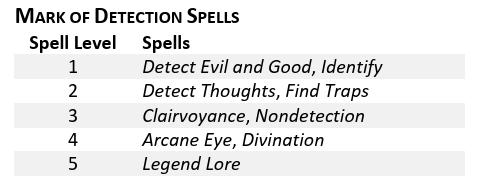
Beyond an intuitive knack for Investigation and Insight, anyone who carries the Mark of Detection can cast Detect Magic and Detect Poison and Disease. Because they always have these spells prepared, they can cast them as rituals. But producing a spell-like effect through a dragonmark isn’t the same process as casting a spell. When performing the ritual to cast Detect Magic, a Medani heir doesn’t invoke words of power. Instead, most use one finger to trace the design of the Mark of Detection on a palm while murmuring observations about the room they’re in—temperature, sound, contents, meditating on each detail until their senses reach beyond the physical and they can feel the flow of supernatural energies around them. If you have the Mark of Detection, that’s just something you can do. Spend enough time contemplating your surroundings and you can sense supernatural energy. Other Spells of the Mark go beyond any sight or sense; they are about intuitive knowledge. An heir with the Lesser Mark can Identify magical objects. This is another spell that can be cast as a ritual, meaning that it’s something an heir with the Potent Dragonmark feat can simply do, provided they have time. If they take ten minutes to study an object, they know its magical properties. With the Lesser Mark they can study an individual and know what they are thinking. With the Lesser Dragonmark (meaning access to 4th level spells) they can simply ask a question and know the answer, by casting Divination.
All of these gifts flow from the same source. While a Medani heir has to go through the same steps a spellcaster does to produce these effects—speaking and gesturing in some way—Medani’s Divination doesn’t feel like a priest calling upon divine guidance. Instead, to the Medani it feels like DEDUCTION. When they cast Identify, they take time to study the object—its weight, its composition, signs of wear, traces of arcane energy—and within ten minutes it becomes obvious what it does. When a Medani casts Detect Thoughts, they aren’t using telepathy as a Kalashtar would; they are simply observing, but through observation they deduce what the target is thinking. The verbal components of a Medani’s Detect Thoughts are questions; the Medani asks a few pointed questions, and draws conclusions from the most minute reactions. “Tell me, did you know Donal Gelder? Ahhh, you worked together, didn’t you? And you hated him.” Should the target succeed on their saving throw and resist the effect, the Medani can’t draw deeper conclusions about them. To be clear, this effect is magical. The Medani also has to provide somatic components—typically touching their dragonmark or tracing its pattern on a palm—and the mark does grow warm while they’re engaged in deduction. They can gain access to information that they couldn’t possibly deduce from available information. But to the Medani, and to observers, it feels like deduction—like they are leaping to certainty from minor details of a scene.
Divination and Deductive Reasoning. Medani heirs with the Lesser Dragonmark often have the ability to cast Divination, and this is the hallmark of Medani’s master inquisitives. While the Augurs of the Voice of Aureon call this gift Divination, Medani inquisitives refer to it as Deductive Reasoning; they aren’t calling on a higher power, they’re evaluating a question and drawing conclusions. With this in mind, what exactly can Medani learn from using this spell? When performing Deductive Reasoning, the Medani draws on two potential sources of information. The first is the scene itself. Is there any possible way the Medani could deduce the answer from their surroundings, at least in part? Otherwise, the question is does any other Dragonmarked Medani know the answer to this question? So when a Medani inquisitive looks at a corpse, casts Deductive Reasoning (Divination) and says “Who killed this man?” the first question is if there’s a living Medani who actually knows the answer. If so, the inquisitive could just get that concrete answer; Alina Lorridan Lyrris poisoned him at dinner two hours ago. Assuming that’s not the case, think of all the greatest detectives you’ve seen in any form of media and the conclusions they might draw. A strand of silver hair… a stray thread from a glamerweave gown… the placement and size of the chair… It was a wealthy female gnome. He knew her, and they were conversing when he died. See the faint scratches on the surface of the table? She was wearing rings, at least one on each finger. The point being that it’s not a randomly cryptic riddle—but it can still be a set of clues that point the inquisitive in the right direction rather than providing a concrete answer. Likewise, if the marked Medani asks a entirely abstract or philosophical question—What is the true nature of the Sovereigns—they'll either receive no answer, or an answer that summarizes the dominant opinions of the Medani gestalt, with the clear note that it's not a certainty.
Legend Lore and Background Checks. Under the rules of 5th Edition, the Greater Dragonmark of Detection grants the ability to cast Legend Lore. But Legend Lore is an odd spell.
Name or describe a person, place, or object. The spell brings to your mind a brief summary of the significant lore about the thing you named. The lore might consist of current tales, forgotten stories, or even secret lore that has never been widely known. If the thing you named isn't of legendary importance, you gain no information. The more information you already have about the thing, the more precise and detailed the information you receive is.
The limitation that “If the thing you named isn’t of legendary importance” bothers me. Critically, who makes that determination? It also seems like an arbitrary limitation on a spell that is supposed to be the greatest power of the Dragonmark. With this in mind, in MY campaign, the Greater Dragonmark doesn’t allow you to cast Legend Lore; instead, it allows you to run a Background Check. Name or describe a person, place, or thing. The spell brings to mind a brief summary of lore about the thing you named based on what is known about them by living bearers of the Mark of Detection. Think of a gestalt consisting of both the conscious and subconscious memory of living Medani. Has any Medani ever seen the person you’re asking about? Do you already have information that could be combined with another Medani’s observations to draw a new conclusion? So like Legend Lore, the more information you already have, the more information you will receive; and likewise, if the individual or object is well known in the Five Nations, then Medani will know more. And again, this is the function of the Private Eyes—to gather as much random information as possible, which may mean nothing to the observer in the moment, but which can be added to the gestalt for Background Checks. So if you ask about someone who is truly unremarkable or about an obscure relic from tens of thousands of years ago, you might not get any information (although here again, the Voice of Aureon includes sages who study history, and their knowledge is part of the gestalt). But if you ask about a criminal, you might draw on the information of a Medani inquisitive who solved a previous crime they were involved in… and you might know that they were seen in Sharn a week ago. As always, it’s entirely up to the DM to decide what information is provided, and the bearer of the Mark can’t ask for clarification; they get the information they get. But even if we imagine a random commoner—let’s say Jurian Cooper—who’s definitely not LEGENDARY, a Medani Background Check might say Jurian Cooper is a male human in his thirties who’s been living in the Callestan district of Sharn for at least a decade. He has been seen in the company of Ilsa Boromar on multiple occasions. Last week he was seen in the Broken Mirror in Callestan, drinking Old Bender and eating a tribex pie. This also touches on the difference between the Mark of Finding and the Mark of Detection. A Background Check can’t tell you exactly where to find Jurian Cooper. But it may point you to known associates, recent haunts, or provide useful details you’re not going to get from Locate Creature.
Nondetection. Everyone knows that the Mark of Detection lets its bearer uncover secrets. Fewer people know that it can help bury them, as well. The Wolves of the Warning Guild specialize in counterintelligence and in making problems go away. In doing so, they often employ the Lesser Mark’s gift of Nondetection—whether to conceal themselves, a client, or an inconvenient object (or body) until a case can be closed or a problem solved. This ability is especially prized by the hunters of the Basilisk’s Gaze, whose quarry often protect themselves with divination. This comes to a minor house rule. The 2024 rules have reduced the number of effects that say a creature cannot be surprised; notably, the Weapon of Warning no longer provides this benefit. But I personally say that if any magical source provides immunity to surprise (as opposed to a skill or mundane class feature) that the benefit will not help against someone who is shielded by Nondetection. Likewise, in my campaign Nondetection protects from magical effects that are clearly forms of divination even if they are not identified as being divination spells—notably, a Wand of Enemy Detection.
Clairvoyance and Arcane Eye. These abilities are a form of extrasensory perception and have more in common with Detect Magic than Identify or Legend Lore. The heir concentrates on their Dragonmark and meditates on the location they wish to see, envisioning it in their mind... and soon finds that the vision in their mind is real and accurate. Sensors created by these spells appear as globes formed from stands of blue energy to those who can see them; sometimes the Mark of Detection appears within the globe, mimicking the iris of an eye.
Detect Good and Evil? Good and Evil may feel like abstract concepts for an inquisitive to monitor. But keep in mind that Detect Good and Evil doesn’t actually detect alignment or morality. The spell effect is “For the duration, you sense the location of any Aberration, Celestial, Elemental, Fey, Fiend, or Undead within 30 feet of yourself. You also sense whether the Hallow spell is active there and, if so, where.” For the sensitive Medani, this isn’t much different from using Detect Magic to sense the flow of arcane energy. The Medani heir concentrates, extends their perceptions, and essentially finds what doesn’t belong, drawing on the Medani gestalt to further clarify the specific nature of the entity.
Dragonmarked NPCs
In a previous article, I discussed how I generally handle NPCs with dragonmarks. Here’s the key piece.
Potent Dragonmark is a feat designed for player characters. It’s flexible—allowing a character to access any spell on the Spells of the Mark list—and recharges after a short rest. But it sets the precedent that there are people in the world who have no spellcasting ability but who can still produce spell-like effects with Dragonmarks. With that in mind, I’d generally give dragonmarked NPCs a form of this, mirroring the original ECS marks. An NPC with a Least Dragonmark would be able to cast a 1st or 2nd level spell from their Dragonmark’s Spell of the Mark list, once per day. An NPC with the Lesser Mark would get a single use of a 3rd or 4th level spell, in addition to the Least Mark. And an NPC with a Greater Dragonmark would gain a single use of a 5th level Spell. Exceptional scions might have a choice of more than one spell at each level, just like a player character with Potent Dragonmark.
Now, as noted above, if a Spell of the Mark is a Ritual spell, then the bearer can cast it repeatedly as long as they have time to do so. But the key point I want to call out is that player characters get access to ALL the Spells of the Mark. Exceptional NPCs may as well. But most marked NPCs will have access to a subset of the Spells of the Mark, and this will often reflect their placement in the house. Members of the Basilisk’s Gaze are generally chosen because they have the ability to cast Nondetection and Detect Thoughts. Members of Aureon’s Voice are sure to have Divination and Identify. The point being that ALL Medani heirs have the ability to Detect Magic and Detect Poison & Disease, but even though it’s a power of the Least Mark of Detection, not every Medani heir can cast Identify.
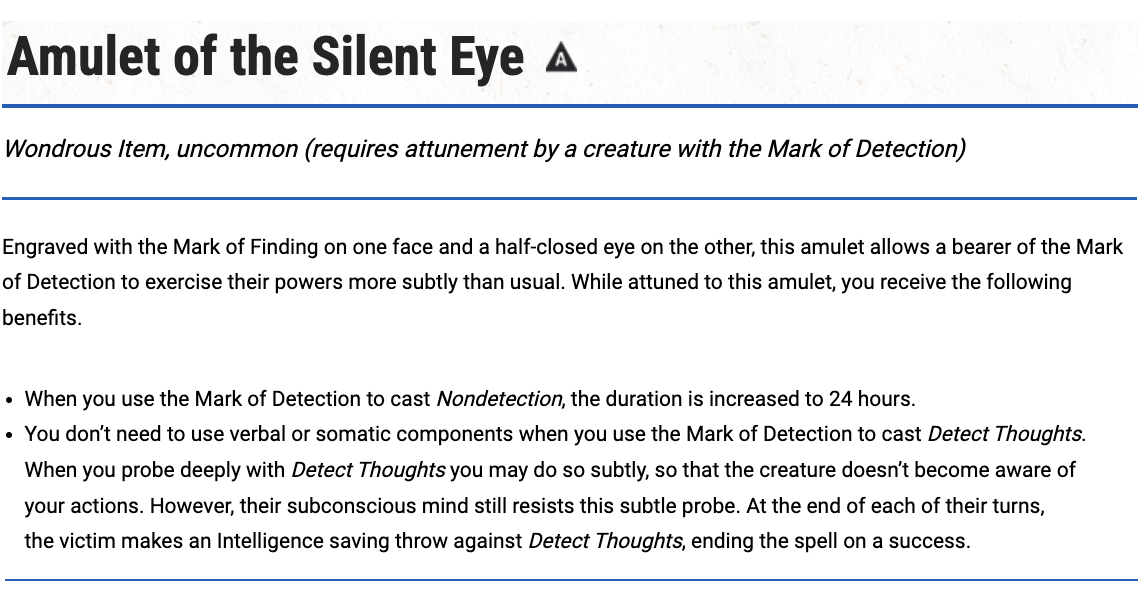
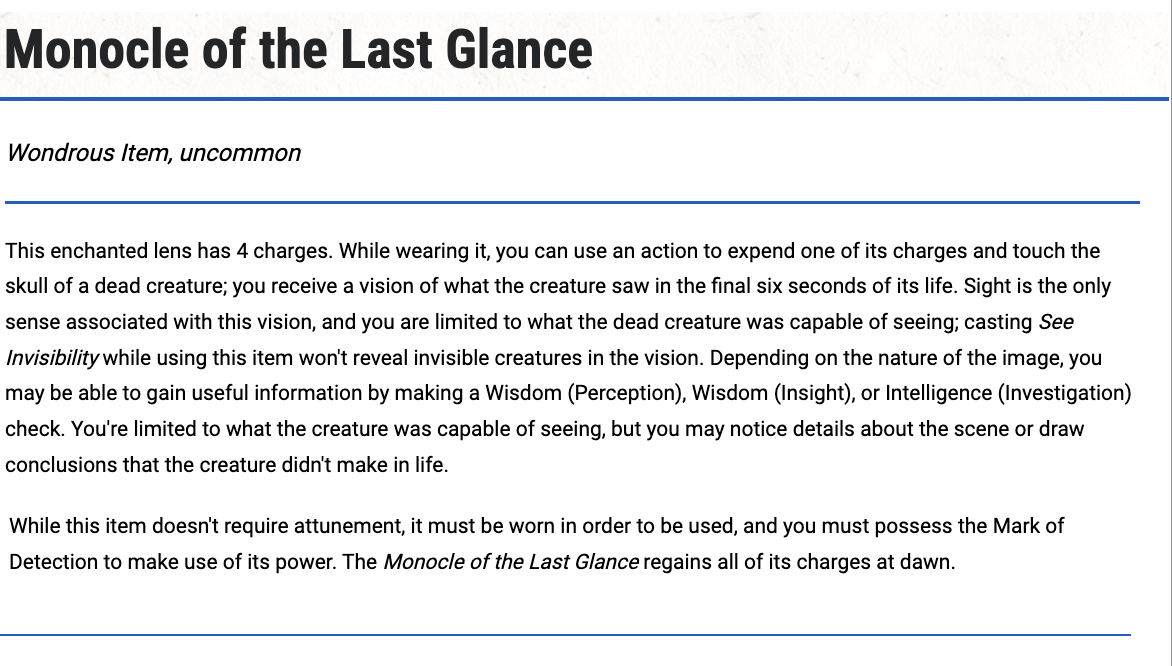
Focus Items. Medani heirs regularly employ the focus items described in Exploring Eberron—Dragonmark Channels and Reservoirs. Exploring Eberron notes the Medi Spectacles and Medi Dowser, dragonmark bound versions of Eyes of Minute Seeing and the Wand of Secrets. Here's two more Medani focus items—one that's useful for undercover operatives, another that helps the Inquisitive investigating a murder.
THE HISTORY OF HOUSE MEDANI
The Khoravar of pre-Galifar Wroat largely lived in poverty and squalor. Barred from most guilds and universities, they lived in the shadows of the Throne City, surviving through work both honest and otherwise. Though they came from different paths and bloodlines, most Khoravar of the Throne City treated one another as members of an extended family. Whenever a new Khoravar came to a neighborhood in the Throne, people would offer what food and shelter they could. And every week, the Khoravar of each district would come together to share stories, news, and food. Today, this is a well-known tradition; these gatherings are called Unity dinners. But in that grim time, the meetings were a secret thing. They were only mentioned using a word coined for the Khoravar cant, a blending of Elven words for gathering and family: Medani.
What made this a grim time? Today, some scholars say that Rak Tulkhesh or Eldrantulku must have been on the rise, or that Shavarath was exceptionally coterminous… that surely a supernatural force fueled the paranoia and cruelty. Whether this evil was unnatural or merely mortal, it was a time when the king was weak and the Dragonmarked Houses were growing in strength. Aberrant Dragonmarks were appearing more frequently than ever, often carrying dangerous power. The Houses stirred up the fears of the common people. While their propaganda targeted those who carried aberrant dragonmarks, it was an age in which anyone who might be seen as the other was in danger. Used to being outsiders, the Khoravar of Wroat were largely sympathetic to the Aberrants. Despite the danger, the Medani sought to shelter and aid both Khoravar Aberrants and others unknown to them. And it was over the course of this century—a time in which fear and tension grew with each day—that the Mark of Detection appeared. It wasn’t tied to a single notable bloodline; instead, it was scattered across the Khoravar of the Medani. While some first thought these were Aberrant marks, it quickly became clear that this was a new true Dragonmark. In Medani meetings across Wroat, Khoravar debated the meaning of this mark and the proper path forward… and in due course, chose to conceal it, staying in the shadows and slums and using this gift to protect their people from the trouble ahead. And soon enough, the whispering campaign erupted into open violence: the War of the Mark had begun. And as the Medani Khoravar were assisting Aberrants, it was simply a matter of time before they clashed with Cannith and Deneith forces—and it was in these clashes that the Houses learned of the Mark of Detection.
Many assume the Medani were forced to become a Dragonmarked House, that Deneith threatened the Khoravar with destruction. The Medani tell a different story. They say their ancestors stepped out of the shadows and demanded to be recognized as equals, so that they could challenge the cruelty of the War of the Mark loudly and in the light. Sadly, this came too late; Dorasharn fell even as Baron Trela d’Medani addressed her new peers for the first time. But House Medani would not let the matter rest. They investigated the events of the war, laying evidence of countless atrocities before the Barons. There had always been those within the Houses that questioned the War of the Mark, and the evidence gathered by Medani gave them unity and purpose. War criminals were forced to account for their actions. Leadership shifted, riding a desire to build instead of destroy. Hadran d’Cannith was one of the new leaders inspired by the Medani, and it was this spirit that drove him to create a new alliance based on research instead of war—and this was the beginning of the Twelve.
House Medani has been a part of the Twelve since its foundation. It’s always been a voice for moderation and unity, urging against programs that would put profit ahead of the greater good. In part, this is because Medani itself has always been an outlier among the houses. Its services are personal and direct—invaluable to Medani clients, but operating on a far smaller scale than the Speaking Stone network, Jorasco healing houses, the Lightning Rail, Gold Dragon Inns or Cannith industry. Medani overlaps with the Shadow Houses, but the primary public-facing business of those houses is entertainment. When it comes to the business of inquisitives, there’s overlap with House Tharashk, but there again, House Tharashk now makes most of its gold through prospecting. For all of these reasons, Medani has always been one of the smallest and poorest of the Houses (although poor in the eyes of a Dragonmarked House is still quite well off compared to the rest of the world). Medani is also noteworthy in never having made any effort to crush competition, as some of the other houses have; notably, it didn’t oppose the rise of House Tharashk in the early days when they were directly competing. Medani has always relied on the quality of its services and its reputation—on the fact that Medani inquisitives and the Augurs of Aureon’s Voice are the best at what they do. Medani is still a business and the Warning Guild works to turn a profit, but it has never been as ruthless as its peers.
House Medani has earned and maintained the trust of every nation. It maintained the broad neutrality of the Houses during the war; Medani Wardens and Watchens protected leaders and exposed spies and assassins from all sides. In the Treaty of Thronehold, every nation supported appointing the Basilisk’s Gaze to bring war criminals to justice. This is in spite of the fact that House Medani has always had a special relationship with Breland. Ever since the War of the Mark, whenever war has threatened the people of the region, Medani augurs have offered advice to military and civilian leaders on all sides of the conflict—not to sway the final outcome of the war, but to minimize the harm done to infrastructure and Brelish civilians. Throughout the age of Galifar, the Medani Baron traditionally offered advice to the governor of Breland. No one was surprised that this tradition continued during the Last War. The point is that Medani managed to maintain its relationship with the other nations; people were confident that Medani would fulfil its contracts, that a spycatcher employed by Aundair wouldn’t let a Dark Lantern slip by. For many, this was a further reason to employ Medani during the war; it was a form of protection, since they wouldn’t reveal secrets they were being paid to protect, but other intelligence was fair game. The Basilisk’s Gaze is the key to recognizing the status of Medani; even at the end of the war, the assembled nations believed Medani would serve as an impartial force and bring criminals of all nations to justice.
While Medani has always offered advice to Brelish leaders, Baron Trelib d’Medani has an especially close relationship with King Boranel ir’Wynarn. The two first met as students at the Library of Korranberg. Trelib later helped Boranel explore the ancient ruins of Dorasharn, and the two planned and executed a number of exciting treasure hunting expeditions in Xen’drik. Trelib was equally close to Queen Chaseva, Boranel’s first wife. Some suggest that the three were more than just friends; those who tell such tales often observe that Syra ir’Wynarn has remarkably sharp ears for a human. Whatever the truth of these tales, Trelib mourned Chaseva’s death and his greatest regret is his failure to bring her murderer to justice.
Today, House Medani continues as it has for the last century. Baron Trelib may be close friends with King Boranel, but commoners and nobles of every nation employ the services of the Warning Guild. Medani is the smallest and poorest of the Houses, but the leaders of the Twelve value the insight of the Voice of Aureon.
What Happens Next? On the surface, House Medani seems to be one of the least ambitious Houses. Medani doesn’t seek to enforce a monopoly. It continues to offer the same services it has for hundreds of years; its tools are its people. But there are a few threads you could pull on if you want Medani to be a source of drama in your campaign.
- Staring Into The Abyss. The Thousand Yard Stare watches the edge of the Mournland, but Channara d’Medani yearns to probe deeper beyond the mists. This can be an opportunity for adventurers, as Channara will often hire independent (read: expendable) operatives to investigate specific regions of the Mournland. However, another way to use the Stare is to suggest that they have sent their own forces into the Mournland… and recovered something better left alone. It could be a new form of lycanthropy, infectious ghouls, a psychic contagion, or something even stranger. Perhaps the Mournland is a crossroads with the Eberrons of other realities destroyed by the daelkyr. A Medani patrol from our reality entered… but the Medani who returned were from a different Eberron, and they have a terrifying plan.
- The Doomsayer. At 24 years of age, Dalia d’Medani is one of the youngest scions of the House to develop the gifts of a Medani Prophet. Her gifts are the strongest the house has ever seen—but she’s not content to follow the traditions of the Voice of Aureon, guiding the House or advising wealthy clients. Her visions are powerful and dangerous. She describes horrible fates that invariably come to pass. She presents visions of virtuous people engaging in corrupt acts, of violence breaking out in peaceful towns, of attacks by aberrations or fiends, and everything she describes comes to pass. Are her visions truly gifts from Aureon? Or is she in fact a witting or unwitting vessel for the Shadow—not predicting the future, but actively guiding it down the dark paths she describes? Can Dalia show adventurers the path to stop a great evil, or is she herself the evil that must be stopped?
- The Evil Within. If the theory of the Medani Gestalt is true, heirs of the Mark of Detection are connected through their Dragonmarks, linked to a well of memories. What happens when Dyrrn the Corruptor poisons this well? Some Medani heirs are overwhelmed by alien concepts when they use their Dragonmarked gifts; when using See Invisibility they see into other realities, and when drawing on Divination they learn horrible secrets unrelated to their queries. Eventually, the heirs who receive these visions evolve into aberrations—gaining the mechanical abilities of Mind Flayers while still maintaining their Khoravar form (Extract Brain is accomplished by laying a palm on the victim’s forehead; the victim’s consciousness is extracted, while the actual brain is left intact). When an adventuring Medani or a Medani ally of the party begins having these visions, they must find a way to exorcise Dyrrn’s influence from the Medani Gestalt.
- Puppet Masters. House Medani has maintained its neutrality for hundreds of years… or so it seems. Adventurers could discover that the Voice of Aureon has always been a conspiracy within the House, using their gifts to maintain a vast web of blackmail with threads on the leaders of the other houses, nations, guilds, and more. Is this purely a mortal agency, or are the leaders serving an Overlord (Sul Khatesh or Tul Oreshka?) or are they agents of the Dreaming Dark? And what secrets do they know about the adventurers and their allies? This isn’t a path I would personally follow with House Medani, but it’s always an option as a shocking revelation.
THE STRUCTURE OF THE HOUSE
In keeping with its role as a house of counterspies, Medani keeps a low profile even in its ancestral home in Wroat. The Medani enclave is a connected network of unmarked buildings within sight of both Brokenblade Castle and Parliament Hall. It is not marked on any map, and those not already aware of its existence would be hard-pressed to pick its well-guarded doors out from among the private apartments and shops that surround it.
The Tower of Inquisition... is the only part of the enclave known by name among the other dragonmarked houses. A nondescript stone building overlooking the river, it is said to be as well guarded as Brokenblade Castle itself.
-from the 3.5 Dragonmarked sourcebook
House Medani doesn’t maintain factories, fleets of ships, or brigades of mercenaries. Its work is subtle, and relies on customers with need for their services and coin to pay for it. Wroat is the ancestral home of the house and the seat of Baron Trelib, but it has its major enclaves in Fairhaven, Flamekeep, Korth, Sharn, and Trolanport. As described above, Medani doesn’t contain its heirs in fortified citadels. Instead, Medani enclaves are connected networks of unmarked buildings. Every Medani stronghold has a central, public location like the Tower of Inquisition in Wroat, home to the Lord Seneschal of the nation. These are the location of the Guild facilities that are accessible to the public. But other Medani facilities—meeting halls, training facilities for scions, libraries, armories, storerooms, and more—are unassuming and unmarked. The existence of these facilities isn’t a vital secret; a party of adventurers won’t be hunted down because they’ve learned the location of the local Medani library. But they aren’t advertised and outsiders aren’t invited in without good reason. However, where some Houses isolate their heirs, Medani scions generally interspersed with the local community. Many live in the same district, usually a district that already has a significant Khoravar population. But they eat, drink, and worship with the people of their community. Medani heirs undergo private training and tutoring in the hidden halls, but they also participate in public education and take apprenticeships with local businesses. In part, this is pragmatic. Most Medani believe in the idea of the spirit of the House, the gestalt that draws on the memories of all marked Medani; the more information and connections the house has, however meaningless they may seem in the moment, the more its inquisitives have to draw upon. Beyond that, the Medani have always preferred inclusion to isolation. Empathy and connections are important tools both for solving mysteries and identifying threats. This is a sharp contrast to House Lyrandar. The Medani are proud of their Khoravar heritage and traditions; in cities with Medani enclaves, the House hosts weekly unity dinners where all Khoravar are welcome. But they celebrate the fact that the Khoravar emerged from the blending of species and cultures. While the House doesn’t actively recruit outsiders, humans, elves, and members of other species are welcomed when they are drawn to Medani by love or talent.
The Warning Guild
When people think of House Medani, they often think of a lone Inquisitive sitting at a desk waiting for trouble to walk through their door. But Inquisitive can cover a variety of roles. The Warning Guild licenses and brokers the services of a number of distinct specialists. These are the common terms used within the Guild itself.
- Watchers are the classic Inquisitives people read about in serials. Do you think your spouse is having an affair? Do you think your uncle faked his death? Are you certain the Sharn Watch won’t find your sister’s killer on their own? Then you’re looking for a Watcher of the Warning Guild. Watchers specialize in acquiring information and solving mysteries. Nondetection, Clairvoyance, Detect Thoughts, and Arcane Eye are all useful tools for the careful observer. But Deduction (AKA Divination) is their greatest gift. Usually it won’t solve a mystery on its own, but it will always provide leads for the Watcher to work with.
- Wardens defend their clients from harm. The Medani Warden is more Rogue than Fighter. Their job isn’t to stand next to you with a shield; it’s to never even be seen. Ideally they eliminate threats without the client even knowing there was a threat; this could be because they identify an enemy and remove them quietly, or it could be that they avoid the threat by changing the client’s route, providing information to the Watch, or otherwise defanging an enemy. Nobles and other wealthy clients may keep a Medani Warden on retainer to direct their personal security forces. Over the last century, Medani Wardens have been in high demand as spycatchers, and the Warning Guild has teams that specialize in these operations. There’s nothing secret about the existence of the Wardens, but common people have less use for a Warden than they do for a Watcher, and if a Warden does their job well the public never knows about it.
- Wolves are problem solvers. You call in a Watcher to get answers, and you hire a Warden to prevent disasters; you hire a Medani Wolf to clean up the mess after a disaster has happened. Insight, Investigation, and the divinatory powers of the Mark of Detection help a Wolf understand the parameters of a problem and identify the people involved. A good Wolf knows how to clean up a scene, how to make evidence disappear, how to negotiate with problematic individuals—when it’s best to employ bribery, blackmail, or simple intimidation. While this work can skirt the law, it’s not limited to concealing evidence of crimes. Wolves are risk managers; they may help clients with the fallout of social blunders, political missteps, unfortunate media coverage, or say, dealing with the problem when a group of adventurers break into a Concordian’s estate and steal a treasure they don’t want to publicly admit to having owned. Keep in mind a Wolf’s ability to use their Mark to Detect Thoughts, to hide their charge with Nondetection, to find details with Deduction (Divination) or Background Check (Legend Lore).
There are only a handful of offices of the Warding Guild in Khorvaire. The Guild has a presence in each of the major enclaves, which are discussed later in this article. Guild offices can also be found in Varna, Newthrone, Krona Peak, Regalport, Taer Valaestas, Rukhaan Draal, and Stormreach. Baron Trelib is keen to have a footing in the new nations, and there’s currently negotiations to establish a Guild outpost in either Graywall or the Great Crag. So far, House Tharashk has blocked these efforts. While Medani isn’t especially aggressive in its competition with Tharashk, the House of Finding values its influence in Droaam and has kept its rivals at bay. However, most people don’t interact with the Warning Guild through a dedicated office. While there are heirs who serve the Guild directly (including the three organizations mentioned below), many heirs run their own agencies; they are licensed and supported by the Guild, but operate independently. This is where that image of the Inquisitive with her feet up on her desk becomes reality. The number of inquisitives in an agency, and the number of agencies in a community, both depend entirely on the size of the community and its ability to support inquisitives. A typical agency will have one to four operatives, with a few assistants or apprentices. An agency may focus on a single speciality—a pair of Watchers solving mysteries—or it could have a diverse set of skills, with a Warden, a Watcher, and a Truthteller all working together. Sometimes such partnerships are purely professional, but it’s not uncommon to find a town with a Medani family agency that’s been serving the community for generations. If a client has need of a particular set of Medani specialists that can’t be found in the local community—someone wants to hire a full-time security chief, or a squad of Wardens—they can send the request to the closest Warning Guild office. The administrator there will either dispatch Guild staff specialists, or broker the services of a qualified licensed agency.
While Inquisitive services are the bread and butter of House Medani, there are a few additional organizations connected to the Warning Guild.
The Voice of Aureon. Most Medani believe that the gifts of their Dragonmark flow from their shared memories. But there have always been Vassals among the Medani who believe that the House as a whole is blessed by Aureon—and that some heirs are gifted with visions from the Sovereigns. Those who feel this calling are drawn to join the Voice of Aureon, which is both a religious order and a business within the Warning Guild. Initiates of the Voice of Aureon possess the Mark of Detection, but they also gain greater power of divination. The common acolytes follow the path of the Augur or the Truthteller; these use the Oracle and Mediator Magewright stat blocks provided in Rising From The Last War, with the addition of the Mark of Detection. Medani Truthtellers use Zone of Truth and Detect Thoughts to assist in legal proceedings, diplomatic negotiations, or business deals. Augurs can perform a ritual form of Augury that reaches further into the future; it still only provides the basic options of Weal or Woe, but it can predict the broad outcome of actions further into the future. Beyond this, Augurs can perform standard Divination; while answers are still cryptic, they aren’t limited to the knowledge of the Medani gestalt. Medani Augurs aren’t the only professional oracles, but the seal of the Warning Guild gives clients assurance that the practitioner is a true oracle, rather than a charming charlatan. Augurs and Truthtellers broker their services through the Warning Guild, but there are a few members of the Voice of Aureon who work directly for the House itself. These are the Medani Prophets—described in more detail in the 3.5 Dragonmarked sourcebook. Beyond their concrete spellcasting abilities, Medani Prophets receive visions of the past and of possible futures. Currently, there are six Prophets in the order. Most remain in the shrine of Aureon hidden in the Wroat enclave, serving as advisors to Baron Trelib. Recently the Prophet Taldor was appointed to lead the Basilisk’s Gaze. On extremely rare occasions, a Prophet will be assigned to a client — serving as an Augur or Warden in addition to their gift of Prophecy — but this would only happen if Trelib believes it to be absolutely necessary.
Most of the Medani are casual Vassals; they may not be as devout as the Voice of Aureon, but there’s no tension between the Voice and the House as a whole. The beliefs of the Voice don’t defy the idea of the spirit of the house. The priests of the Voice believe the Mark of Detection—including the Medani gestalt—is a blessing of Aureon. Some initiates of the Voice can be a little arrogant, believing themselves to be especially blessed, but it’s not a driving source of tension within the House.
Seneschal Ruran d’Medani is the leader of the order and a Prophet himself—though his visions aren’t as frequent as powerful as those of his five peers. He maintains Aureon’s Shrine in Wroat, and it's generally Ruran who discusses the affairs of the house with Baron Trelib.
The Basilisk’s Gaze. Ever since the War of the Mark, there have been Medani heirs who have sought to expose and persecute atrocities carried out in times of war. Early during the Last War, the leaders of the Five Nations met to establish the terms of the conflict; at that time, a small group of Medani observers were empowered to monitor the conflict and investigate war crimes. Officially, this is the Thronehold Warfare Observer Corps, or “Two-C”. However, it quickly became known as the Basilisk’s Gaze. During the War, the Gaze reported on war crimes, but took no action to persecute them. When the Treaty of Thronehold was signed, provisions included empowering the Basilisk’s Gaze to pursue war criminals in all of the signatory nations, whenever possible apprehending these fugitives and transporting them to Thronehold to face justice. The Gaze is a small, elite force of operatives that draw on the resources and safehouses of House Medani, but don’t answer to the Viceroys and Baron. It has a few dozen members drawn from the best of the Warning Guild including specialists from each of its disciplines. Because an entire team of Medani may draw attention, it’s common for field agents to assemble teams of talented operatives to assist in their operations; these hirelings may or may not know exactly who they’re working for. With this in mind, the Basilisk’s Gaze can be a concrete foundation for a party of adventurers. At least one character should be a Medani heir who serves as the mastermind and connection to the House; the other adventurers can be the team they’ve assembled. Can they unmask and bring down dangerous war criminals—including those now serving with the Emerald Claw or Blades of Liberty? For an entirely different twist, an adventurer with the Soldier background could have been implicated in a war crime and be on the Basilisk’s list. Are they in fact guilty of the crime they’re accused of? If not, how were they framed? The evidence would have to be reasonably strong and the crime significant to be targeted by the Basilisk’s Gaze: how can the character prove their innocence?
The Basilisk’s Gaze is led by Taldor d’Medani, a Medani Prophet who believes that Aureon wishes to see justice done. Taldor is icy and serious; he claims to have “left extraneous thought and counterproductive emotion behind.”
The Thousand Yard Stare. Officially the Western Mournland Working Group, the Thousand Yard Stare is a Medani operation funded by the governments of Thrane and Breland. The Thousand Yard Stare patrols the edge of the Mournland, providing early warning of monsters or strange magical phenomena that could threaten nearby settlements. Stare operatives are capable soldiers, typically in the model of Rangers; they will engage and attempt to neutralize minor threats. However, their ultimate mandate is to warn, and if a threat is too powerful to be eliminated their duty is to gather as much information as possible and to provide that data to the closest fortress of the nation. Members of the Stare are capable foragers who typically live off the land while on long patrols, but they have become well-known by the people in the border villages they protect and are usually welcomed. The organization is based in the fortress of Arythawn Keep on the edge of the Thornwood. This stronghold was heavily damaged during the Last War, and Thrane has granted the fortress to the Medani as long as they carry out their duties and continue to repair it.
The Thousand Yard Stare is led by Channara d’Medani. As noted earlier in this article, Channara yearns to delve deeper into the Mournland and to unravel more of its mysteries. The Stare is stretched thin, and she can’t commit her own forces to such a dangerous and foolish endeavor—but she might be willing to pay adventurers to investigate reports!
MEDANI CUSTOMS
In popular stories, Medani characters are usually depicted as being exceptionally curious—inquisitive, you might say. A Medani is always yearning to try new things, to taste new foods and see what’s behind every door. While this is a stereotype, there is some truth to it. From childhood, Medani are encouraged to investigate and explore, because every new experience adds to the collective memory. You never know when the scent of a new type of Tal could be a vital clue in a murder investigation, so it can’t hurt to smell every cup. For some Medani this curiosity goes hand in hand with an outgoing personality; such people are happy to talk to strangers and always eager to make new friends. However, there’s just as many Medani who are quiet observers, preferring to watch from the edge of the room instead of being the life of the party. This doesn’t necessarily reflect an antisocial nature. Instead, it’s that there’s so much to see. Think of a dog with their head out a car window, flooded with scents and the stories attached to each one. For a Medani, watching a room full of people is like a delicious banquet; each person tells a silent story with their clothing, their body language, their movements, their interactions and it is delightful to drink it all in. This isn’t limited to people; a Medani can get lost in any complex environment, cataloguing details and noticing things that are out of place. Every room and every person is a story, and the quiet Medani enjoys each one.
Word Games. From childhood on, Medani heirs are pushed to develop their skills of insight and deductive reasoning. They play a variety of games that hone these skills, and adult Medani may play such a game for fun. A few examples…
- Secrets. Each participant is given a secret. The participants converse until one of them believes they have deduced all of the others’ secrets, calling the end of the game.
- Questions. A faster game, this teaches participants to draw out information while revealing nothing. Players must engage in a natural conversation, compelling the other participants to continue to talk… but they lose points any time they make a concrete statement instead of parrying a question with a question, or if they break the flow of the conversation.
- Stories. The participants observe one or more individuals and deduce their stories. This could involve eavesdropping—listening to a conversation and piecing details together from what is overheard—or the players could be challenged with a silent individual or even an object. What can they deduce through observation?
Once heirs manifest the Mark of Detection, games adapt to hone these skills. Scions constantly practice with detect magic and identify, and the game of Secrets shifts to incorporate Detect Thoughts. For many Medani, this becomes a habit throughout life; every conversation is a game.
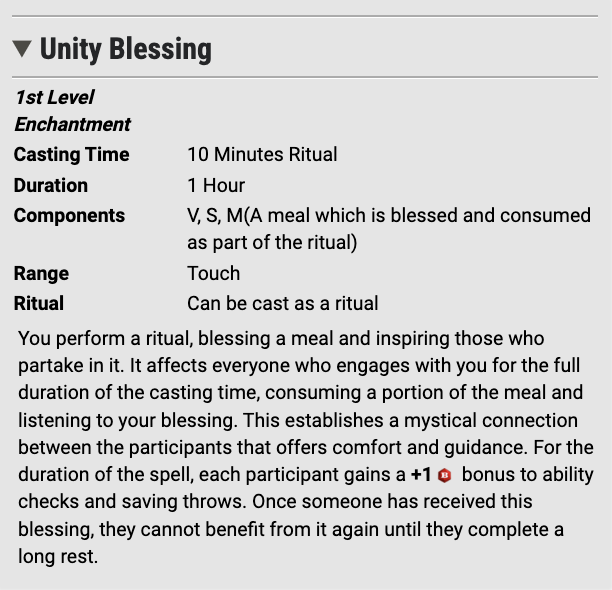
The Unity Meal. The exact nature of the Unity Meal varies from city to city and district to district. In some communities it’s always midweek, and always at one specific location—whether that’s the home of a particular Khoravar or a favorite tavern. In other communities, the honor of hosting passes with each meal, and the host chooses the day. But the principle remains the same. A Unity Meal is a feast to which all Khoravar are welcome, whether they are part of the community or just passing through. It is a time for people to share stories and news, to celebrate triumphs and mourn losses. While the time and location shifts, when passing through a Khoravar community a traveler can always simply ask Medani distal—”Where are we gathering?” This is a tradition that evolved among the Khoravar of Wroat and spread to Cyre, and Medani has carried the practice wherever it has gone; every major Medani enclave hosts Unity Meals for the surrounding community. While in the beginning the tradition was limited to Khoravar, it has long been accepted that a Khoravar can bring anyone who is important to them, whether family or found family—as long as the guests are willing to fully participate, sharing their stories and news.
While the Khoravar have been sharing meals for centuries, there’s been a recent development. In 983 YK, the Khoravar priest Jovial Denn called on the Sovereign Boldrei to bless his Unity Meal, urging the attendees to embrace their shared connection. Jovial’s blessing had a powerful effect, and he has shared the ritual with other Khoravar communities. While Jovi himself always blessed the wine, any sort of meal can channel this magic. However, there is a catch not mentioned in the spell description: to benefit from its effects, someone must embrace the spirit of the blessing—to truly wish to connect with their fellow diners. This is a relatively new ritual which to date is only known among a handful of Khoravar Vassals. In principle, any Vassal priest could learn and cast it, and there could be versions of this spell tied to other faiths. This version is specifically tied to House Medani.
Apprenticeships. Even while they learn techniques of deduction and investigation, young heirs are encouraged to pursue some form of apprenticeship or advanced education outside the house, to build connections and broaden their skill base. In developing a Medani heir, consider your skills and proficiencies and decide if one or more are related to this period of study. Who was your mentor at this time? Have you remained in touch with your teacher or any of the people you met there? Baron Trelib studied at the Library of Korranberg for their apprenticeship, and it was there that they met Boranel ir’Wynarn, beginning a lifelong friendship.
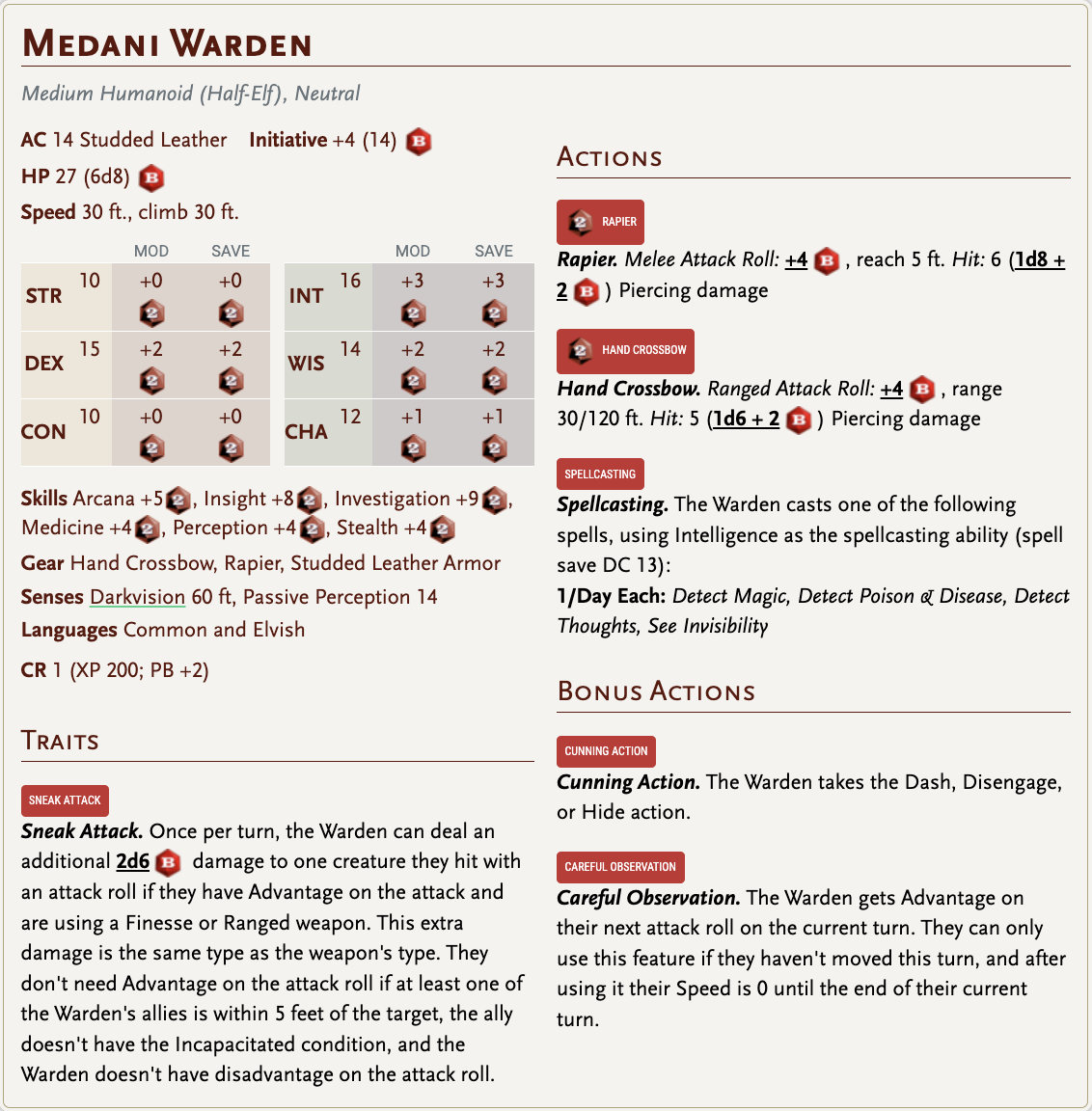
Martial Training. Most Medani know what speciality they hope to pursue from an early age. Watchers or Augurs don’t dwell on combat training, but would-be Wardens and Wolves need to be ready for trouble, and Medani enclaves have a weapon master in residence to train the scions. Medani combat techniques focus on finesse and precision, emphasizing Dexterity over Strength. While not every heir has the capabilities of a player character, the Medani combat style is that of the Rogue—light armor, finesse weapons, and a devastating precision blow. The Medani Warden stat block shared below is an example of a capable Warden with the Least Mark of Detection. The enclaves in Korth and Flamekeep provide more extensive combat training for scions, intended for those who wish to serve as scouts and in units such as the Thousand Yard Stare. This training follows the model of the Ranger, still focusing on Finesse weapons and precision.
MEDANI FAMILIES AND ENCLAVES
This section typically provides details on influential clans or families within a Dragonmarked House. However, when the Mark of Detection appeared among the Khoravar of Wroat, those who carried it joined together as a single united community. Heirs of the House Medani don’t use secondary surnames. Within an enclave, residents will often invoke the name of a parent—So when talking to fellow members of the Wroat enclave, Dalas d’Medani would identify herself as Dalas, Haela’s Daughter. While family doesn’t play a powerful role in shaping a Medani character, their enclave does. Medani has six major enclaves spread across Khorvaire. Heirs are typically born and raised within a single enclave, and the majority go on to train and work within that same enclave or the city that surrounds it. Especially given Medani’s custom of building ties with local communities, over centuries the enclaves have developed unique traditions and flavor—and even if the Medani celebrate their unity, most heirs feel a particular sense of loyalty to the enclave of their birth. When creating a Medani character, consider if you have ties to one of these major enclaves and how that has shaped your personality. The enclaves are generally referred to using the name of the Warning Guild office, and when heirs talk to one another, they’ll shorten the name to a single word; I’m Dalas, from the Tower.
Keep in mind that while these enclaves include offices of the Warning Guild, they are more than just centers for business. These are the population centers of Medani, where heirs are raised and trained. They are centered in Breland and Zilargo because this is where the House has its roots, and they spread to other major cities over time. The Warning Guild had an office in Metrol, but it didn't have an enclave there, because it didn't need one. And while most Medani are raised in enclaves, some are born into families running independent agencies in smaller towns; you can be Medani without having a tie to any of these six. For the record, these six locations are drawn from the 3.5 sourcebook Dragonmarked, but the Sharn: City of Towers sourcebook doesn't mention a Medani enclave; I reconcile this contradictory canon with the point that Medani enclaves have low visibility. Again, the buildings are unmarked and spread through a district, in contrast to the ostentatious citadels many Houses use as their enclaves.
Wroat: The Tower of Inquisition, “The Tower”
While he was born a century after House Medani became part of the Twelve, Alasar d’Medani is considered by many to be the true founder of the House. In his last days he wrote The Manual of Inquisition, still considered to be the definitive guide to the arts of investigation and deduction. It is this book that established the use of the term Inquisitive for a professional investigator. It is also the origin of the name of the greatest stronghold of House Medani—the Tower of Inquisition in Wroat. Some might hear Inquisition and think of torture or persecution, but that’s not the way of the Medani. The Tower of Inquisition is the oldest school for Inquisitives in Khorvaire, and has produced the finest Watchers in the Warning Guild. The Tower stands within sight of Brokenblade Castle, and has long provided advisors and augurs to the leaders of Breland. The rest of the Medani enclave is spread out in the neighborhoods around the Tower. Notable locations include the Old Galley—a dining hall that’s been used for Unity meals since before the War of the Mark—and the shrine of the Voice of Aureon. Augurs and Prophets sell their services in the Tower of Inquisition, but the shrine is a place of devotion and contemplation, with a library holding the writings of generations of Medani Prophets.
Wroat was the birthplace of House Medani, and the Wroat enclave is home to approximately 30% of the population of the House. Its scions take pride in the history and traditions of the House, and due to the presence of the Voice of Aureon, many in the enclave are devoted Vassals. The Wroatian Medani have an underlying belief that their Mark is an instrument of justice. They aren’t naive; they live in Breland and know corruption runs through many of its systems. But Wroatian Medani believe in the ideal of the law. They usually work along with local authorities, and in return are largely trusted by the Wroat Watch. The Basilisk’s Gaze is largely composed of Medani from Wroat, dedicated to bringing war criminals to justice.
As a Medani raised in Wroat, you are likely proud of the history of your house and have a favorable opinion of the forces of the law. If you studied your trade in Wroat, you most likely focused on investigation or divination. You don’t have to be a Vassal, but many Wroatian Medani are devoted Vassals who feel a particular connection to Aureon.
Fairhaven: Insight House, “Insight”
Insight House sits on the edge of the Distant Exchange, a bustling market that deals solely in goods from beyond Aundair. It’s a humble, cozy outpost for a Dragonmarked House; it offers access to all of the services of the Warning Guild, but has a smaller staff than the other major enclaves. As with all Medani enclaves, its true footprint extends much farther than the Guild offices. To outsiders, Insight House doesn’t seem to have a clear function. While there are mentors who train the resident heirs in the basic arts of inquisition and defense, there’s no grand academy like those found in Wroat or Korth. This is because the most important work of the enclave is conducted in the unmarked buildings spread around the ward. Insight House is a center for research into forensic magic—finding ways for Medani scions to extend their supernatural senses ever farther. It was the seers of Insight House who honed the techniques allowing gifted heirs to use the Mark of Detection to produce the effects of Clairvoyance and Arcane Eye, and they continue to develop techniques and focus items that enhance these spells.
Fairhaven was home to two distinct Khoravar subcultures before the Medani arrived there. The settled Khoravar had strong ties to House Lyrandar. But Fairhaven is also home to a population of half-elves who identify not as Khoravar, but as River Elves. The River Elves dismiss the notion that their ancestors were tied to Aerenal, instead claiming to be descended from the fey of the woods and the River Aundair. All Khoravar are welcome at the Unity meals of House Medani, and over the course of centuries River Elves have joined the House and heirs (those who fail to develop the Mark of Detection) have left it to pursue a life on the water. This blending has added an artistic, sometimes whimsical aspect to the Fairhaven Medani. While any of the Medani enclaves could produce a character with the mechanical abilities of a Bard, it’s Fairhaven where you’ll actually find those who love music as well as deduction. With that said, the River Elves hold fast to their traditions and have no interest in being swallowed whole by Lyandar or Medani. In addition, thirty years ago the inquisitive Hesta d’Medani exposed a grand confidence scheme being carried out by a River Elf known as the King of the Docks; ever since then, there has been some distance between the two communities.
As a Medani born in Fairhaven, you are likely more creative and artistic than your cousins. You may have a love of magic, beyond just its pure function; you love seeing the world in ways others can’t imagine. Try to find joy in your work, and savor the stories you uncover.
Flamekeep: The Witness
When Medani established themselves in the city then known as the Sovereign’s Seat, they bought an old inn called The Witness. The Warning Guild office has expanded and grown since then, and little of the original building remains, but the old inn sign still hangs above the door, next to the seal of the Warning Guild.
As with every enclave, the heirs of the house have built ties to the community, and young Medani can be found working in taverns, smithies, and schools. Given this, the faith of the Flame has a strong foothold among the heirs of the Witness. There’s no zealotry to this, and no pressure for every heir to embrace the faith. But some do serve a tour of duty as a templar or acolyte, and a few of the Church’s finest exorcists began as Medani heirs. The heirs of the Witness specialize in investigating and defending against supernatural threats, and are often called in on cases that involve haunting, possession, or curses. The Witness also has a strong program for producing Truthtellers. It is second only to Korth in the number of Wardens it trains. The Thousand Yard Stare is based in Arythawn Keep in Thrane, and most of the members of the Stare trained at the Witness.
As a Medani born in Flamekeep, you are attuned to supernatural threats. You may or may not follow the faith of the Silver Flame, but throughout your life you’ve been encouraged to be empathetic and to help those in need. You may feel an impulse to investigate possible threats that endanger innocents, even if you’re not being paid for the job.
Korth: The Old Shield, “The Shield”
In the wake of Galifar’s War of Unification, Korth underwent widespread reconstruction to repair the damage from Daskaran attacks. Medani laid claim to an abandoned garrison in what would eventually become the Commerce Ward, restoring it and improving its martial facilities. This is the Old Shield, the heart of the Medani enclave in Korth. The Shield is the largest facility for training Medani Wardens. Such training focuses on threat detection and risk management as well as martial skill; the best Wardens ensure that their charge is never at risk of physical harm. But if it comes to combat, a Warden needs to be able to end a battle quickly and decisively, and the mentors of the Old Shield train their charges to be swift and ruthless. Since the beginning of the Last War, the Shield has offered more extensive martial training for heirs who wish to serve as battlefield scouts; this follows the combat style of the Ranger.
Medani heirs serve apprenticeships throughout the community. In Korth, scions of the Shield often serve a term as Deneith mercenaries, working as scouts or skirmishers. While some assume that Deneith and Medani are rivals, their skill sets are complementary and heirs often work together to provide a full spectrum of security. A Deneith Blademark provides direct physical protection, interposing themselves between the client and a threat; the Medani Warden provides tactical advice and watches from the shadows. Many of Medani’s private security agencies across Khorvaire include Medani and Deneith heirs, often drawing on connections established during their youth in Korth.
As a Medani born in Korth, you are likely more pragmatic and ruthless than your cousins—and more prepared to see decisive violence as a potential solution to a problem. Korth Medani are often depicted as grim and stoic, and there’s some truth to that stereotype. You are always considering possible threats, always preparing for betrayal. Consider if you served with a mercenary unit during your apprenticeship; if so, what action did you see during the Last War?
Sharn: Omen Hall, “Omen”
The Medani of Sharn are the mirror image of their cousins in Wroat. Where Wroatian Medani are often devoted Vassals who believe in the blessing of Aureon and work with the forces of the law, the Medani of Sharn are mostly cynics who know it’s a coin toss whether a Watch officer is taking bribes from the Boromars. If the Wroatian Medani are largely lawful in their outlook, the Medani of Omen Hall are more chaotic—believing that it’s often necessary to bend the rules to get results. This attitude may be why Omen Hall produces the most effective Wolves of the Warning Guild. The job of a Medani Wolf isn’t to solve crimes, it’s to make problems go away. And the people of Sharn have many problems that need to be taken care of. Many Sharn-trained Medani are willing to work with any client, taking jobs a Wroatian might refuse; whether the client is a City Councilor or Saidan Boromar, all that matters is the color of their coin. However, there are still a few Medani idealists even in Sharn—Inquisitives who run their own agencies, working for the people who can’t get justice from the Watch. Much like the ruthless Wardens of the Shield, the pragmatism of Sharn Medani is a boon for the Warning Guild overall; while they might have been raised in the City of Towers, Sharn Wolves can be found working solving problems across Khorvaire.
While Wroat is the heart of House Medani, the Sharn inquisitive is the Medani most often depicted in fiction or popular entertainment: the hardboiled investigator willing to take on any case, often at odds with the ineffective or corrupt agents of the law. Many heirs of the house enjoy that image and are happy to play up the role. Omen Hall is located on Central Plaza at the edge of the Dragon Towers district. The enclave spills out into Dava Gate, but there are a few Medani residences and boltholes scattered around the city, providing anchor points for heirs to pursue apprenticeships on any level. The Stone Eye is a tavern in Vallia Towers in Lower Central, licensed by Ghallanda but run by old Caslin “Cask” d’Medani; the Eye is renowned for its raucous Unity dinners.
As a Medani born in Sharn, you’re likely to have a cynical outlook. You’ve grown up surrounded by crime and corruption. The question is whether you accept that as the way of the world, or whether you believe that you can make a difference. Do you believe in justice, or are you just here to do your job and do it well?
Trolanport: Medani Hall, “The Hall”
Medani Hall in Trolanport was the first major enclave that the House established beyond Breland, and it’s the busiest and most profitable outpost of the Warning Guild. The Trust rarely needs any assistance dealing with crime, but private citizens have countless reasons to hire Inquisitives. The Zil love intrigue, and Medani Watchers are tasked to dig up information on rivals and relatives, to investigate possible affairs… or to facilitate them! The Trust usually prevents physical violence, but Medani Wardens are valued for overall risk assessment and especially to watch out for poisoning. The Trust frowns on murder, but the Zil have an extensive etiquette of poisoning, and the Trust won’t intervene in what’s considered a justified duel—the results of which may be nonlethal, but certainly won’t be pleasant. And the Zil adore Augurs; wealthy gnomes may get daily Auguries just to see how the day is going to go. Beyond their work for Zil clients, one of the most important services Medani Hall provides is tourist guides. This is a subset of the Warden. These guides help clients navigate the city and to see its many sights, but their primary job is to keep clients from crossing any lines with the Trust. Whether the client is trying to establish a legitimate business, to pursue a shadier opportunity, or to survive a grand bachelor party, a Medani Guide will evaluate their options and highlight all of the risks involved.
Among the enclaves, Medani Hall is considered the foremost facility for training counterspies. Over the course of the Last War, this speciality became increasingly important; even now, counterspies from the Hall are in high demand in Thronehold and other hotspots. While the Hall works hard to maintain a friendly relationship with the Trust—rumors say that during the Last War, the House often fed vital intelligence they’d gathered to the Trust so it could be shared with Breland while maintaining Medani’s neutrality—if you need to break the law in Zilargo, you’d do well to work with Medani.
As a Medani born in Zil, you’ve likely picked up some of the flair of the city. Medani from the Hall often wear dramatic fashions and glamerweave clothing, leaning toward the stereotype of boundless curiosity. However, beneath any sort of eccentric demeanor, Trolan Medani are sharp and strong. In Zilargo, beauty often hides a blade. You may disarm the people around you with wit and charm, but you never lower your guard.
FRIENDS AND FOES
As called out in its history, House Medani is one of the smallest and least ambitious Houses. As an institution, it’s made little effort to challenge rivals; notably, the House raised no objections to House Tharashk, even as the Mark of Finding created a host of rival Inquisitives. Where people often assume that Deneith and Medani are rivals, there’s actually good reason for someone who’s serious about security to employ both houses. So as a House, it has few enemies. However, on the ground those rivalries the House doesn’t care about can come into sharper focus. When Tharashk and Medani inquisitives have agencies in the same district, there’s always fierce competition. Some Deneith bodyguards work well with Medani Wardens, especially if they served together in Korth; but if Warden and Blademark are hired as individuals, there can be a tendency for each to try to outshine the other. Spies and assassins from the Houses of Shadow often clash with Medani Wardens and counterspies, and while most recognize one another as doing a job, there are many lingering personal feuds tied to spoiled schemes or murdered clients. Finally, the Medani have a complicated relationship with House Lyrandar. Both houses are champions of the Khoravar, but they formed at different times and in different regions and have very different outlooks on the world. Lyrandar is loud and ambitious, while Medani is quiet and content. Lyrandar feels the Medani don’t do enough to elevate the Khoravar; Medani would rather build bridges than walls. This can often lend itself to sharp words between scions on the streets. However, there’s also common ground between the two, and they have often stood together when key issues come up among the Twelve… even if such alliances are usually short-lived.
Setting aside the House as a whole, any experienced Medani inquisitive will have made some friends and enemies along the way. Whose schemes have you foiled, and what clients might still be in your debt? One option is to discuss this with your DM early in a campaign, and to establish one or two past clients you could connect with or enemies who might return with a grudge. However, it’s often hard to build up that level of detail before a campaign has begun. It’s easier if you offer to give the DM leeway to establish this connections over the course of the campaign—so when you go into a grimy tavern in Callestan, the DM could say “You recognize the one-handed halfling in the corner—that’s Lefty Tulac, a Boromar enforcer. You’re the one who got him branded an outlaw, and he doesn’t look too happy to see you.” On the other hand, if you’re looking for an invitation to the Tain Gala, you could always ask the DM “I’ve done some work for wealthy clients in the past… did I ever do a job for one of the Sixty?” The DM always has the final say on such things, and you can’t DEMAND to have a wealthy client who can solve your current dilemma; but you can always ask if it feels like it fits the current arc of the story.
FINAL THOUGHTS
In creating a character or NPC from House Medani, consider if you they into any of the following paths.
- Retired Legend. A few decades ago, you solved a number of cases that were all over the chronicles. But time marched on, and you settled in and enjoyed your retirement. Now something’s drawn you out of your comfortable armchair and back on the streets, but your legendary skills are rusty and the world’s not the place you remember. The idea here is that you may start as a low-level character to reflect your long retirement; you WERE higher level once, and as you gain experience, you’re simply restoring your skills to their previous level.
- Something to Prove. You have a parent or a sibling who’s a beloved star of the House, and you’re determined to step out of their shadow. You need a big case, something that will get your name in the chronicles. You’re proud of your skills and you like to show off your deductive prowess, but your arrogance can get you in trouble.
- Fugitive Foundling. You have the Mark of Detection, and sometimes you know things you never learned on your own. You sometimes feel like you’re part of something larger than yourself. The question is… why haven’t you joined the house? Are you from somewhere so remote that you don’t understand what the Dragonmarked Houses are, and you’re afraid of them? Or is it something darker—your parents were on the run from a mysterious villain within the house, and you believe it was this villain who finally had them killed. Until you unravel this mystery and expose the murderer, you have to keep your identity hidden from House Medani.
- Instrument of Justice. Aureon guides you. Sometimes directly, with an Augury or Divination—other times, just with a hunch. But you believe that you have a purpose—that you can see that justice is done. You might be driven to expose corruption within the forces of the law or to hunt war criminals, or you might just help people in need whenever you can. But you know that you’ve been given your gift for a reason.
- Crossed a Line. Sometimes one bad decision is all it takes to bring everything crashing down. You took a job you should have passed on. You made an enemy of a dangerous individual. They destroyed your previous life. Were you framed, or were all the threats physical? Did you at least manage to save your client, or do you have nothing left but regret? Whatever city this took place in, you’ve never gone back. Now you’re getting a fresh start with this group of adventurers. You’re seeking redemption for the mistakes you’ve made—and revenge on the villain who ruined your life.
- The Apprentice. You’ve only just developed the Mark of Detection, and you’re still carrying out your apprenticeship, trying to build connections and learn interesting things to add to the Medani memory. Have you chosen “adventurer” as your career—in which case, is one of the other characters serving as your mentor? Or is it a different career path that’s brought you together with this party?
- Rival Mastermind. You have an enemy—a brilliant heir of House Medani whose vile misdeeds you exposed. They were excoriated, and now they’re somewhere in the criminal underworld of the city you’re in—and they hold a grudge. They don’t want to kill you. They want to present you with a score of crimes, to know that they were responsible, and to prove that you can’t catch them—that they are smarter than you. Can you catch your rival? This sort of plot only works if the DM is on board and if it fits the arc of the campaign. If you’re doing a sandbox adventure in Sharn, a villainous rival can be a fun piece of the puzzle. If you’re exploring a megadungeon in Xen’drik, it may not make sense.
- Private Eye. You’re a House Agent of Medani. By default, your job is to wander the world and see things, making connections and adding to the Medani knowledge base. But at any time the House could reach out to you, charging you with a particular task or a mystery to solve.
These are just a handful of ideas! The key things to consider when making a Medani heir are where you’re from and how you’re attached to the House. Are you licensed as an independent Inquisitive? Do you work directly for the House or Guild? Or have chosen to follow a different path in life? Do you want to start your own agency, to rise within the House, or do you have other aspirations?
Some adventure ideas are presented in the History section. In general, House Medani isn’t pursuing grand ambitions as some of the other Houses are. But a Medani Inquisitive could always recruit adventurers to assist with their current case. They could be asked to assist the Thousand Yard Stare or the Basilisk’s Gaze. A Medani Prophet could approach an adventurer with a disturbing prediction or revelation. And, of course, the adventurers could find themselves trying to bring down a villain who’s protected by Medani Wardens—or they could be a problem a Medani Wolf needs to solve.
Q&A
So how would one go about hiring one of the Wolves? Is this an advertised service? Or is this a more secretive business like the assassins of House Thuranni?
So first of all, consider this piece from the Structure of the House section... most people don’t interact with the Warning Guild through a dedicated office. While there are heirs who serve the Guild directly (including the three organizations mentioned below), many heirs run their own agencies; they are licensed and supported by the Guild, but operate independently. This is where that image of the Inquisitive with her feet up on her desk becomes reality. The Warning Guild itself has a certain number of specialists on staff, but its primary function is to broker the services of licensed agencies. Wolves who work directly for the Warning Guild are more above-board risk managers—people who will help clean up the mess of your embarrassing misstep at the Tain Gala. If you go to a Guild office and say "I need someone to deal with the body of the guy I just killed" you'll probably be politely asked to leave, and in Wroat they might report the incident to Watch. On the other hand, if you're in SHARN, and if you're wealthy and powerful, they might pass you a slip of paper that says Killan d'Medani, the Old Alley, Callestan. Or you might just have a friend—who knows a guy who knows a guy—and they put you in touch with Mister Killan. The point is that most of these people are, well, lone Wolves who run their own agencies for a select set of clients. So people know Wolves exist, especially in Sharn. And the Guild can connect you with them, if you're someone they value as a client. But the ones the Guild publicly acknowledges are the ones who solve legitimate, above board problems; other Wolves maintain a lower profile.
That’s all for now. Thanks for your support!