House Ghallanda and the Mark of Hospitality

A King’s Bounty with a pinch of vazilla, as always. But what’s wrong? I can see it in the slump of your shoulders, my friend; something’s weighing you down. Tell me your troubles. A burden shared is a load lifted. And if I can’t help you solve your problem… Perhaps I know someone who can.
House Jorasco possesses the Mark of Healing. Those who carry this Mark can cure disease and heal physical injuries. The gifts of House Ghallanda are subtler than that. Rather than healing existing afflictions, the Mark of Hospitality grants the ability to provide sustenance and comfort—to maintain health and happiness through times of hardship. Those who bear the Mark can provide food and shelter, and settle disputes before they result in violence. In its earliest days, House Ghallanda used the Mark of Hospitality to help travelers survive the many dangers of the Talenta Plains. Since then, the House has spread across Khorvaire. As innkeepers and bartenders, as bakers, brewers, and chefs, House Ghallanda continues to provide sustenance, shelter, and comfort for those in need.
In many ways, House Ghallanda is the happiest Dragonmarked House. The majority of its heirs take real joy in the work that they do. A Ghallanda innkeeper takes pride in providing a sanctuary from the grim world beyond their walls. A Ghallanda chef hopes each meal they prepare will give someone a moment of joy. Yes, they charge for their services, because they have to in order to continue to provide them. But even as Ghallanda maintains casinos and luxurious resorts for the wealthy elite, it still continues to look out for those in need. The Wandering Inn is an ancient tradition, traveling across the Talenta Plains and helping travelers. There is no Wandering Inn in the Five Nations, but there are Wanderers. Some Ghallanda heirs know exactly what they want to do in life. They train in culinary arts or hostel management, going straight from their training to service in a thriving establishment, working their way up from within. But other heirs wish to see more of the world before they lay down roots. These heirs can choose the path of the Ghallan—the “Helpful Hound”—or as they are generally called, the Wanderers. Ghallans are charged to travel. They’re encouraged to make as many friends as possible, and to try as many types of food as possible—to learn recipes they might use in the future. But like the Wandering Inn, the primary charge of the Wanderer is to help those in need. This might mean giving goodberries to a starving family, offering a fugitive a temporary shelter in an extradimensional space, or stepping in to mediate a dispute before blood is shed. Wanderers aren’t expected to have an answer for every problem, or to be able to provide long-term support. But they strive to make a difference, to ease burdens and to help where they can. When a Wanderer does settle down, they bring those experiences with them. How is it that the bartender at The Dog & Biscuit knows Prince Oargev? I’ll tell you. It was a few years back, with the war still going then. It was raining cats and dogs… and I don’t mean that as a figure of speech. Lamannia was coterminous and we were in a manifest zone, and, well, I’ve never seen anything else like it. The Prince and I were traveling in the same Orien coach, him in the private chamber mind you, when a brace of falling wolfhounds just shatter the thing. We’re out in the open now, and it’s clear that we’re either going to be crushed by falling beasts or eaten by the ones already on the ground. So I raise my Tiny Hut and invite the prince and the coachman inside, and we spend the next hour eating morsels and playing cards. By the time the storm was over, well, I’d won a fine estate near Metrol and a friend for life. Too bad the manor was lost in the Mourning, but of course the Korth wouldn’t have let me keep it…
The innate, ongoing gifts of the Mark of Hospitality include an intuitive bonus to using Cook’s Utensils and Brewer’s Supplies. As an heir carrying the Mark, you have an innate appreciation for flavor, as well as an instinctive sense for proper timing and ratios. The Mark also provides an intuitive bonus to Persuasion. This is less about active manipulation, and instead reflects the fact you’re inherently easy to like. People who carry the Mark of Hospitality have a disarming charm; it’s why it’s so easy to open up to the Ghallanda bartender.
In playing a Ghallanda heir, consider the road you’re on. Most of your cousins know exactly what they want, and they’re willing to take the slow road to get there—cleaning tables, working as cooks, bellhops, or stewards until they eventually have the opportunity to own their own establishment. What is it you dream of? Do you want to own an inn? If so, do you already have a name for it? Are you always tracing out the floorplan or doodling ideas for the inn sign? Would you rather be a brewer or a chef, in which case you might be searching for the perfect flavor or some legendary ingredient? Are you a Ghallan Wanderer, always looking for a way you can lend a hand? Or are you finding your own path—not committed to any tradition or duty, just waiting to see where fortune takes you? Beyond this, consider where you’ve been and who you met along the way. Talk with the DM and ask if you have any interesting friends who might owe you a favor—or who might be expecting a favor from you!
THE MARK OF HEARTH AND HOME
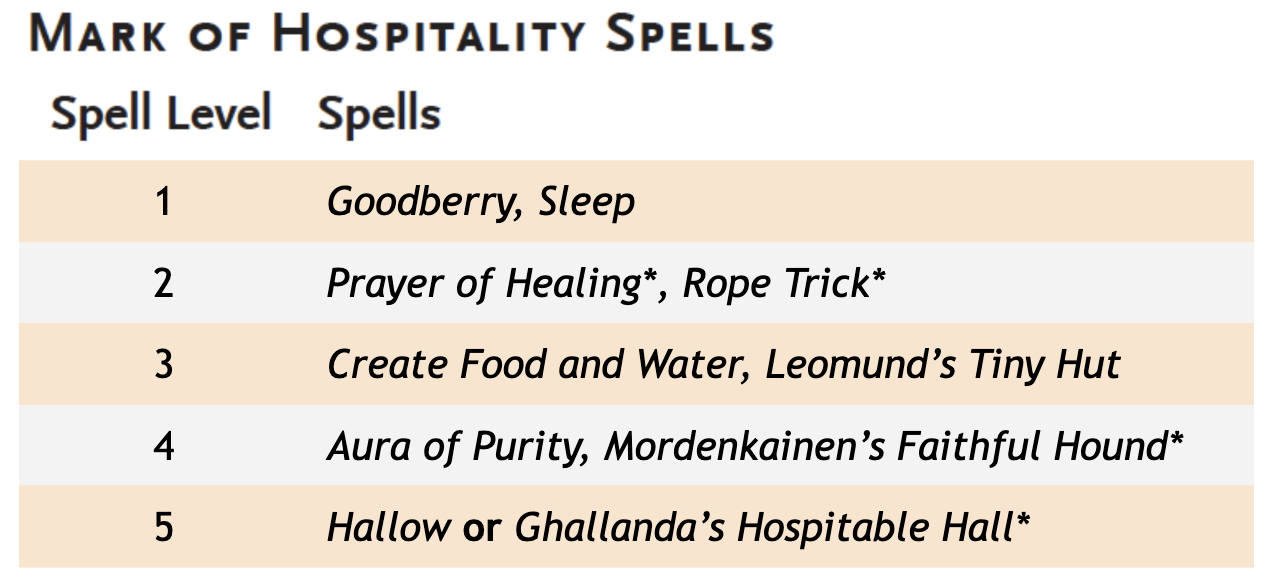
The Mark of Hospitality has three aspects: Food, Shelter, and Soothing. The ability to provide nourishing food is a key aspect of the Mark of Hospitality. Anyone who bears the Mark has the ability to Purify Food and Drink. The greater gifts of the Mark allow heirs to produce food from thin air. When cast through the Mark, Goodberry is called Mighty Morsel; rather than producing berries, the spell creates ten pellets that provide the sequential flavors of a three course meal. Prayer of Healing is called Fortifying Feast: when cast using the Mark, the ten minute casting time involves conjuring a small meal which must be consumed by the beneficiaries. Ghallanda’s Hospitable Hall allows the caster to create a meal for up to thirty people! For all of these food related spells, the caster must make a Wisdom (Cook’s Utensils) check to determine the quality of the meal; 10 is acceptable, 15 is excellent, and 20 or higher is superb. When casting Create Food and Water the caster has disadvantage on this check; this food tends to be bland, and it takes an exceptional chef to imbue it with compelling flavor.
Providing shelter is a second key aspect of the Mark of Hospitality. The Tiny Hut of the Lesser Mark conjures a simple physical shelter that endures for eight hours. It’s an excellent way to escape from unexpected bad weather. There’s a branch of the Hosteler’s Guild that specializes in what we would understand as Glamping—a Ghallanda guide takes you through an interesting stretch of wilderness, producing a Tiny Hut as a secure shelter for the night and preparing a fine meal. Rope Trick has a short duration that prevents it from being terribly useful as a commercial service, but it is the stepping stone toward the most iconic power of the Mark: Ghallanda’s Hospitable Hall. This allows an heir with the Greater Mark of Hospitality to open a portal to a small extradimensional space, with furnishings and decor drawn from the imagination of the heir. The 24 hour duration allows any heir with this power to run their own “pop-up” business. Aside from putting a roof over one’s head, the Mark of Hospitality also helps to secure that shelter. Any heir with the Mark of Making can cast Unseen Servant. This is said to draw off a fragment of the heir’s own spirit, calling on their own helpful nature to offer assistance. Heirs with the Lesser Mark can conjure a more palpable force: Mordenkainen’s Faithful Hound, or as it’s called when cast in this way, Ghallan Guardian. This typically takes the shape of a spectral Blink Dog formed from the swirling lines of a dragonmark, though occasionally heirs manifest unique shapes for their guardian; Baron Yoren is known to summon a guardian Clawfoot raptor. A Ghallanda innkeeper may offer to cast a Guardian for a customer who seems to have a need for a little extra security for the night. The final gift is quite rare: the ability to cast Hallow, drawing on the power of the Mark to protect an area from malign forces. No heir can cast both Hallow and Ghallanda’s Hospitable Hall; even player characters must choose which of the two spells they have access to.
The final aspect of the Mark of Hospitality is the ability to soothe others, helping people enjoy their food and shelter. At its simplest level, this is seen in the innate bonus to Persuasion granted by the Mark. Any experienced heir can extend this to cast Calm Emotions, which has brought an end to countless bar fights. Some heirs learn how to concentrate this effect, channeling this soothing energy into the ability to cast Sleep.
What about Prestidigitation? Prestidigitation has always been associated with the Mark of Hospitality. It was one of the optional spells tied to the Mark in the original Eberron Campaign Setting book, and it was a gift of the Mark in Eberron Rising From The Last War. However, Forge of the Artificer has dropped it, instead allowing the bearer of the Mark to cast Calm Emotions. Prestidigitation is an extremely useful spell for an Innkeeper or chef: it allows them to heat, chill, or flavor food and drink, as well as to clean floors and dishes with a gesture. This article already imposes a number of changes to canon in the revised Spells of the Mark list, and I prefer not to change the traits as well. As a result, this article introduces the Innkeeper’s Gloves as a common focus item that allows a Ghallanda heir to cast Prestidigitation. The point being that almost every marked heir CAN cast Prestidigitation—they’re just doing it through a focus rather than through the unassisted Dragomark.
Kanon vs Canon. My goal with these articles is to strengthen the story of the Dragonmark, ensuring that its abilities paint a consistent picture and support the services the House provides in the world. With the Mark of Hospitality, this has resulted in me changing four Spells of the Mark from those that will appear in Forge of the Artificer.
- At 2nd level, I’ve replaced Aid and Enhance Ability with Rope Trick and Prayer of Healing. I like Prayer of Healing because the ten minute casting time allows it to be presented as a form of Heroes Feast (which was originally granted by the 3.5 Greater Mark of Hospitality); the idea being that the heir actually prepares a meal that strengthens the party. This is more compelling to me than the random boost of Aid. Meanwhile, Rope Trick plays to the idea of providing shelter and foreshadows Ghallanda’s Hospitable Hall.
- At 4th level, I’ve replaced Mordenkainen’s Private Sanctum with Mordenkainen’s Faithful Hound. This was a difficult decision; Ghallanda inns would benefit from being shielded by Private Sanctum. But Private Sanctum is a spell that becomes permanent if cast enough times, which means that if Ghallanda had it, people would be paying them to cast it for them. Nobles would want Private Sanctums in their homes. And for that reason, I feel that Private Sanctum should be a gift of the Mark of Warding, not the Mark of Hospitality. KUNDARAK is the house you’re supposed to be paying for magical security, not Ghallanda. Furthermore, Private Sanctum primarily protects against Divination and Teleportation, which again feels more like WARDING. By contrast, the Mark of Hospitality already has the ability to cast Unseen Servant. Mordenkainen’s Faithful Hound is essentially a strengthening of that existing spell; it fits the Blink Dog iconography of the House; and having an Innkeeper put a dog at your door for the night feels appropriate without stepping on the toes of Kundarak.
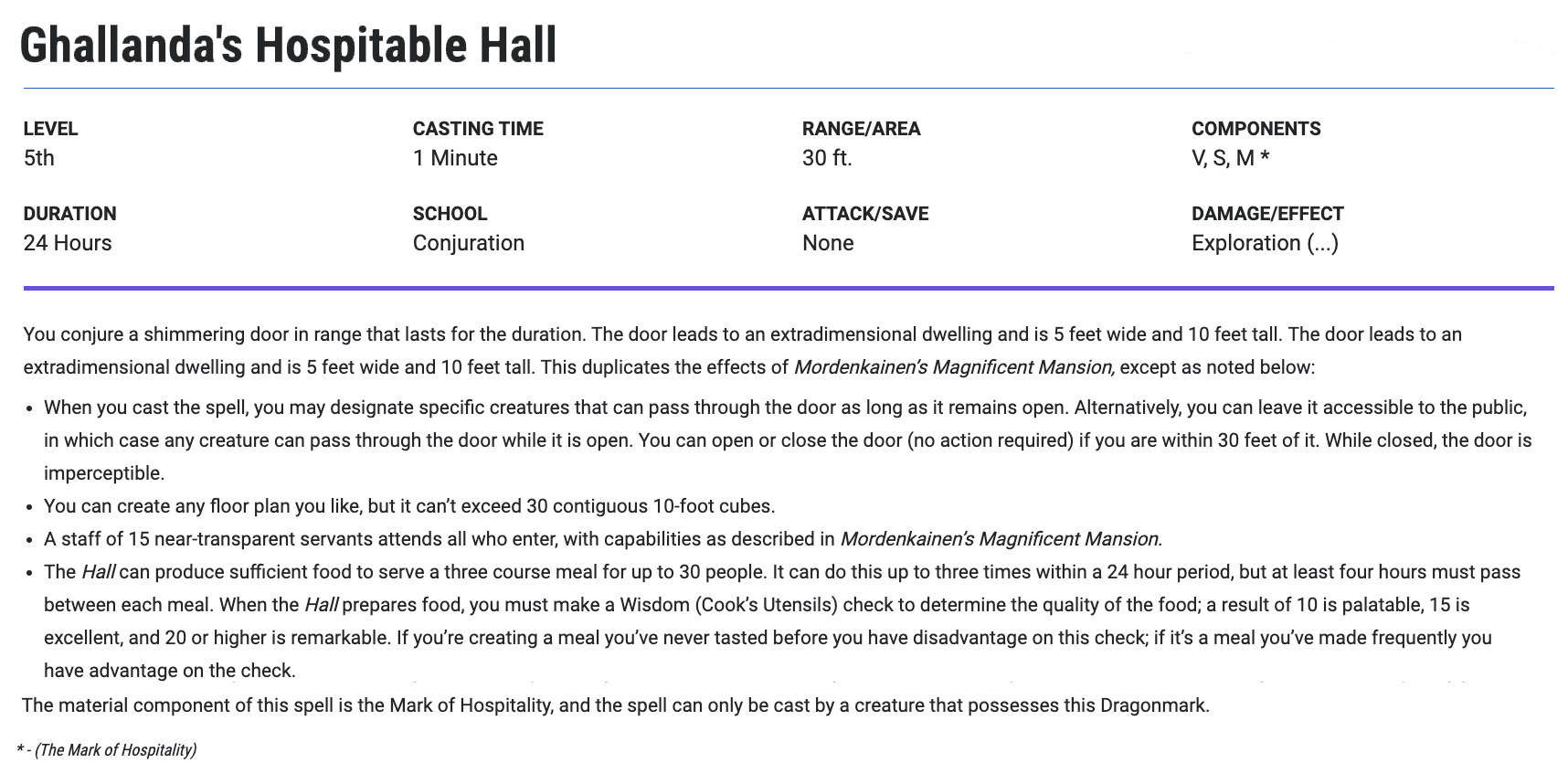
- At 5th level, I’ve added the option of Ghallanda’s Hospitable Hall. Hallow is a powerful spell, but it’s very limited in its use; it has a 24 hour casting time and a 1,000 gp casting cost; it’s not something an adventurer can use on a regular basis. Beyond this: Mordenkainen’s Magnificent Mansion was one of the original options for the Greater Mark of Hospitality in the 3.5 Eberron Campaign Setting, and for me it’s always been part of the flavor of House Ghallanda. Part of the point of the Wandering Inn is that you have mansions inside wagons. With the current structure it’s awkward to give a Dragonmark the ability to cast a 7th level spell; so I’ve created Hospitable Hall as a slightly weaker version of Magnificent Mansion. Note that this is a spell that is only supposed to be available to characters with the Mark of Hospitality—emphasized by making the Mark a component of the spell. For most people, this is still a 7th level effect.
As always, using kanon content is something that requires DM approval. This is how I use the Mark of Hospitality in MY campaign, but other DMs may prefer to rely on canon material.
Focus Items
Ghallanda heirs employ the common focus items presented in Exploring Eberron—Dragonmark Channels, Dragonmark Reservoirs, and Channeling Rods. Exploring Eberron also introduces the Ghallanda Cauldron (which reduces the time required to prepare a meal) and the Manor Key, which preserves the 3.5 tradition of Ghallanda Magnificent Mansions. Exploring Eberron also highlights the idea that existing magic items can be reflavored as focus items, calling out the Ghallan Jug as a form of Alchemy Jug that draws on the Mark of Hospitality. In addition to these, here’s a few new focus items to play with.
Bag of Bounty
Wondrous Item, Uncommon
This leather bag has three charges. A creature with the Mark of Hospitality can take a Magic Action to open the bag and cast Create Food and Water, expending one charge in the process. When using the Bag, a creature can make a Wisdom (Cook’s Utensils) check to determine the quality of the food; they don’t suffer the disadvantage that normally applies when casting Create Food and Water with the Mark of Hospitality. The Bag of Bounty recovers 1d3 charges at dawn.
Hosteler’s Anchor
Wondrous Item, Uncommon (requires attunement by a creature with the Mark of Hospitality)
The Hosteler’s Anchor is a stone brick engraved with the Mark of Hospitality. If the anchor is placed in an extradimensional space created by the creature attuned to Anchor—such as a Magnificent Mansion, Hospitable Hall, or Rope Trick—it can help maintain the space in the absence of the caster. When the duration of the spell expires, the caster can immediately refresh the spell through the Anchor. This requires the creator to expend the appropriate spell slot or charge from a magic item, but it requires no action on the part of the creator. The creator can even set this effect to occur even if the creator is unconscious, although they must have the appropriate spell slot or item charge available to be spent. A creature who possesses both a Hosteler’s Anchor and a Manor Key can attune to both items using a single attunement slot.
Innkeeper’s Gloves
Wondrous Item, Common
If you possess the Mark of Hospitality, you may use a Magic Action to cast Prestidigitation while wearing these gloves.
Hospitable Halls and Magnificent Mansions
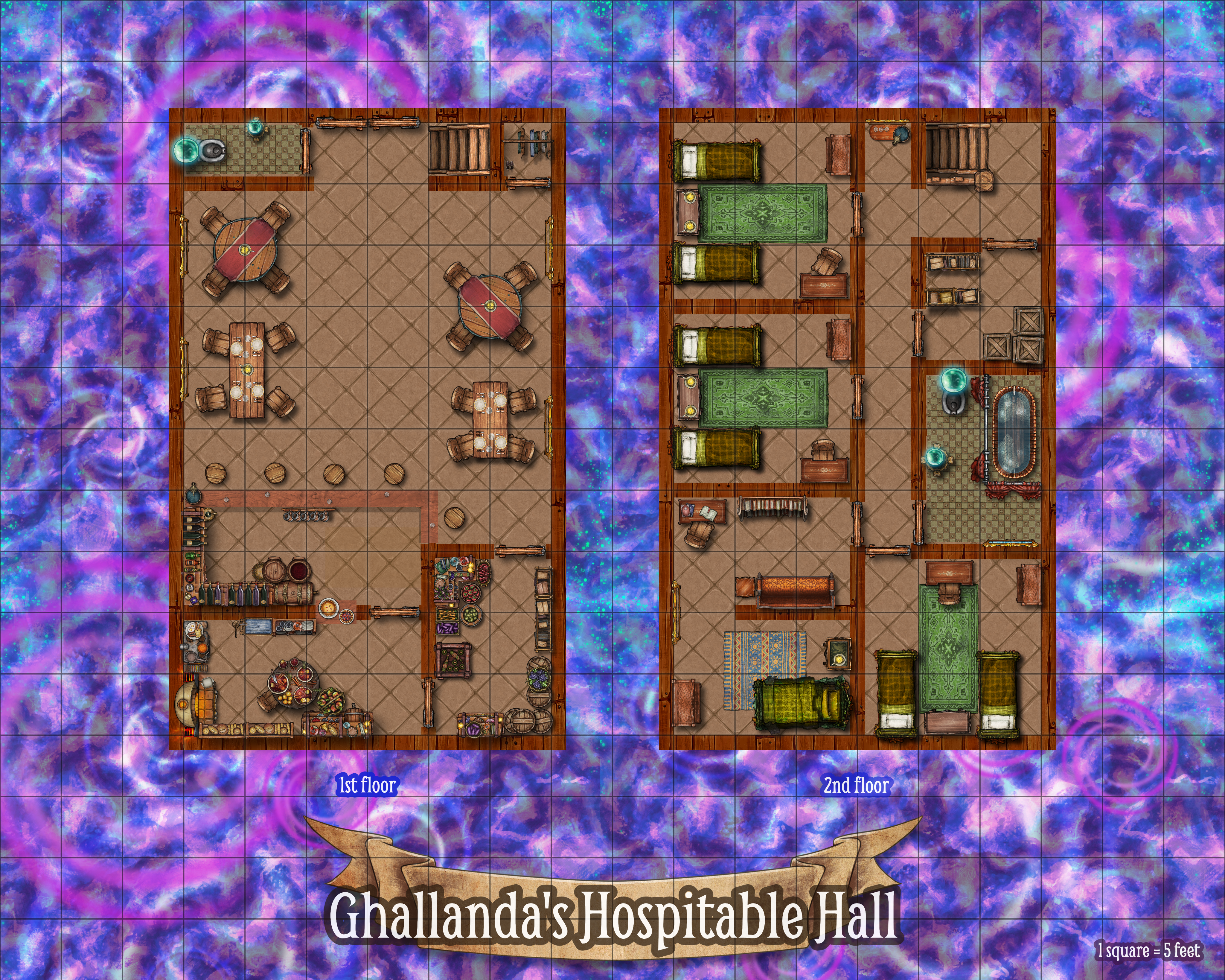
Ghallanda’s Hospitable Hall and Mordenkainen’s Magnificent Mansion are hallmarks of House Ghallanda. It takes the Greater Mark of Hospitality to cast Hospitable Hall, while the Manor Keys used to produce Magnificent Mansions are rare items largely held by House officers and the Dragontail Guild. In the wake of the Last War, there are a few hundred people in Khorvaire capable of producing these effects. So it’s not part of everyday life for most people; the typical Ghallanda inn is made of brick and mortar. But Ghallanda pop-ups are wondrous things. Some heirs operate in the major cities, providing a unique experience to wealthy patrons. But part of what’s amazing about a Hospitable Hall is its portability, and a number of Greater heirs enjoy the ability to open their door to a new community every day.
The latest version of Magnificent Mansion says that when the spell is cast, “You can create any floor plan you like for the dwelling, but it can’t exceed 50 contiguous 10-foot cubes. The place is furnished and decorated as you choose. It contains sufficient food to serve a nine-course banquet for up to 100 people. Furnishings and other objects created by this spell dissipate into smoke if removed from it… A staff of 100 near-transparent servants attends all who enter. You determine the appearance of these servants and their attire.” The atmosphere is clean and warm, and light is provided in a manner befitting the decor. Ghallanda’s Hospitable Hall is limited to 30 cubes, 15 servants, and can create a 3-course meal for up to 30 people—although it can produce such a meal three times in a day. In all other respects Hospitable Hall matches Magnificent Mansion, meaning that the layout, decor, and furnishings are all determined by the caster.
Ghallanda specializes in providing food and shelter, and as such Hospitable Halls are frequently encountered as restaurants, taverns, or inns. A Hospitable Hall doesn’t require a kitchen or supplies to produce its magical meals, and a wandering Ghallanda heir may not bother allocating space to a kitchen or pantry; however, an heir running a long-term pop-up in a city may choose to produce mundane food in addition to the conjured meals, in which case they’ll need to have those facilities as part of the layout and bring in mundane supplies (thus producing food that can be removed from the Hall without disintegrating). The layout of a Hall can be changed every time the heir casts the spell, allowing the proprietor to adjust to the needs of the day… adding a stage to accommodate live music, or shifting from large, comfortable guest rooms to small cabins to handle an influx of guests. These functions… Inn, Tavern, Restaurant… are the typical pop-up businesses associated with the Hosteler’s Guild. But consider a few of the other things a Ghallanda heir could produce with Hospitable Hall…
- … A Theater. Traveling musicians or companies of actors may employ a Ghallanda heir to produce a stage when they require one; the heir can adapt the decor to match the needs of the performance, while heirs of the Mark of Shadow can enhance the experience with illusory effects. Keep in mind that the only entrance to the Hall is the door created when the spell is cast, so an heir can create a small theater, but they can’t create an open air stage that can be viewed from the outside; someone will have to pass through the door to enjoy the show.
- … A Manor. Noble families often have Ghallanda stewards or butlers. A steward with the Greater Mark of Hospitality may accompany the family and provide them with a facsimile of their home estate while they are traveling. The valet Hastor Brightmantle d’Ghallanda accompanied Lord Boroman ir’Dayne on his expeditions to Xen’drik, ensuring the explorer was able to sleep soundly at night.
- … A Prison. The Quartermasters of the Dragontail Guild typically use their magic to create barracks for soldiers or command posts for officers, but when a group of soldiers suddenly has to deal with a group of prisoners of war, the ability to quickly create a prison with only one possible exit can be a boon.
- … Training. Large Ghallanda enclaves often have a rotating business, using a Manor Key to create a new restaurant or inn every few weeks. The purpose of this is to test or train local apprentices in a particular set of skills. Is it time to learn Talentan cuisine? Unveil The Curious Clawfoot, a Talentan-themed tavern!
- … A Facade. House Ghallanda relies on the public trust and heirs are charged not to engage in criminal activities. But excoriates, Black Dogs, and other heirs not bound by the rules of the House can use Hospitable Hall to facilitate any number of confidence games or deceptions. In one infamous incident, the excoriate Daraya Swiftwhistle planted a Magnificent Mansion on a lightning rail, replicating the train itself on the other side of the door.
The facade is one example of how an unscrupulous heir could make use of a Hall, but Ghallanda excoriates and foundlings have also used this gift to create fight clubs, dreamlily dens, and hidden hideouts in the heart of hostile territory.
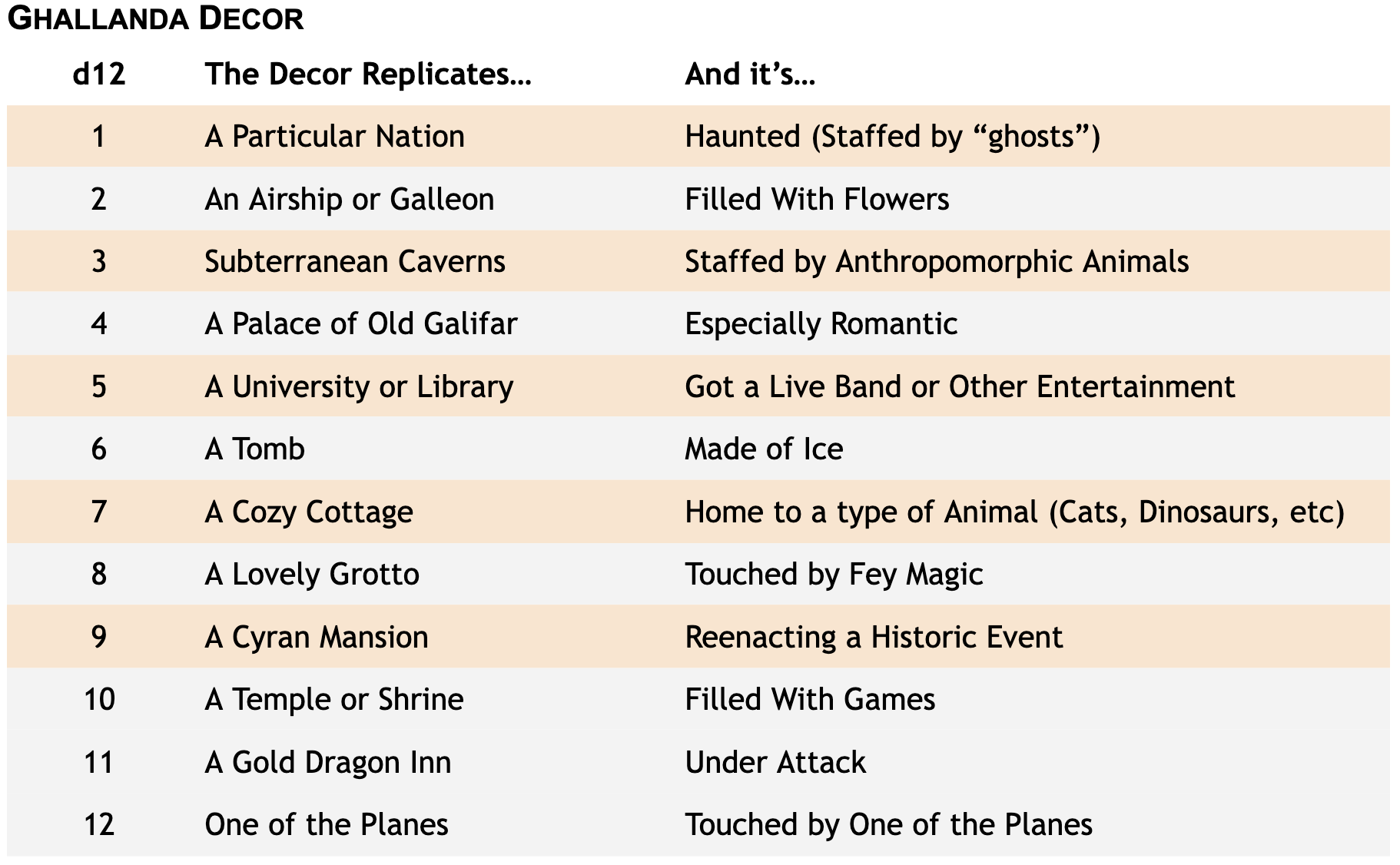
While the layout and furnishings of a Hall or Mansion will be shaped by its function, the decor is limited only by the imagination of the caster. This is part of what makes the pop-up business such a wondrous experience: a pop-up restaurant can have a new theme every night! The decor can be adapted to a particular festival, to replicate a particular culture or period in history, or even to emulate another plane of existence. The Ghallanda Decor table offers a few ideas for what people could find inside a Hospitable Hall! Keep in mind that the flavor—such as “Haunted” or “Touched by Fey Magic”—is cosmetic. The caster chooses the appearance of the attendant spirits, so they can look like ghosts, pixies, or badgers; but it’s only surface level.
THE HISTORY OF HOUSE GHALLANDA
There are many ways to die on the Talenta Plains. The easiest is to stand still, to wait for malign spirits and hungry ghosts to find you. But even those who stay in motion face many dangers. Sometimes there’s no shelter to be found when predators prowl or when strange storms are brewing. Sometimes mischievous fey or malevolent fiends steal food or spoil it, condemning travelers to misery and death. The Talenta tell countless tales of those who have fallen on their journeys, warning the young of the dangers that lie ahead of them. Even in these grim tales, there’s always hope. There are hidden oases and helpful allies. Ustukata is the inner spirit that lifts the tired foot, a possessing spirit that animates those too exhausted to carry on and drives them on until they reach safety. Ghallanda is the helpful hound that appears where needed the most, the blink dog who appears with food for starving travelers and guides those who have lost their way. In one tale, a wanderer named Kullikora is caught in a blood storm with her family and friends. Their supplies are ruined and they’re driven off the path of safety. The travelers know that when the storms come again, it will consume their spirits and leave their dancing bones behind—and even if they could find shelter, they would soon starve. Kullikora wanders away from the group and begs the spirits to show mercy to those she loves, offering herself as a sacrifice in exchange for their safety. Ghallanda appears before her, and leads her to a door in the side of a mound of sand. On the other side of the door, Kullikora finds a vast billowing tent filled with soft cushions and piled high with food and drink. She leads her family to this sanctuary and they rejoice, but there is still concern. They have shelter tonight, but they are far from the safe paths; what will happen tomorrow? Ghallanda tells her you didn’t FIND this sanctuary, Kulli. You created it from the love in your heart. You carry it with you, and you can open the door whenever you wish. But you said you would lay down your life for others, and I will hold you to that. You carry the sanctuary within, but you must open that door to those in need. Continue on. Wander where you will. But help those in need, for you are the shelter from the storm.
The tale of Kullikora is the oldest known reference to the Mark of Hospitality, and while it’s impossible to date it precisely, the scholars of the Twelve believe it is the oldest reference to any Dragonmark. Canonically the Mark of Hospitality first manifested around 3,200 years ago, just before the Marks of Shadow and Death appeared in Aerenal. It’s said that Kullikora wandered the Plains helping those in need, and as she did so she met other halflings who had also been blessed in moments of dire need. Together they established a caravan that would be a mobile sanctuary—the foundation of what’s now known as the Wandering Inn. As their numbers grew, these wanderers named themselves the Ghallandala, the Tribe of the Helpful Hound.
Tradition is important in the Talenta Plains; following the paths laid out by the ancestors is the key to survival. For centuries the Ghallandala followed in the footsteps of Kullikora. In addition to aiding those in dire need, the Ghallandala found ways to ease the burdens of every traveler. Someone didn’t need to be starving to enjoy a conjured feast, and the Hospitable Halls of the Ghallandala offered a wondrous respite to any weary traveler. They would host celebrations for heroes, and provide food and drink for gatherings of the tribes. The Ghallandala expected compensation for this, and this laid the groundwork for the House as it operates today; the Wanderers and the Wandering Inn perform acts of charity, but innkeepers and tavernmasters are paid for their services.
The Plains are vast and dangerous, and when humanity spread across Khorvaire most shunned this haunted land. But over the course of centuries, some folk did plumb the mysteries of the Plains. There were Zil explorers, Karrnathi soldiers, would-be settlers from Metrol and more. None stayed in the Plains for long, but they delved deep enough to encounter trouble… and some of them, to be offered respite by the Wandering Inn. Stories of the helpful halflings spread, and the sages of House Sivis took note. The Wandaryn-Harn Expedition was a joint operation of House Cannith and House Sivis, charged to investigate tales of ancient ruins, strange magics, and possible Dragonmarks in the Talenta Plains. Wandaryn-Harn found everything it was looking for, and it was lucky for them that they did; without the assistance of Ghallanda and Jorasco, the explorers would have died a dozen times over. In the wake of this expedition, envoys of the Twelve met with the leaders of Ghallanda and Jorasco in Gatherhold. While some of the Ghallandala resisted the idea of joining these outsiders and expanding into the world beyond, many embraced it. The elder Gray Gavaral said “When these outsiders came to the Plains, they didn’t know the paths and they walked into danger; if not for my kin, they would have died painful, miserable unpleasant deaths, save for those who lingered, praying for death’s release. One lesson to take from this is to stay in our Plains and never leave, for here we know the paths to walk. But some day there could come a time when we had to leave, and on that day we would have no guides. These outsiders are our Helpful Hound, here to show us the path. Let us find our way in the world beyond. Surely there are travelers on the roads beyond our Plains; surely they have need of our gifts.” With the help of House Sivis and the Twelve, the Ghallandala became House Ghallanda. It took time for the halflings to become comfortable in enclaves, and to learn to love inns that stayed in one place instead of wandering. And so they spread and prospered.
Taken as a whole, House Ghallanda is one of the most benevolent Dragonmarked Houses. Most of its heirs love what they do. The typical Ghallanda bartender isn’t trying to compel you to share your secrets to add to their stockpile of data; they truly do want to help lighten your load. Most Ghallanda like mediating disputes and making their customers happy. At the same time, most won’t ignore their own self-interest. A Ghallada bartender may happily do you a favor; but a time may come when they’ll ask a favor in return. They aren’t trying to steal your secrets, but they won’t forget what you share. And while the Wanderers offer charity to those in need, heirs tied to traditional businesses are expected to do what they need to do to ensure that those businesses prosper. With that said, Ghallanda is a case where the monopoly of the house is largely self-enforcing. House Ghallanda doesn’t seek to sabotage independent restaurants, inns, or taverns. They have gained a degree of monopolistic power because of three things. The first is the quality and reliability of the services they provide. The Hosteler’s Guild has a team of inspectors who travel across Khorvaire ensuring that every business that carries the Ghallanda seal maintains its standards of health and quality. Over the course of centuries, people have come to rely on that Ghallanda seal. The second thing Ghallanda offers is familiarity. While there are countless unique inns and taverns, everyone knows the Gold Dragon Inn and many travelers want the security of that familiarity when they arrive in a new place. So quality and familiarity have helped Ghallanda succeed. The final piece of the puzzle is the simple fact that people like the Ghallanda… and as a whole, the House has earned that trust.
When people think of Dragonmarked Houses on the fields of the Last War, they typically imagine Deneith soldiers, Jorasco healers, and Cannith magewrights operating arcane artillery. However, House Ghallanda has always had a military role. The quartermasters of the Dragontail Guild have long supported House Deneith and the army of Galifar. The standard Ghallanda quartermaster deals with logistics, supplies, and food for their unit, with the added benefit of being able to supplement shortages with a Bag of Bounty and the power of their Dragonmark. But the most prized quartermasters are those who possess the Greater Mark of Hospitality or a Manor Key—and thus, who can provide a Hospitable Hall or Magnificent Mansion for their unit. The Twelve would often assign a Greater Quartermaster when a large force of noncombatant Dragonmarked heirs were assigned to a dangerous area. When threatened, the heirs would retreat into the Hall until the danger passed. But Greater Quartermasters were in high demand by all of the Five Nations. With Ghallanda’s Hospitable Hall an heir can provide food and shelter for up to 30 soldiers, and when the door to the Hall is closed it is imperceptible—making it an incredible boon for a small force operating behind enemy lines. On an ongoing front, a Hospitable Hall is an excellent shelter for an army’s commanders to plan their strategies, especially as the Hall provides absolute protection from any sort of bombardment. At its height, the Dragontail Guild had over two hundred Greater Quartermasters in the field. This work was something done out of a sense of duty to the house. Most Greater Quartermasters would rather run a pop-up inn or tavern than serve as a portable garrison, and at the moment the Dragontail Guild only has thirty Greater Quartermasters on staff; the rest are out in the world pursuing their dreams and praying that the peace will last.
Ghallanda Sanctuaries
During the War of Unification, a Ghallanda quartermaster named Kalaba Fullbarrel saved Galifar Wynarn from a deadly ambush. While sheltering in the extradimensional space, Kalaba discussed the principles of the house with the King. When his kingdom was established, Galifar I made an amendment to the Korth Edicts, ruling that the enclaves of House Ghallanda were to be treated as sovereign nations. Ghallanda owns the land upon which its enclaves sit; it can maintain a military force—the Hearth Guard—to defend its enclaves; and those within a Ghallanda enclave are beyond the legal reach of any nation or House. Just as the Sentinel Marshals have retained the right to enforce the law across all nations, House Ghallanda has retained the sanctuary status of its enclaves to the present day. Ghallanda enclaves have long served as neutral ground where enemies could negotiate face to face, and as well as offering sanctuary to all manner of people; a Sentinel Marshal famously observed that Ghallanda Hall in Sharn holds “more fugitives, scoundrels, and mysterious strangers per square foot than anywhere else in Khorvaire.”
House Ghallanda takes pride in providing sanctuary to those in need. Adventurers may take advantage of this protection, or they may run up against it when an enemy takes shelter in an enclave. There’s a few principles to keep in mind. Keep in mind that these things only apply to Ghallanda enclaves, not to every Ghallanda business! The Gold Dragon Inn isn’t a sanctuary.
- Ghallanda enclaves are protected by the effects of Hallow. This has the secondary effect that no creature can enter or exit an enclave using teleportation or interplanar travel.
- Each enclave houses a garrison of the Hearth Guard, charged to defend the enclave from outside threats and to maintain order within it.
- House Ghallanda isn’t obligated to provide sanctuary. An enclave only has room for a limited number of guests, and it’s up to the master of the enclave to decide who will get the beds. This can be revoked at any time, at which point the Hearth Guard will escort the ex-guest from the premises. A guest’s privileges are lost every time they leave the enclave and will be reevaluated upon their return, so it’s unwise to dart in and out.
- Any act of violence or theft will result in a guest being expelled from the enclave. In some cases, a guest can be expelled even for engaging in violence in self defense, especially if their actions endanger others.
- Sanctuary isn’t free. The base cost of room and board at a Ghallanda enclave is 5 gp/night. This can be adjusted by the master of the enclave as they see fit, either lowered if the master is sympathetic to the guest’s circumstances or raised if the guest is deemed to be a particular burden. In some cases House masters have been known to bargain with guests, promising ongoing shelter in exchange for some sort of service. Notably, a master might engage the services of a group of investigators to assist a current guest, to investigate a guest, or potentially to convince a guest to leave if such a task is beyond the capabilities of the Hearth Guard.
What Happens Next?
House Ghallanda isn’t as hungry for profits and expansion as most of the other Houses. House leadership strives to ensure the security of Ghallanda’s heirs and to continue the charitable work of the Wanderers. However, there are Ghallanda heirs working with the Twelve in the hopes of doing more for the world… whether helping the hungry or finding ways to spread a little joy. But even the best intentioned experiment can go terribly awry!
- The Lost Mansions. House Ghallanda records suggest that there were at least twenty Hospitable Halls and Magnificent Mansions equipped with Hosteler’s Anchors in Cyre on the Day of Mourning. It’s possible these mansions and their creators were destroyed by the Mourning. But it’s also possible that they are still active. Perhaps the people inside are afraid to venture into the dangerous world beyond… or perhaps the door to the demiplane is sealed and can’t be opened, and the inhabitants have been trapped since the Day of Mourning. A team of researchers from the Twelve have created an experimental orb that should be able to locate and open sealed hall doors, but they need a team to go to the Mournland and find these lost mansions. Of course, it’s possible one of them has become a Living Magnificent Mansion, and now prowls the Mournland looking for victims to draw into its luxurious depths!
- Breaking Sanctuary. The adventurers are hired to extract an Aurum Concordian from a Ghallanda enclave. Brute force isn’t the answer, so what will they do? Can they find leverage that will convince the target to leave of their own volition? Find a way to trick them, or to deceive the Hearth Guard? What happens if they discover that the target is a decent person—and that their employer is a ruthless criminal who wants to kill the target?
- Feed me! The adventurers have been invited to Green Three, an isolated research facility where House Cannith, House Ghallanda, and House Vadalis are working with Conjure Food and Water, Plant Growth, and other techniques to try to create an inexhaustible food supply. The adventurers are supposed to be participating in a taste test, but when something goes terribly wrong, they must defend Greet Three from the rampaging meals! The cake may be a lie, but the pudding will kill you…
- The Suite Life. An unusual start to a campaign is to have all of the player characters be people who are claiming sanctuary in a Ghallanda enclave. Why are they trapped inside? Are they political renegades? Reformed criminals targeted by ruthless rivals? Innocent people framed for crimes they didn’t commit? Dragonmarked heirs hiding from in-house feuds? Whatever the reason, all of the adventurers are trapped in a hotel. Can they spot and expose the spies and assassins pursuing them? How will they deal with their brutal enemies who are also guests of the enclave? What would it take for them to be able to leave again? Consider John Wick 2 and A Gentleman in Moscow for inspiration.
- To Serve Galifar. The adventurers are tasked to recover a tome from Sora Katra’s library in the Great Crag of Droaam. It’s… a cookbook! Is it the secret recipe for grist? Is it culinary secrets from the Age of Demons? There’s only one way to find out!
- The Haunted Hall. House Ghallanda has been working with House Phiarlan on a new endeavor—Ghallanda’s Haunted Hall! Combining the flexibility of Hospitable Hall with Phiarlan illusion, this is supposed to be a pop up entertainment that provides spooky delights to anyone who dares to pass through. But something’s gone terribly wrong. The Hall is actually haunted, and the creator can’t shut it down! Is it Thuranni sabotage? Was it opened in an unknown manifest zone? It’s up to the adventurers to venture into this very haunted house and find a way to shut it down!
THE STRUCTURE OF HOUSE GHALLANDA
While some Dragonmarked Houses have a sharp divide between the administration of the House and the guilds that run its businesses, in Ghallanda these two are woven together. Every Ghallanda enclave has at least one active business operating within the building, and guild offices for the Hosteler’s Guild and the Dragontail Guild are always found within enclaves. Ghallanda heirs aren’t required to serve in a guild, but most heirs are taught the basic principles of Ghallanda trades beginning in childhood. Ghallanda children are always encouraged to help in the kitchen, to develop their palate, to help with cleaning and maintenance, and myriad other tasks associated with a career in hospitality. So while they aren’t forced into it, many Ghallanda heirs grow up with a dream of the restaurant or tavern they want to open some day.
Businesses at Ghallanda enclaves are fully owned by the House, and operated by the families that permanently reside at the enclave. Ghallanda is well known for its bound businesses. The House helps to establish these businesses and provides access to specialized supplies, but it takes a significant cut of profits and imposes strict guidelines on the appearance and services provided by the establishment. The best known example of this is the Gold Dragon Inn. There’s a Gold Dragon Inn in almost every major city in Khorvaire, and the decor, the menu, and the service is nearly identical; customers want that familiar, reliable experience. There are many bound businesses that aren’t as widespread as the Gold Dragon—but any bound business has close ties to the House, which provides support but imposes demands. At the bottom of the ladder, licensed businesses pay dues in order to display the seal of the Hosteler’s Guild, promising that they uphold Ghallanda standards; but beyond this, every licensed business is unique and independent. Many are run by Ghallanda heirs who want to explore their dreams or showcase their unique talents, instead of conforming to the cookie-cutter mold of a bound business. A licensed business run by a Ghallanda heir may display the House seal in silver in addition to the seal of the Hosteler’s guild. In many ways, an inn or tavern plays the same role in Ghallanda that a ship does in House Lyrandar. There’s certainly honor to be earned by serving in the Lyrandar house fleet or running a Gold Dragon Inn, but a Ghallanda innkeeper with their own establishment commands the same respect as a Lyrandar captain with their own ship.
Ghallanda Enclaves. Ghallanda has more enclaves than any other Dragonmarked House, though its enclaves are often far smaller than those of other houses. A Ghallanda enclave typically includes the following things.
- Ghallanda enclaves are protected by Hallow, and are traditionally shielded against Aberrations, Fiends, and Undead. Such creatures can’t willingly enter the enclave, and any creature that is possessed by or that has the Charmed or Frightened condition from such creatures isn’t possessed, Charmed, or Frightened from them while in the enclave. In addition, all creatures are blocked from using teleportation or interplanar travel to enter or exit the enclave.
- Living quarters for a number of Ghallanda families. Because there are more Ghallanda enclaves than those of other houses and because many Ghallanda heirs live in the inns or taverns they run as businesses, these populations are generally smaller than those found in the enclaves of other houses.
- Facilities and resources needed to train Ghallanda heirs in one or more vocations.
- Some form of active business, typically a tavern, restaurant, or inn. This doubles as a training space for the heirs who are serving as apprentices in the enclave. A point here is that when you go to a typical Gold Dragon Inn, it’s not a Ghallanda enclave; it’s not protected by Hallow and doesn’t provide sanctuary. However, a Ghallanda enclave could INCLUDE a Gold Dragon Inn, in which case THAT inn would have those benefits.
- Significant enclaves usually include a pop-up space, where an heir with a Manor Key can create a temporary business to fit the current training needs of apprentices. This Mansion space can also be rented out and tailored to the needs of a private event, or used to celebrate important festivals. So typically, a Ghallanda enclave in a major city will have two active businesses in operation—one permanent, one cycling.
- A garrison of the Hearth Guard. The size of this garrison will depend on the perceived need for defenders. A small enclave in a town might only have one or two guards, while the enclave in Thaliost has a sizable garrison.
So a Ghallanda enclave serves the typical functions of a Dragonmarked enclave, providing a safe space for Ghallanda families and training facilities for a particular vocation. However, enclaves also involve active businesses, and offices within enclaves manage both the overall administration of the House and the administration of its guilds.
The Hosteler’s Guild
The Hosteler’s Guild is the primary business arm of House Ghallanda. While everyone knows of the guild’s work with restaurants and inns, the Hosteler’s Guild has a broader mandate than many people realize. This includes the following elements.
Food and Drink. In addition to licensing restaurants, taverns, and bars, the Hosteler’s Guild brokers the services of caterers and chefs.
Lodging. Inns, hotels, and any other form of paid lodging.
Legal Gambling. While there are only a few designated casinos in the Five Nations, the Hosteler’s Guild licenses bookmaking and many taverns run a few games. Within the Five Nations, gambling winnings are taxed by the nation; Ghallanda collects this tax on behalf of the crown. This is why unlicensed (and untaxed) gambling continues to thrive.
Domestic Service. Ghallanda brokers the services of a wide range of domestic servants, from maids and valets up to stewards trained to manage estates, whether short term or long term employment.
Site-Based Entertainment. If House Vadalis wants to create an amusement park filled with dinosaurs or if House Thuranni wants to run a haunted house, they’ll work with House Ghallanda to make it happen. The Houses of Shadow can provide terrifying illusions, and Vadalis can wrangle dinosaurs—but it’s Ghallanda who understands how to staff such a facility, how to manage crowds, and all the other issues involved in such an operation.
Information and Concierge Services. House Ghallanda doesn’t solve crimes or engage in espionage. But through the course of their work, Ghallanda heirs acquire all sorts of interesting information. Ghallanda heirs typically preserve the secrets of their clients; people wouldn’t share their burdens with the bartender if they believed that information would be used against them. But Ghallanda heirs generally know what’s going on in their community. Are you looking for tickets to the sold-out Skyblade tournament? Do you really need to get ahold of some Absentia? Do you just want to know who really makes the best kettle-fried spider nuggets in Sharn? If your Ghallanda innkeeper doesn’t know the answer, odds are good that they know someone who does.
The Hosteler’s Guild directly operates businesses and schools in Ghallanda enclaves, and plays a supporting role in running bound businesses. It also acts as a brokerage for the services of cooks, caterers, and domestics. There are a few divisions within the Guild. The Sukalasha (a Talentan word meaning “Guardians who watch from the shadows”) are inspectors who evaluate licensed and bound businesses to ensure they are meeting Guild standards; operatives act both openly and undercover. The Korlatta (“Those who share wisdom with the young”) are the Guild’s teaching staff. And the Tantalara (“A shelter that stands against the storm”) are responsible for the construction and maintenance of enclaves and bound businesses. These are branches of the Guild, and as such employ people from outside of Ghallanda. The Sukalasha employ a significant number of Changelings, including immigrants from the Talenta Plains, and anyone with sufficient skill can serve in the Korlatta or the Tantalara.
Deep Dive: The Cuisine of the Gold Dragon Inn
When you travel across Galifar, there’s one thing you can rely on: in any major city, you can always find a Gold Dragon Inn. The Gold Dragon isn’t a luxurious experience, but it is reliable, affordable, and above all familiar. But what is that familiar, reliable experience? Gold Dragon Inns adjust their menus to account for local customs and available ingredients, so there’s always a few regional specialties. However, there is a seasonal menu you will always find available at any Gold Dragon Inn, regardless of location. These staples serve a wide appeal, ensuring that there’s always something for everyone at a Gold Dragon Inn. Talentan Fusion is what dominates the classic menu, a blending of Talentan cuisine based around foraging and herding, adapted to please a more general Galifaran palette.
All year round it is possible to find Tribex steaks, served hot with a pat of fresh herb butter. This steak is a classic, and according to a 989YK survey, the most ordered dish. They also have Dragonuggets, a favorite for picky kids and adults alike; chicken is shaped into cartoonish dragon silhouettes that are flavored to the specificity of the guest, normally using Prestidigitation to get the shape and flavor just right. A Threehorn Egg Frittata filled with mushrooms, tribex belly, and walnuts is what Gold Dragon Inn claims as its signature dish. Due to the scarcity of Threehorn eggs, most Gold Dragon inns don’t cook the Threehorn Egg Frittata with an actual Threehorn egg, instead opting for several goldenfowl chicken eggs. Customers who complain will often be jovially asked if they expected the Dragonuggets to be made of real dragons as well.
The spring special menu, which is offered from the beginning of Therendor through the end of Dravago, prioritizes fresh leafy vegetables. Rampion salad with grilled tribex, chicken, or pork, drizzled with a Lhazaar Island dressing is a favorite. The Ferntip Omurice often steals the show as the waitstaff gently slices the top of a perfectly cooked omelet that lays on a bed of rice, which opens up to reveal vibrant green tender fern tips seasoned with butter and garlic. Daisy Dainties are a dessert item which is brought out in a small trough of cake crumbs that appear to be soil, along with a pitcher of sugar water. As the syrup is poured onto the soil springtime flowers such as daffodils, daisies, and tulips sprout before your eyes. The petals open up into edible sugar confections.
During Nymm, Lhavion, and Barrakas the summer menu shines with the Family Feast, a small plate tapas style dinner that can feed 4 to 6 people. Dough made with scamp or goldenfowl chicken eggs is gently fried and served alongside garlic shrimp, meatballs, and fried potatoes. It comes with 12 dips and sauces that range from chunky mango salsa and creamy tribex curry to Fiernian chutney and Blinky’s Blanco cheese sauce. Fruit takes the stage in the summer months with Jam-glazed Rotisserie and special fruit-laden desserts like 13 berry tarts. Goldie’s Wildfire Kebabs are the most entertaining meal to get at a Gold Dragon Inn, tribex meat and local vegetables are brought raw to the table atop a bed of dried herbs, once at the table the herbs snap and pop and burst into flame that cooks the kebabs. Guests can decide on when to remove them from the fire. Once all kebabs are removed, the fire dies immediately.
As autumn comes Gold Dragon Inns shift to cozy recipes, filled with mushrooms, nuts, and warm spices. The Goldie’s Mushrooms, acorn coated mushrooms that are served atop a bed of rice mixed with crushed chestnuts and walnuts with a drizzle of cranberry compote, is a must-try even for meat-eaters. Other offers include a nut-crusted beef tenderloin and Autumnal Tal, the thick hot beverage given a floral and fruity flavor thanks to rosehips being crushed with the talroot. During the Autumn Gold Dragon Inns will host harvest feasts where tables are all lined up and food is poured onto them in great hulking piles. For a fee you can eat however much you want, filling and refilling your plate with rice, potatoes, roasted nuts, mushrooms, meats, fruits, etc. The important thing is that all of the food that is poured onto the tables is extremely easy to make, either coming off a grill quickly, or poured from a giant pot all at once. There’s slight variation region-to-region, as local farmers, fishers, cheesemongers, and butchers sell their bounties to their local inn.
When the darkest and coldest months of the year hit, Gold Dragon Inns strive to serve the freshest tasting food possible, to distract from the monotony of eating pickled and preserved foods that many eat during the winter. A winter salad of magically preserved lettuce with citrus fruits like pineapple and pork remind guests what the sun feels like on a dark day. Chicken and Tribex are stewed in paprika and cream to create a thick and spicy meal guaranteed to warm travellers up inside out. On chilly afternoons high-tal is served to guests at the Inn, a five-tiered tray is brought out, serving up a slice of quiche filled with talentan vegetables like rampions and spinach; Talentan Fusion finger sandwiches in the Aundairian style the scamp egg salad is a guest favorite; extremely fluffy pastries similar to scones served with butter, honey, and jam; tiny fey cakes and petit fours; the top tray is reserved for things like sugar, honey, milk, lemon, and flowers to enhance the tal that is taken with the tray of food.
The Gold Dragon Inn has a special three-day menu served over Long Shadows. During this time guests can buy hard brick-like bread, and toss it into the fireplace feeding the fire, then the waitstaff will place fresh round dough on a ceramic plate hanging above the fire. When the dough is finished cooking it is practically an orb, the top is cut off, revealing soft herby bread filled at the center with a stew of beef, pork, chicken, mushroom, or tribex. The secret of how they get the stew in the bread before you even cut it is fiercely kept.The practice of throwing the brick-like bread into the fire is a vague replication of Talentan Long Shadows traditions.
Below is a recipe for Gold Dragon Inn’s signature Threehorn Egg Frittata. This recipe was handed out in participating locations in 996YK to celebrate the signing of the Treaty of Thronehold, allowing even the most inexperienced chefs to create this Ghallanda classic dish at home.
Threehorn Egg Frittata
1 Threehorn Egg (1 Emu egg, or 9 Chicken eggs)
3 Tablespoons of plain yogurt
1/2 teaspoon of salt
1/3 teaspoon of black pepper
1 tablespoon olive or avocado oil
1/3 cup diced tribex belly (Bacon or steak tips work as well)
1/2 cup diced yellow onion
1/2 cup chopped walnuts
2 cups sliced mushrooms
1 garlic clove
1/3 cup shredded sharp aged cheddar
Ensure oven temperature is at 350°F or 175°C
Beat together the salt, egg, and yogurt
In a 12 inch oven-safe skillet, cook diced tribex belly and onions in the oil over medium heat until the onions are soft, add the walnuts, garlic, and mushrooms. For crispier meat, add the onions a few minutes after starting the meat.
When the mushrooms have softened, use a brush to ensure the walls of the skillet are well oiled, then pour the egg mixture over the top of the vegetables and leave on heat until the egg begins to set.
Sprinkle cheese on top then bake for 8 to 10 minutes or until the egg is well set.
Cut into wedges and serve.
The Hearth Guard
Ghallanda enclaves provide sanctuary from all enemies. But who defends that sanctuary when it’s challenged? Who stops the bounty hunter, the brigand, or the Sentinel Marshal should they pursue their prey within Ghallanda walls? This is the task of the Hearth Guard. But Ghallanda is a house of cooks and innkeepers… so how does it acquire a force of guardians tough enough to stand against any foe? There was a time when Ghallanda relied on House Deneith to protect its enclaves, but this was an expensive proposition—especially because the services of these soldiers are vital when needed, but not needed all that often. In 92 YK, the Matriarch Malara Longfinger came up with the answer. Sanctuary within an enclave is never free, and there are limited spaces within each one; someone seeking refuge may be turned away for any number of reasons. But a bed will always be found for a member of the Hearth Guard. Should someone be willing to swear to defend the enclave—provided they have the skills to do so—they can join the Guard and be assured of sanctuary within its walls.
The Hearth Guard is an unusual force. Each enclave has a Guard Captain, someone with the absolute trust of the master of the enclave and the viceroy of the region. But every unit of the guard is an independent force whose structure and traditions are entirely in the hands of the Captain. This reflects the fact that the members of the Hearth Guard come from an extremely diverse range of backgrounds. A Guard squad in a Brelish enclave might include three Brelish deserters, a former Boromar enforcer, a former Templar who lost her faith, a member of the Blackened Book who was framed for a crime, an Aundairian duelist, a hunter from the Talenta Plains, and so on—all people with different reasons for seeking sanctuary, and all with very different skills and experiences. It’s up to the Captain to determine how to forge these individuals into a functional squad, and how to make the most effective use of their diverse skills. It is also the Captain who evaluates any new applicant to decide whether to accept them into the Guard. The general principle of the Hearth Guard is that you leave your old life behind when you enter the enclave. The Captain doesn’t want to know who you were yesterday, what you’ve done that drove you to seek sanctuary. They want to know who you are today, and if they can trust you to do your duty within the enclave. Captains are chosen not just for their own skills and integrity, but for their judgement regarding the character of others.
When joining the Hearth Guard, a recruit must swear to serve for a full year, without leaving their enclave in that time. In exchange the recruit receives room and board for that period; equipment, if needed; and a small salary, which is paid in a lump sum at the end of their term of service. At the end of the year, the recruit is given the option to take their gold and leave, or to sign on for another year. Any time after the first year, a recruit can ask their Captain for permission to leave the enclave for short periods, but should they ever leave without their Captain’s permission their service ends. It’s also the case that a Hearth Guard is only protected by the sanctuary of the enclave while within the enclave, so many guards never take advantage of the option to leave. While it’s never a promise, there have been many cases when a Ghallanda viceroy has sought clemency for a guard who’s served faithfully for many years, helping to resolve the situation that led to their seeking sanctuary. The philosophy of the House is that service in the Hearth Guard provides a fresh start; whatever you may have done in the outside world, this is your opportunity to do better, and to be the person you should have been.
While the majority of members of the Hearth Guard are people in need of sanctuary, there are exceptions. Warriors from the Talenta Plains sometimes serve a few years in the Hearth Guard as a way to repay a debt to Ghallanda, either one incurred personally or by their tribe. Some people serve a term in the Guard after a particularly tragic loss, taking it as a way to retreat from the world for a time. And a few simply believe in the mission of the Hearth Guard and want to help protect the Ghallanda sanctuaries. Should an enclave lack sufficient recruits, House Ghallanda will hire mercenaries from House Deneith or Tharashk to make up the numbers; but this is always seen as a last resort.
The Hearth Guard specifically serve in Ghallanda enclaves. Other businesses must provide their own security. Some employ mercenaries as bouncers or guards, but most Ghallanda inns and taverns seek out locals who serve in part because they love the establishment. Quite a few Ghallanda businesses have warforged bouncers—guardians who were purchased during the war, but who now serve as employees and friends.
The Wanderers
House Ghallanda began as the Wandering Inn, a caravan that travels the Talenta Plains providing shelter and sustenance to all who need it. Thousands of years later, the Wandering Inn still meanders through the Plains. While there is no Wandering Inn in the Five Nations, heirs of House Ghallanda honor the spirit of the Wandering Inn by serving as Ghallan Wanderers. Wanderers are encouraged to make friends and learn new things, but their primary charge is to provide food, shelter, and encouragement to those who need it. A Wanderer isn’t expected to take sides in a dispute. It’s not their job to end a feud or to unseat a tyrant; they provide a moment of respite and offer advice before moving on. Some Wanderers do try to do more than this, and this is a possible path for an adventurer—a Wanderer who is prepared to fight to help the innocent. But as a general rule, a Wanderer will offer comfort and advice and then move on.
Ghallan Wanderers can always find shelter at any inn run by a Ghallanda heir, even if it’s sleeping in the stables. Beyond this, you never know who may have received a helping hand from a Ghallan Wanderer in the past; an adventuring Wanderer could receive assistance from someone who is repaying a debt to a different Wanderer.
The Wanderers are a loose organization. Wanderers are expected to check in when they pass by an enclave; this allows the House to keep track of Wanderers within a region, and an enclave master may tell the Wanderer of a community in particular need of assistance. When a Wanderer feels they’ve reached the end of their road, they simply inform the House of their decision and carry on with their new life. Wanderers are often young heirs who aren’t ready to commit to a settled life at an inn or tavern, but sometimes more experienced heirs choose to spend a year wandering, putting their talents to charitable use.
The Dragontail Guild
The Dragontail Guild is the mercenary branch of House Ghallanda. It’s not a guild of warriors, but rather of Ghallanda heirs who are trained and prepared to serve with a military unit. The Dragontail Guild specializes in providing Quartermasters, experts in managing supply logistics and organizing food services for a unit of soldiers. Largely this involves mundane talents, but a marked Quartermaster can always supplement supplies with a Bag of Bounty. As discussed in the History of House Ghallanda, the more remarkable service provided by the Dragontail Guild is that of the Greater Quartermaster, an heir capable of casting Ghallanda’s Hospitable Hall or Magnificent Mansion. Throughout most of their history, Dragontail Quartermasters have served with Deneith mercenaries and certain units within the Army of Galifar. During the Last War, the demand for capable quartermasters skyrocketed, and the Dragontail Guild called on the Hosteler’s Guild and independent heirs to supplement its ranks—drawing in heirs who would prefer to be civilian caterers or running pop-up restaurants to meet the demand for battlefield assistance. In the wake of the war, these volunteers have returned to their civilian services, and the Dragontail Guild is a shadow of what it was a decade ago. Keep in mind that any Ghallanda restaurateur may have served a tour with the Dragontail Guild; they might not be a soldier, but they may have experienced the war on the front lines.
The Dawn Builders
The Tantalara are the division of the Hosteler’s Guild responsible for building and maintaining Ghallanda enclaves. Establishing an enclave is a significant investment, and it requires consultation between Baron Yoren, the leaders of the Tantalara, and the viceroys of the nation in question. It involves a thoughtful evaluation of the populace, the needs of the area, and the demands that have been placed on other enclaves in the region, as well as the cost of construction and of staffing the enclave. At least, that’s what usually happens. On the other side of the coin, you have the Dawn Builders—a traveling force of masons, carpenters, and artisans who may show up anywhere in Khorvaire, ready to build an enclave. The Dawn Builders are the personal retinue of Chervina the Architect, a woman House Ghallanda proclaims to be a prophet. Chervina perceives lines of mystical energy and spiritual forces, sensing the flow of planar energies in ways others can’t understand. Chervina’s insights and visions lead her on an endless journey across Khorvaire. Sometimes her team makes adjustments to existing enclaves in order to align them with local energies; in other cases, they devote months to the construction of a new enclave, which then has to be staffed and supported by the House. So far, she’s established enclaves at the base of the Icehorn Mountains by the Demon Wastes, in the middle of the Blade Desert, and in the town of Lakeside in Karrnath.
The leaders of the Tantalara are frustrated with Chervina’s free hand, but Baron Yoren believes in her visions. Chervina can’t explain exactly why these enclaves need to be built; she simply knows that they are bringing greater balance to the regions and to the world, and that each enclave has a crucial role to play. There’s a few possibilities here, and the DM will have to decide which is the truth. One option is that Chervina is simply delusional, and that her actions are indeed a waste of Ghallanda’s resources. Another possibility is that Chervina is a true prophet—that she has an intuitive connection to the Draconic Prophecy, even though she can’t fully understand it. If this is the case, some of the members of Chervina’s entourage could be agents of the Lords of Dust or the Chamber; it’s possible she’s accompanied by dragons or fiends and doesn’t know it! A less dramatic option is that Chervina is indeed attuned to local energies and spirits, and her actions are doing exactly what she says they are—supporting the flow of local energies. An interesting option would be for the areas around her enclaves to become beneficial manifest zones over time. This would defy the current understanding of manifest zones among the sages and scholars of the Five Nations, and could cause quite a stir among academic circles if discovered. Another question is the nature of Chervina herself. She’s a Ghallanda heir. Some say Chervina is a skilled wizard. Others say that she has an affinity for spirits, and has established pacts with a number of powerful entities. Some claim that Yoren indulges Chervina because she’s secretly his granddaughter. Does Chervina have a powerful Mark of Hospitality… or does she have an Aberrant Dragonmark that is somehow tied to her ability to sense mystical energy? There’s no question that Chervina is a remarkable individual, but the DM will have to decide the truth of her story and the role that the Dawn Builders will play in a campaign.
The Black Dogs
The Black Dogs aren’t part of House Ghallanda—they’re an urban legend that lives in its shadow. In the early days of the Wandering Inn, one of the most beloved chefs was a halfling named Dhurinda Rootwise. Late in life, Dhurinda was exposed as a murderer who’d poisoned cruel chieftains and bandits, defying the Ghallanda principle of helping all travelers in need. Dhurinda stood by his actions, saying his actions had helped the people of the Plains. Today, rumors say that there are a handful of Ghallanda heirs who’ve learned how to use their Dragonmark to poison food instead of purifying it. Supposedly these heirs engage in vigilante justice by poisoning the food and drink of evildoers. This justice needn’t result in death. An arrogant wizard could be dosed with a toxin that makes it impossible to concentrate. A cruel noble could be given a stupefying poison just before they have to make a speech. On the other hand, that noble could just drop dead. These “Black Dogs” usually work alone and pursue vigilante agendas. A Black Dog could be an unexpected ally of a party of adventurers, poisoning their enemies; how long will it take the heroes to figure out who’s helping them? On the other hand, a rogue with a criminal background could become concerned when their former associates are targeted by a Black Dog. And what if a Black Dog is influenced by the Daelkyr Kyrzin? They might have delusional visions leading them to target innocent people, believing these victims to be monsters or possessed; and with a little help from Kyrzin, the Black Dog might be able to create some extremely unnatural toxins!
Scoundrels and Bagmen
House Ghallanda works hard to maintain public trust in its services. But even if most scions of the House are honest folk, there are excoriates and foundlings willing to use the powers of the Mark of Hospitality for nefarious purposes. While Create Food and Water may not be the most terrifying spell, Rope Trick and Hospitable Hall can be used in all sorts of interesting ways. Rope Trick creates an invisible portal leading to an extradimensional space that can hold eight people. This can allow fleeing villains to escape (“When we turned the corner, it was a dead end!”), but it can also allow a villain to suddenly change the odds of an encounter (“This seems like a good time for you to meet my eight friends—come on out, boys!”). Hospitable Hall does all of this and much more. It allows a gang to set up a base of operations wherever they need it to be. It’s a refuge that can only be entered by the people chosen by the caster. And it also provides all sorts of interesting options for con artists. Need a “publisher’s office” or a “Citadel outpost”? The Bagman has it covered!
GHALLANDA CUSTOMS
Food and drink are important to the members of House Ghallanda. Food is to Ghallanda as paintings or poetry are to others, works of art that should be fully appreciated and savored. When a Ghallanda heir consumes food, it’s an experience. Many heirs enjoy sharing this experience with others. Often this means that they’ll offer a taste of what they’re eating or drinking to their companions, and also that they’ll want to discuss it. This can be pedantic—what are the notes of flavor, how does it compare to others of its type—but it can also be simple and joyful. How does the meal make you feel? What does it remind you of? If you’re eating bread, what’s the best piece of bread you’ve ever had? This ties to the point that every Ghallanda heir HAS a favorite meal, the thing they dream of having again. If you’re making a Ghallanda character, what is your favorite meal? Where did you have it, and when? Is it something you could have again, or is that impossible—it was a sticky bun made by a vendor in Metrol, lost in the Mourning. Oh, the tragedy of it!
All Ghallanda heirs have an intuitive talent for using Cook’s Utensils and Brewer’s Supplies. Almost all Ghallanda heirs dabble in cooking, baking, or brewing, and if your Class or background doesn’t provide proficiency with one of these tools, you may want to ask the DM if you can swap a different tool proficiency for one of them. Bake-offs are House Ghallanda’s answer to duels, and a bake-off at an enclave will always draw a crowd. Meanwhile, preparing meals for friends and loved ones is an important way for a Ghallanda heir to show affection. Ghallanda cooking techniques incorporate the use of Prestidigitation, and most Ghallanda heirs develop a signature flavor that can only be created using magic; if you’re a Ghallanda chef or brewer, what’s your unique flavor?
House Orien loves storytelling; House Ghallanda loves gossip. Whenever heirs gather, they’ll share news about recent events and scandals both inside and outside of the House. Heirs also love being able to use information they’ve gathered to assist other family members. This follows the basic principles of concierge service; heirs won’t take physical action to help one another, but they may be able to help with information or introductions. You need tickets to the Shadow show tonight? I know a guy. As noted earlier, heirs won’t casually spill the secrets of people who’ve spoken to them in confidence, but they may use that information or connection on behalf of a cousin without revealing the secret itself. While heirs love helping one another, in part this is because there’s social leverage in having done someone a favor that hasn’t yet been repaid.
Ghallanda heirs don’t use secondary family names; Ghallanda is one big family. However, Ghallanda heirs choose a personal name when they complete the Test of Siberys, regardless of the outcome of the test. The heir chooses their name, and it can be absolutely anything. Typically heirs choose names that are either descriptive or aspirational. Descriptive names are things like Sweetooth, Lightfoot, Piebaker, Stronghand, usually highlighting a skill or talent that the heir is proud of, or embracing a nickname others have bestowed upon them. Aspirational names speak to the person the heir hopes to become. Someone who dreams of being an innkeeper might take the name Hearthtender or Goodhost. An heir who wants to be a chef might be Purebread or Everstew. On the other hand, an heir could choose a name that celebrates their favorite meal or beverage (Nightwood), a hobby they love, or a name that commemorates a friend or relative. Likewise, they could use a Talentan word as their personal name. Ultimately it’s up to the heir, and reflects how they wish to be seen in the world.
House Ghallanda began as the Wandering Inn, and all heirs know stories about the Talenta Plains. Heirs learn Talentan recipes, and there are festivals that incorporate Talentan music and dance. However, House Ghallanda has thrived in the Five Nations for centuries. Many cityborn heirs don’t dive too deeply into their past. But there are those who choose to live in both worlds, and viceroys and other House officials are often called to Gatherhold to meet with the Baron. Heirs who do take an interest in Talenta culture may hone their Survival and foraging skills, work with reptiles, or train with the tangat (a simple weapon that deals 1d6 Slashing damage; has the Two-Handed and Finesse traits; and the Vex mastery property) or the sharrash (a martial weapon that deals 1d6 slashing damage; has the Two-handed, Finesse, and Reach traits; and the Topple mastery property).
GHALLANDA FAMILIES AND ENCLAVES
When the Mark of Hospitality first appeared on the Talenta Plains, the halflings who bore the Mark came together to form their own tribe. Ghallanda has been united since that day. Ghallanda heirs have no secondary surname. Instead, they choose a personal name after completing the Test of Siberys, as described in the previous section. There are strong bonds between parents and siblings, and many licensed inns and taverns are family businesses, but beyond this direct connection Ghallanda heirs are encouraged to think of every member of the House as part of their extended family. So while Ghallanda heirs are often quite close to their direct family, you don’t have the deep-rooted divisions and traditions seen in some of the other Houses. Instead, Ghallanda heirs are most often influenced by the enclave in which they learned their trade; this reflects the choices they made and the path they originally planned to follow. A few of the best known enclaves are described below, but Ghallanda has many enclaves; the Livery was the premier school for valets before it was lost in the Mourning, but there are other enclaves that teach these skills.
Ghallanda is a welcoming House, and people of all species and nations serve in the House guilds. Anyone can marry into House Ghallanda, with one exception: Ghallanda heirs are forbidden from marrying heirs of House Jorasco. Ghallanda is sympathetic towards bearers of Aberrant Dragonmarks, and has even welcomed some into the House; but Ghallanda tradition maintains that it is cruel to knowingly inflict this burden on a child. One thing many people don’t realize is that House Ghallanda—like most of the tribes of the Talenta Plains—includes a number of Changelings. The Thelanian energies found in the Plains can affect an unborn child and cause them to be born a Changeling, much as the energies of other planes can produce Tieflings or Genasi. These Changelings have the Fey subtype, and their natural form is that of a halfling with pale hair and clear white eyes; while there are obvious similarities, Talentan Changelings are easily distinguished from the Changelings descended from the Children of Jes. Changelings are typically accepted and embraced by their Talentan families, and their talents are seen as a gift of the spirits; there are a number of famous shapeshifting tricksters in Talentan folklore. To date, no Changeling born in House Ghallanda has developed the Mark of Hospitality.
Gatherhold
Known for: House Administration, teaches all skills
Located in the Talenta Plains, Gatherhold is the heart of House Ghallanda. Gatherhold is a town, and it’s the Great Hall at the center that is the true enclave—the seat of Baron Yoren, and the structure whose denizens are protected by Ghallanda’s sanctuary. But House Ghallanda maintains the entire town and beyond the enclave there are a host of Ghallanda facilities, including schools for each of the primary career paths associated with the house. The Hosteler’s Guild has its own keep, which contains the archive of licensed businesses. However, Gatherhold is more than just a company town. It’s the traditional meeting place of the Talenta tribes, where chieftains come to register or settle disputes. Dozens of shrines are spread around the periphery of the town, and there is an order of Maskweavers who tend to these and honor the spirits. On any given day, one of the nomadic tribes will be resting in Gatherhold; the town also supports the adventurers, explorers, and merchants who come to explore the Plains.
Gatherhold is Ghallanda’s largest population center, and teaches the skills needed to follow many different paths. It’s both the administrative center of the House and also its bridge to its past on the Plains. Heirs raised or trained at Gatherhold will be used to working with Clawfeet and Scampers (Scamps are tiny dinosaurs, the only species whose eggs are eaten), working with Maskweavers, and honoring the spirits of the region. As such, Gatherhold heirs are used to walking in two worlds. They’re comfortable in cities or foraging in the wilds, and they are used to arcane science but still respect the spirits.
Notable Residents. Baron Yoren Kettlewise d’Ghallanda is the patriarch of the house. Yoren is a remarkable leader, combining a disarming charm with a razor-sharp mind. During his tenure he’s managed to balance the demands of the Last War and the increased role of the Dragontail Guild with the everyday needs of the Hosteler’s Guild and the traditional duties of the House in Gatherhold and the Plains. While his administrative duties take up most of his time, whenever possible Yoren enjoys cooking in the kitchens of the Great Hall. Lady Sasza Golden d’Ghallanda is a Lord Seneschal and master of the Hosteler’s Guild. Born in Sharn, Sasza is a pragmatic woman who does her best to ensure the House remains profitable. Alarakan is the Captain of Gatherhold’s Hearth Guard; a former hunter who murdered a treacherous rival, he leads a force that’s largely composed of Talentan warriors exiled from their tribes. Alarakan is grim and deadly, but never starts a fight if it can be avoided.
Fairhaven: Sconehold
Teaches: Culinary arts
Ghallanda’s Fairhaven enclave has long been recognized as the premier culinary institute on Khoravaire. While its official name is The Fourth Stone, the Korranberg Chronicle called it “Sconehold” in the article that first declared its prominence, and now even the Baron has adopted the name. In addition to training the cooks of tomorrow, Sconehold is also House Ghallanda’s test kitchen and the workshop where it explores the culinary potential of Prestidigitation, the Mark of Hospitality, and other forms of magic. Sconehold has long had close ties to The Font, the Cannith alchemical center in Fairhaven; a number of unique flavors and techniques have emerged from this partnership. Sconehold’s Gold Seal program seeks to produce the finest chefs in the Five Nations and to foster exciting new talents, but the institute has other paths for those seeking simpler lessons; there’s a track that specifically teaches how to prepare meals at the Gold Dragon Inn. So if a chef is bragging about having attended Sconehold, be sure to check whether they received a Gold Seal or Gold Dragon training.
Sconehold is primarily a teaching institution. Its dormitories are reserved for students, and if someone wants sanctuary at this enclave, they’ll have to enroll as students or serve in the Hearth Guard. It does have a few embedded businesses. The Mark of Siberys is a small, exclusive restaurant serving food of Wealthy and Aristocratic quality. The Mess Hall is the dining hall for the Institute, but is also open to the public; it serves Modest and Comfortable meals. Fairhaven Rising is the institute’s bakery. In addition, Sconehold has a Magnificent Mansion that rotates through themes tied to the student’s courses of study; sometimes it takes the form of the common room of a very large Gold Dragon Inn! This space is also used to showcase the talents of visiting chefs. If a Ghallanda adventurer is also a chef, they could be invited to have a spotlight night at Sconehold!
Sconehold heirs in the Gold Seal program are typically haughty, proud of their exceptional skills. Some strive for absolute precision in everything they do; others are so certain of their own brilliance that they believe it bleeds out beyond cooking. Students who train in the other Sconehold programs are generally more grounded and are typically driven by a genuine love of food. An adventurer with a Sconehold background might always be asking their adventuring party to try new things—potentially, using new ingredients found in their adventures. They eat Gelatinous Cubes in Droaam—let’s see what I can do with it!
Notable Residents. Viceroy Bettia Crockchild d’Ghallanda is the master of Sconehold. She taught for years before taking the administrative position, and still takes the occasional shift in Aundair Rising. Bettia seems like the kindest, gentlest halfling you could meet, but cross her and you’ll find an iron glove in her baking mitt. Gul Fiery d’Ghallanda is a teacher at the Institute and the head chef at The Mess Hall, or as he likes to call it, “The Kingdom of Flavor.” Fairhaven d’Ghallanda doesn’t actually work at the enclave, but she’s the daughter of the Viceroy and has managed to become famous for being famous. Fairhaven’s parents brokered a pact on her behalf with Fortune’s Fool, and Fairhaven has led an astonishing airship wreck of a life ever since, somehow always coming out on top no matter how bad things yet. Recently Fairhaven has declared her intention to become a professional adventurer, possibly working with the Sharn’s Clifftop guild; she’s currently negotiating the crystal rights with House Phiarlan.
Korth: The Old Cask
Teaches: Brewing, Tavernkeeping
Nightwood Ale is the finest beer in Khorvaire. As Ghallanda hasn’t been able to match it, it buys Nightwood at the source in Karrnath and ships it to Ghallanda businesses. Viceroy Yager is the master of the Old Cask enclave and oversees the Nightwood trade. But the Old Cask is a brewery in its own right. While Ghallanda has never surpassed Nightwood, it has developed two distinctive beers of its own. Black Dog Brew is a lager that’s brewed in a number of enclaves across Khorvaire; beer snobs may sneer at it, but it’s half the price of Nightwood. Swordtooth ale is brewed at the Old Cask and there are a few people who actually prefer it to Nightwood. For the last decade, Brewmaster Jola has been working on a new brew that she’s nearly ready to release to the world; this is a reduced calorie beer she calls “Lightwood Ale.”
The Old Cask teaches the arts of brewing and tavernkeeping. The River of Gold in the Old Cask is the largest tavern in the Five Kingdoms, while The Graven Griffon is the name of the Cask’s internal inn. In addition to festivals and live music, the Old Cask regularly hosts competitive drinking contests. Ghallanda heirs who choose to train at the Old Cask love beer, and on the whole, love life; they are often seen as carefree and able to lift the spirits of a room. With that said, the Old Cask sees more casual brawls than any other enclave. The Hearth Guard of the Old Cask is exceptional, but in spite of that, bartenders who’ve learned their trade at the Old Cask can usually handle themselves in a tussle.
Notable Residents. Viceroy Yager Brewmore d’Ghallanda is the master of the Old Cask and manages ale affairs for the Hosteler’s Guild. He’s quite stout for a halfling and has never been defeated in a drinking contest. Lady Jola Fermentation d’Ghallanda is the brewmaster of the Old Cask. Jola studied alchemy at the Font of Fairhaven before devoting herself to brewing, and she’s always experimenting with the intersection between mundane brewing, alchemy, and the powers of the Mark of Hospitality. Some might call Jola a mad scientist, but others would surely call her a genius. She’s always got a few experimental brews that need to be tested!
Metrol: The Livery
Known For: Domestic Service
Some people say that a butler can’t truly be called a butler unless they trained at The Livery. This enclave was Ghallanda’s largest school and brokerage for domestic service. The Livery was located a short distance from Metrol, and was lost on the Day of Mourning. In the aftermath of the Mourning, Ghallanda has declared its Sigilstar enclave, The House of Ten Teas, to be its successor… but there is still a huge demand for Livery-trained valets.
Sharn: Ghallanda Hall and Havenhold
Known for: Concierge services, Bartending, Gambling (Ghallanda Hall); the Sukalasha (Havenhold)
Sharn is an anomaly in the Five Nations: it has two enclaves of House Ghallanda. In the Dragon Towers district, Havenhold (referred to in canon sources as “the Ghallanda enclave”) is unusual in having no attached tavern or inn. It’s a secure residence for Ghallanda families, and it’s dedicated to administrative work, with offices for the Hosteler’s Guild and the Dragontail Guild. In particular, it is a center for the training and operation of the Sukalasha—the inspectors who ensure that licensed businesses are upholding Ghallanda standards. Because Havenhold doesn’t have guests, it has no means to recruit and maintain Hearth Guards; as such, security is provided by House Deneith and a small, elite force of Talentan volunteers. Quiet and focused, Havenhold is a sharp contrast to the constant chaos and revelry of Ghallanda Hall. Heirs who choose to live and train in Havenhold are more focused on administration and investigation than on entertaining travelers; other heirs sometimes make fun of their serious demeanor.
Ghallanda Hall is located in the Underlook district. It’s both older and larger than Havenhold. The structure of Ghallanda Hall is unusual: it contains three separate inns, each with their own common room and lodging. The Crooked Tower is austere, designed for maximum affordability; it offers minimal services, simple meals, and shared rooms. Mechanically it is considered Poor quality; however, it’s perfectly safe and meets Ghallanda health standards, it’s simply ascetic. Boldrei’s Banquet offers a more typical level of service, with room and board ranging from Modest to Comfortable. Finally, The Palace is surprisingly luxurious for Middle Dura, with room and board ranging from Wealthy to Aristocratic. The intention of this was to support three different tiers of traveler, with the Crooked Tower being accessible to anyone and the Palace offering a more secure and luxurious experience for those who can afford it. However, because of the appeal of Ghallanda sanctuary, the Hall is often booked to capacity, with people who could normally afford to stay in the Palace sharing a room in the Crooked Tower because that’s all that’s available. If you’re hoping to find a room at Ghallanda Hall, offer a prayer to Olladra and hope there’s something available. Beyond the three inns, the Feast Hall is a grand hall that’s open to all, providing food, drink, and the best live entertainment to be found in Middle Dura. The Feast Hall hosts themed events on festival days, and wealthy clients can rent the hall for banquets, weddings, or other grand events. Finally, Ghallanda Hall has a pop-up Magnificent Mansion that can be reserved for meetings or private parties; at other times it is typically opened as The Bones, a (legal) gambling parlor. One remarkable festival that takes place at Ghallanda is known as The Great Rat Hunt. The death curse of the Lady of the Plague still lingers in Sharn, and managing vermin is an ongoing chore. When it reaches a troublesome level, Lord Keslo calls for a Great Rat Hunt. Teams enter the cellars of the Hall in shifts, and are given 15 minutes to kill as many rats as possible; proof of rat is required for credit, and competitors must be careful not to inflict collateral damage, so no fireballs! Prizes vary, but the winning team gets to appoint one of their members as the Rat King until the next Hunt... and the King drinks for free at Ghallanda Hall.
As has been noted, Ghallanda Hall “holds more fugitives, scoundrels and mysterious strangers per square foot than anywhere else in Eberron.” It’s home to a host of people who have reason to fear the world beyond its walls… along with those who wish to work with these fugitives or to watch them. Combined with the people who come to the Feast Hall and The Bones for entertainment, Ghallanda Hall is the wildest and most chaotic enclave in the House; you never know what will happen on a particular day. For this reason, it’s known within the House for producing the toughest, most capable bartenders and tavernkeepers: if you can weather five years in the chaos of Ghallanda Hall, you can handle anything. It’s also known as producing exceptional concierges, as the heirs who work in the Hall are challenged to handle all sorts of difficult requests—but also have the opportunity to make many interesting connections. Heirs who choose to serve and train at Ghallanda Hall are comfortable with chaos and typically love the thrill of a big city; they may be frustrated should adventurers take them to the countryside.
Notable Residents. Keslo Patience d’Ghallanda is the Viceroy of Sharn and master of Ghallanda Hall. After spending a lifetime negotiating with powerful people to preserve the sanctity of the enclave, Keslo is a clever diplomat who knows all of the movers and shakers in the City of Towers. His patience is indeed legendary, and he never lets his emotions interfere with his work. Monesti Lanner is the captain of Ghallanda Hall’s Hearth Guard. Monesti is a human who possesses an Aberrant Dragonmark that allows her to cast Charm Person at will and Dominate Person once per day. Monesti despises this gift and only uses it when necessary to deal with malefactors, but it can trigger automatically when she is angry. It’s possible that Monesti was part of the same unit as Thora Tavin, but that she chose Ghallanda sanctuary over a life of crime; if this is true, she may be using the inn as shelter from both the Dark Lanterns and House Tarkanen. Inspector is the master of the Sukalasha in Havenhold. Inspector is a changeling from the Talenta Plains. Some Sukalasha apprentices believe that Inspector is an identity shared by multiple changelings, as they seem to be in many places at once… or at least, to always show up when an apprentice has made a mistake. Inspector is calm, observant, and always focused on details. They typically appear in their natural changeling form… or, more accurately, they never reveal their true identity when not in changeling form!
Talenta Plains: The Wandering Inn
Known For: Versatility, Talentan Tradition
The Wandering Inn is where House Ghallanda was born, but today it exists in parallel to the House. In Gatherhold, Baron Yoren oversees the operations of dozens of enclaves, consulting with viceroys via Speaking Stone and Sending, discussing alchemical flavorings with House Cannith and entertainment ventures with House Phiarlan. House Ghallanda is an international enterprise. By contrast, the Wandering Inn maintains traditions older than Galifar—traditions that embrace the unique nature of the Talenta Plains—and largely ignores the world beyond the range of its outriders. Ghallanda heirs from beyond the Plains are always welcome to travel with the Inn for a while and learn its ways, and some stay indefinitely. But the Inn also has a permanent population; one of its wagons is devoted to the elders and the children of the community.
Each of the wagons of the Wandering Inn is heavily enchanted, imbued with centuries of blessings and rituals. Each wagon is protected by Hallow, and this extends in a 30 ft radius from each wagon; this protects against Aberrations, Fiends, and Undead and also allows any creatures that can understand a language to understand one another. The wagons serve as focus items that allow an attuned heir to create a Magnificent Mansion, and to maintain it as if using a Hosteler’s Anchor. Three wagons are dedicated to the Inn staff, and three serve the needs of the people they meet along the way. Feast hall, dormitory, stage, shrine; there are a host of well established layouts that can be raised as necessary.
The Wandering Inn serves two functions. The first is to provide respite for travelers. Any traveler who encounters the Inn is welcome to hospitality for a day and a night. The Inn staff provide food, entertainment (music, dancing, storytelling); discussion of dangers along the traveler’s path; and limited healing. There is no charge for these services. It is common courtesy for a traveler to give a gift as thanks; but if they have nothing to give they can pay for their stay with a kind act to someone in need in the future. The Wandering Inn follows a well-established path, but the staff includes a squad of clawfoot riders and a pair of glidewing riders. These scouts ride on a wide patrol, searching for travelers who’ve strayed from the safe paths and foraging for foodstuffs to supplement the meals conjured by the Inn.
In addition to helping travelers encountered at random, the Wandering Inn interacts with the nomadic tribes. When the path of a tribe intersects with the Inn, there is a day and a night of feasting and celebration. The tribe shares stories of its triumphs and losses since last encountering the Inn, and listens to the stories the Innkeepers have to share. At certain points and times, the Wandering Inn remains stationary for five days in order to host a gathering of multiple tribes.
The keepers of the Wandering Inn have to master many talents. They cook and forage. They know the weather and the ways of the Plains and can anticipate dangers. They can entertain in a variety of ways. And they are knowledgeable in matters relating to the spirits of the Plains, knowing how to identify them, how to honor benevolent forces and defend against malevolent ones. An adventurer born in the Wandering Inn would most likely be a Bard—blending a broad set of skills with a knack for performance and a smattering of magic—or a Ranger, if they were focused on scouting. The spellcasting of a Wandering Bard would reflect a blend of primal magic and bargains with spirits; thematically, a sort of blend of Warlock and Druid. (Perhaps in the future I’ll create a subclass to represent this more precisely!) If an adventurer was raised in the Wandering Inn, the key question is why have they left? Did they do something that got them exiled? Are they bound by the geas of a powerful spirit? Are they fulfilling a vow made to a dying traveler (Returning a family heirloom? Pursuing vengeance? Helping a child?)? Or are they purely driven by curiosity?
The Wandering Inn is a single convoy. However, there are rumors of two additional wagons that have been sent beyond the Plains. Some say that a wagon of the Wandering Inn has been seen in the Mournland! The DM will have to decide if there’s any truth to these tales, and if so, where these two wagons have gone.
Notable Residents. The Wandering Inn is more like an extended family than a business. Gentle Foresight is the head of the household—the first to speak at meetings, and the final word on any change in plans or paths. Foresight is over a hundred and fifty years old, but he is sustained by a number of minor spirits and is still sharp and vigorous. It is Foresight who evaluates any who wish to join the Inn staff; he is an excellent judge of character, and by consulting with the spirits he can cast Augury with a longer reach into the future. Lusa Joy organizes the entertainment and festivals, and strives to bring light to the darkest times. Troupe is a Talentan changeling who is the star of the Inn’s performances. And Galan Wandermore d’Ghallanda is a recent recruit who is eager to master Talentan recipes and foraging; he’s yet to fully learn the dangers of the Plains, and has had a number of brushes with death due to straying from the path. Note that Lusa and Gentle are also Ghallanda halflings; it’s taken for granted that the halflings of the Inn are part of the family, and they don’t feel a need to state it.
FINAL THOUGHTS
Every adventuring party needs a home away from home, and the questions of Where’s your watering hole? Where do you go after a hard day of adventuring? can help establish the tone of the group and the sort of people they associate with. If a party is tied to a particular location—if, for example, you know the early part of your campaign will be in Sharn—you might want to establish this detail during Session Zero; after all, every classic adventure begins in a tavern. As DM, you might propose a location but then give each player a chance to add a detail to this tavern. What is it they enjoy about it? Is there a particular drink special? Good acoustics for the bard? A warforged bouncer with a hook for a hand? A goal here is to make this imaginary tavern a place you’d like to spend time in, and a place that is a good start to an adventure. Which of course brings us to the bartender. Whether they’re an independent heir or working directly for the House, a Ghallanda bartender wants to make you feel welcome and to ease your burdens. A good Ghallanda bartender will know local news, and if you share your stories, they’ll offer advice. If you’re having trouble finding something or someone you need, perhaps the bartender knows a guy. This in itself may be the start of a new adventure; you’re going to have to negotiate with that mysterious contact. But the bartender will help get the dice rolling.
In general, when creating a tavern—Ghallanda or otherwise—it’s good to think about why it exists. Why has it prospered? What sort of clients was it aiming for, and is that what it’s actually found? Is it a college bar for Morgrave students, a tavern frequented by the City Watch when they’re off-duty, or a place where the Boromar Clan is always doing business in the back room? Is live entertainment part of the experience? Is there gambling, and if so, is it lowbrow and low stakes (pub trivia!) or sophisticated games for real money?
While an inn or tavern is the obvious place to meet a Ghallanda heir, don’t forget the Ghallanda valet or the Ghallanda cook in the nobleman’s kitchen. Beyond this, the Hospitable Hall allows adventurers to stumble upon safe havens in the most unlikely places. And when relaxing at an inn, adventurers could be asked to judge a Bake-Off duel between two feuding heirs—or they could be witnesses to a murder by poison, as a Black Dog is targeting a local gang.
Here’s a few ideas for Ghallanda characters you could play or meet.
- The Mourner. You used to own the loveliest little place. It might have been a tavern in Metrol or an inn in a hamlet so small no one bothered to give it a name. Wherever it was, it was yours and it was perfect. Then the Mourning struck, swallowing Cyre and your little business along with it. You’d sunk everything you had into it, and now you’re starting from scratch. Your goal in adventuring is to raise the funds you need to reestablish this business. It may be that you’ll get swept up in adventure and want to see things through even once you have the money—but you’re always dreaming about what you’ll do with your place once it’s restored. For an added twist, perhaps one or more of the other members of your party were patrons of your business. The Warforged Fighter might have been your bouncer, and the Cleric of Boldrei would drink at the bar and debate religion with you!
- The Prodigy. You’re an eccentric genius, and you’re going to change the way people think about food. You’re young, and you haven’t had the time or resources to establish your reputation, but you have big ideas. Rust monster ragout (eat it with a wooden spoon). Cockatrice casserole. Black pudding pops. You’re looking to work with ingredients that aren’t available in any store, and that means getting out into the field. Every encounter is a chance for you to discover a new ingredient—now you just have to convince your fellow adventurers to test your creations!
- The Valet. If another member of the adventuring party has the Noble background, you might be a Ghallanda valet trained at The Livery and hired to travel with the Noble. Work out the details with this player. Were you hired by the Noble themselves, or retained by their family (possibly against their wishes)? Have you only just been employed, or have you known the noble since they were a child? Do you have any special directives—are you supposed to help the Noble find a spouse, or bring honor to their family name?
- The Inspector. You’re an undercover agent of the Sukalasha—food critic, health inspector and spy all rolled into one. Your job is to evaluate the quality of any Ghallanda-licensed business you encounter. Your career as an adventurer is a great cover for your job; but for you the work really begins when it’s time to take a Long Rest!
- The Wanderer. As a Ghallan Wanderer, your goal is to keep moving and to help those in need. The Wandering Inn offers room and board for a night; you offer a day’s assistance to those who truly need it. You’ve likely joined the adventuring group because you believe you can do more good in their company, and that may limit your wandering. But you’re always going to encourage your companions to find little ways to make a difference in the lives of the people around you—looking not just at the grand impact of your actions, but at the small ways you can ease someone’s burdens.
- The Wise Man’s Bear. You used to be a famous adventurer. Perhaps you traveled with the Wayfinder Foundation, or served with the Clifftop Adventurer’s Guild. They wrote songs about your deeds. But now you’re running an inn in Callestan. What happened? Did it get too dangerous? Did you make powerful enemies? Are you cursed? Now a group of novice adventurers (the other players) have shown up at your inn. You know you’ve got knowledge they need. Perhaps they’re fighting your old nemesis, or maybe you just need quick funds to pay off a Boromar loanshark. You’re a little rusty (which is to say, you’re starting at the same level as the other characters in spite of having had a legendary career) but you’re sure it will come back to you. Hopefully your staff can keep the business afloat while you duck out for an adventure!
That's all for now! Thanks to guest writer Rebecca Gray, who provided the Gold Dragon Cuisine sidebar. Next up: House Sivis and the Mark of Scribing!