House Deneith and the Mark of Sentinel
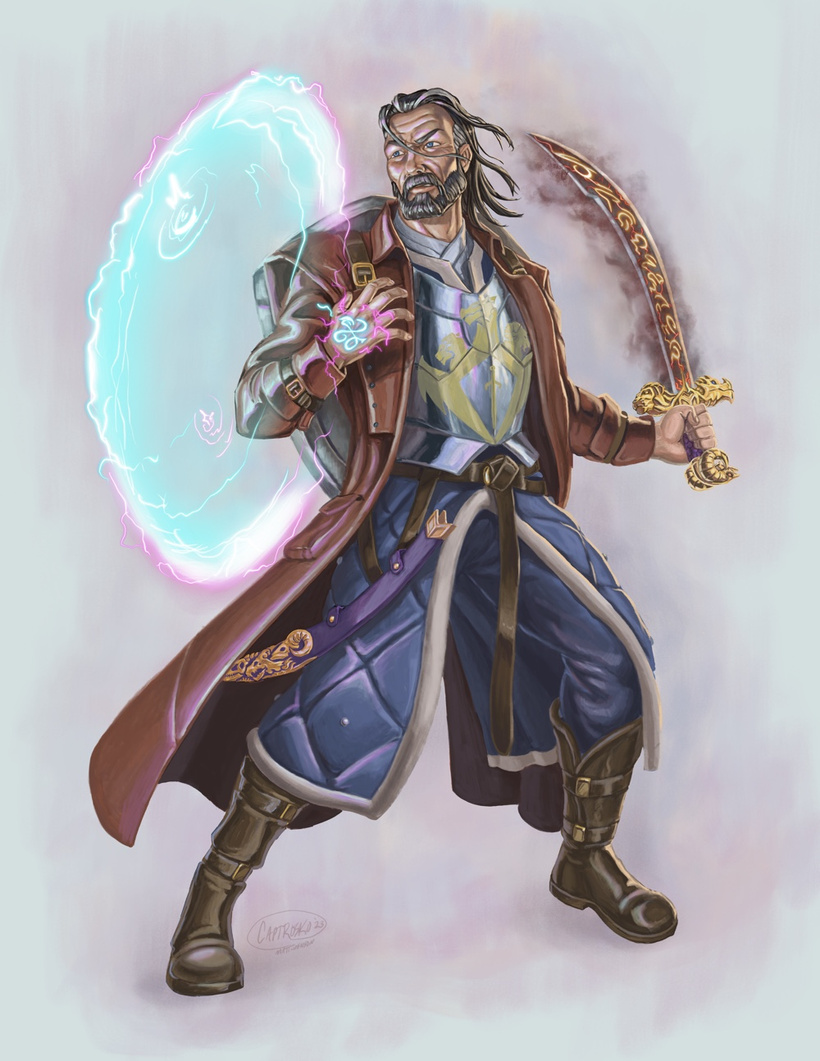
Those two have been watching you since you came in. The dwarf in the conveniently nondescript chainmail recently drank a Potion of Giant Strength—see the way his muscles are trembling, barely able to contain the power? The Khoravar’s a mage. That’s a wand of Xorian wenge in his hand, so she’s probably an enchanter. Which probably means they intend to take you alive… probably. Do you want to try your luck and see how it turns out? Or shall we discuss my rates for protection?
The Mark of Sentinel sharpens your senses. It provides an intuitive bonus to Perception and Insight. But this isn’t just about keen sight and sharp ears. It’s an intuitive bonus—an instinctive evaluation of all possible threats. The Dragonmark keeps you alert, every ready. When you enter a room, you always check the exits. When you meet a stranger, you’re always searching for signs of hidden weapons or hints as to their combat capabilities. It’s not a conscious thing; it’s been drilled into you and enhanced by your Mark. House Deneith has never abandoned its martial roots. If you were raised in the House, your education was on par with any military academy in the Five Nations. And once you survived your Test of Siberys—whether you manifested a Mark or not—you had to serve a tour in the Blademarks or the Defender’s Guild. Whatever path you’re following now, you were raised in a culture of martial discipline and service.
When creating a Deneith adventurer or NPC, consider how this upbringing has affected them. The majority of Deneith heirs serve as Blademarks or Defenders for their entire careers; that service is all they know and all they need. What about the Deneith you’re making? Do they still serve the house or have they turned their back on it? Or is it something in between—they’re a mercenary licensed by the Blademarks, but they’ve chosen to follow an independent path? Regardless of the answer, consider this. A Deneith heir was raised with a strict code of discipline and bound to a chain of command. Do they maintain that discipline as an adventurer, and possibly seek to impose it on others? Do they want the party of adventurers to function like a military unit? Or have they rejected their upbringing, choosing to celebrate their independence and freedom? Is war second nature to them, or are they trying to bury their blade?
While it varies by family, Deneith heirs tend to be stoic and serious. Heirs of the house were raised to be soldiers, and furthermore, trained to be ever alert for danger. It’s nearly impossible for a Deneith heir to fully relax and let their guard down; it simply isn’t in their nature. Likewise, Deneith heirs are driven by their desire to protect the people and things they care about. In making a Deneith character, consider who or what you’re protecting. Is it your entire adventuring party? Is it a particular individual? Or is a concept—a nation, a faith, a village? This is one of the main reasons heirs end up leaving House Deneith, whether voluntarily or as excoriates. As a Blademark or a Defender, you serve the client only as long as gold continues to change hands. You could be defending a noble one day, and serving their mortal enemy the next day. The House does its best to push heirs to see themselves as, ultimately, defending DENEITH—protecting the family and ensuring its prosperity through their hard work. But there are always Sentinels who develop an attachment to their clients or to ideals beyond pure profit. As a Deneith character, are you driven by gold and the good of your House? Or have found something that’s more important to you than platinum?
Deneith upbringing is much like a military academy, but that doesn’t mean that Deneith adventurers have to be fighters. Heirs initially train with spear, club, dagger, and crossbow, and those that excel at physical combat focus on martial training. But magic is part of everyday life in Eberron, and heirs who have the potential to become Wizards, Sorcerers, or Bards receive specialized training to develop those skills. Blademark mages are trained to focus on Evocation, Conjuration, and other spells that can play a powerful role on the battlefield; those destined for the Defender’s Guild will focus more on Spells of the Mark and personal defense. Meanwhile, a Deneith Bard is primarily trained to lead. They’re warlords, not entertainers; their Inspiration reflects this leadership, and they are driven toward the College of Valor. These paths—martial and magic—are the common choices; heirs without the exceptional potential of player characters will still be tapped as player characters. Other classes could reflect unusual training or focus. The Peacekeepers are an elite force within the Defender’s Guild, trained to protect clients in environments where no weapons are allowed; they are an order of Monks with the Warrior of Mercy subclass. While there’s no schooling for it, Deneith has produced a number of champions whose mastery of the Mark of Sentinel allows them to reduce the damage from attacks; this is a different way of playing a World Tree Barbarian, presenting their Rage and other class features as being manifestations of the Dragonmark. Other classes are less common in House Deneith. A Rogue or Warlock with the Mark of Sentinel likely developed their skills outside of the House; Deneith doesn’t typically traffic with spirits, and while the Peacekeepers are subtle, the Blademark and Defender’s Guild primarily focus on strength rather than stealth. Deneith heirs with a religious calling typically follow this beyond the House. An heir who becomes a Paladin may return to Deneith once they have mastered their gifts, and such champions often become Sentinel Marshals; but the house itself doesn’t have the depth of faith required to train Clerics of Paladins, let alone Druids.
THE MARK OF SENTINEL
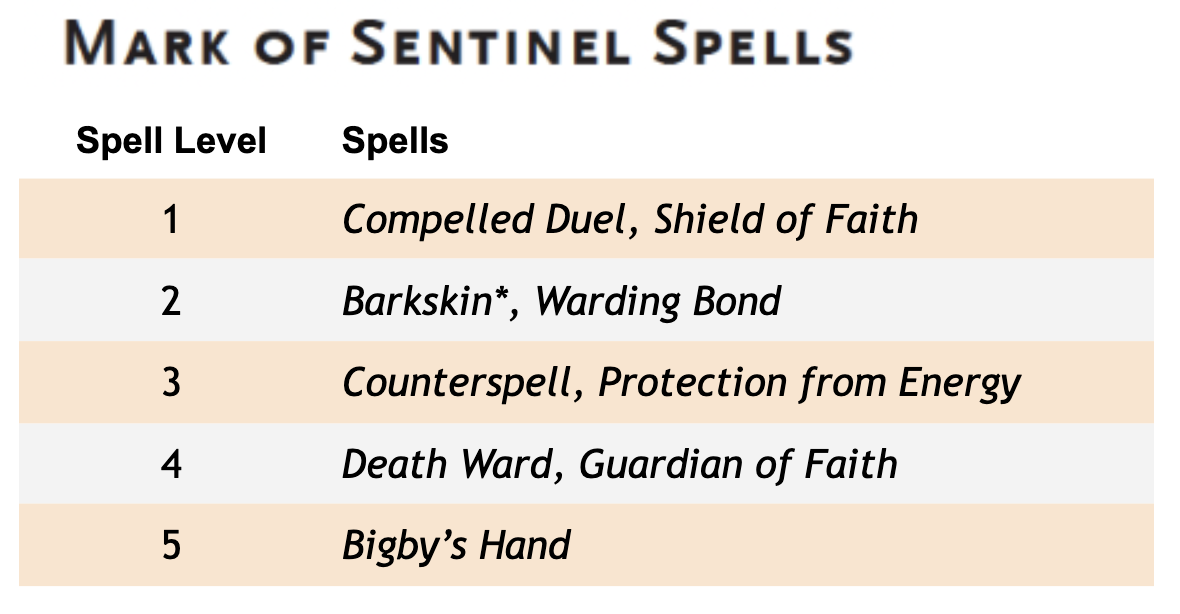
The Mark of Sentinel allows its bearer to protect themself and the people around them. Many of its gifts are straightforward, whether deflecting an attack with a wave of force (Shield) or providing slightly weaker protection over a longer period (Shield of Faith, although no faith is required). Heirs who possess the Lesser Dragonmark can disrupt other forms of energy, as seen with Counterspell and Protection from Energy. Heirs with the Greater Mark have the ability to cast Bigby’s Hand; this draws on the same force manifested with Shield, amplified and wielded with more finesse. Guardian of Faith draws on this same power, manifesting a being formed from this shield energy. Typically, a Deneith Guardian of Faith draws on the appearance of the heir’s family beast—a Ram, Lion, or Dragon. However, there have been heirs of the House whose Guardians have taken other forms; Matriarch Dalia d’Deneith was celebrated for manifesting a full Chimera with her Dragonmark.
Most of the spells of the Mark of Sentinel revolve around the projection or disruption of energy, but there’s a second thread that’s more subtle: Compelled Duel and Warding Bond. While adventurers with the Mark of Sentinel have access to all of its powers, NPCs are often more limited. Deneith NPCs from the Ravan line tend to develop Compelled Duel and Warding Bond, while those of the Wyrn families are more likely to be able to cast Shield of Faith and Barkskin. The children of the Lion—the core Deneith—are equally likely to manifest either or both sets of spells.
Kanon vs Canon. One spell on the list above is marked with an asterisk, and that’s because it’s a change from the list that appears in Forge of the Artificer. By canon rules, the Spells of the Mark for the Mark of Sentinel include Zone of Truth… and I don’t like it. Zone of Truth is a great spell for a Sentinel Marshal, and could be a useful one for a bodyguard. But thematically, it feels quite different from the other spells; it’s about investigation rather than defense. Which ties to the fact that we’ve previously said that it’s House Medani that licenses Truthtellers—Magewrights that can cast Zone of Truth. If Zone of Truth was a core ability of House Deneith, I’d expect Deneith to be licensing Truthtellers. So, in my campaign I replace Zone of Truth with Barkskin. This allows the heir to give a willing individual an Armor Class of 17 for up to an hour, with no concentration required. Thematically, I see it as an extension of Shield and Shield of Faith, describing it not as “giving the target’s skin a bark-like texture” but rather as surrounding them with a faint but noticeable shimmer of energy. This flares up when it deflects a blow, manifesting as a web of blue-purple threads. This is something people have been working with for centuries, commonly used by Defenders to protect charges who either can’t wear armor or aren’t proficient in it. So while the shimmering is subtle, it’s an effect observers will notice and recognize.
FOCUS ITEMS
Deneith heirs use Channeling Rods, Dragonmark Channels, and Dragonmark Reservoirs to access the Spells of the Mark. As suggested in Exploring Eberron, any magic item that focused on warning or protection could have a Sentinel focus version (which can only be attuned by someone possessing the Mark of Sentinel). This includes the Sentinel Shield, Weapon of Warning, or Cloak of Protection; Deneith versions of these items will bear the Chimera crest or the Mark of Sentinel itself. Here’s a few examples of unique items produced by the house.
Duelist’s Glove
Wondrous Item, Uncommon (requires attunement by a creature with the Mark of Sentinel)
These gloves are commonly issued to heirs serving in the Defender’s Guild, and bear the seal of the Defenders on the back of the hand. When the wearer casts Compelled Duel, they gain the following benefits.
- The target of the spell has disadvantage on the saving throw.
- You don’t need to concentrate to maintain the spell.
Helm of the Sentinel
Wondrous Item, Uncommon
The three faces of a chimera are engraved on this helmet, each gazing in a different direction; the pupils of their eyes are tiny siberys dragonshards. While wearing this helmet, a character with the Mark of Sentinel and the ability to cast Spells of the Mark can cast a spell with a reduced casting time. The following spells can be cast as a Reaction to being struck by an attack: Barkskin, Protection from Energy, Shield of Faith; the spell effects apply to the triggering attack, and can cause the attack to miss. Once this effect has been used, it can’t be used again until the wearer has completed a long rest (this is true even if a new person takes the Helm and wears it). Casting the spell still requires the expenditure of a spell slot; the Helm simply allows it to be cast as a reaction.
Ring of Shared Suffering
Ring, Uncommon (Requires attunement)
These rings come in linked pairs. If you possess the Mark of Sentinel, you can use a Magic Action to form a link to the creature attuned to the other ring; from then on, whenever that creature suffers damage, they only suffer half of that damage and you take the rest. This effect continues until you end it as a Bonus Action or until you or the other creature removes their ring. This Ring isn’t limited by range, though both creatures must be on the same plane to benefit from its effects. A creature cannot be attuned to more than one Ring of Shared Suffering.
Shield Beacon
Wondrous Item, Rare (Requires attunement by a creature with the Mark of Sentinel)
The Shield Beacon is a heavy, cylindrical object similar in size and shape to a large barrel. It’s made of steel and weighs 250 pounds. The sides of the metal frame are typically engraved with the image of a chimera; when the Beacon is activated, this glows with a purple-blue light. A creature attuned to the Beacon can touch it and use a Magic Action to create an emanation that extends up to 30 feet from the Beacon. Any spell of level 3 or lower cast from outside this shield can’t affect anything within it. Such a spell can target creatures and objects within the shield, but the spell has no effect on them. Similarly, the area within the shield is excluded from areas of effect created by such spells. The shield lasts for as long as the activating character remains in contact with the Beacon and maintains concentration, as if concentrating on a spell. A Shield Beacon is a durable object, but can be destroyed; it has Armor Class 19 and 30 Hit Points.
THE HISTORY OF HOUSE DENEITH
Some say war is bound to the roots of Karrnath. The area is infamous for its Mabaran manifest zones, but perhaps Shavarath and Daanvi have a subtler, broader influence. Maybe there are shards of Rak Tulkhesh’s prison buried beneath the great cities of Karrnath, whispering of violence. Or maybe it’s just that the land is cold and harsh, and that the people there must be strong to survive. That, too, is part of the mystery of Karrnath. It’s a grim land, harder on its people than the green fields of Aundair… and yet those born in Karrnath often feel a fierce love for their bleak homeland, finding the more hospitable lands of the Five Nations to be uncomfortably soft and warm.
The Mark of Sentinel was the first Dragonmark to manifest on humans. At that time, what is now Karrnath largely followed the model still seen in the Lhaazar Principalities of the mainland—a scattering of domains carved out by those with the strength to hold them. When the Mark of Sentinel first appeared on Jarla Deneith, she kept it hidden while she mastered its powers. When three of her children developed the Mark, Jarla and her kin used its power to challenge the tyrant Dynass. Though Jarla was slain in the battles that followed, the Deneith triumphed. Jarla’s eldest son, Karrlak, laid the foundations of Sentinel Tower in the city that still bears his name. At that time, almost every heir of Deneith developed the Sentinel Mark, and the legend of these mystical warriors spread across the land. It was a century later when new stories arose of Sentinel-marked champions in other realms—the Wyrns of Korth, and the Ravans of Vedakyr, which was then called Ravanloft. The Ravans were crueler than the Deneith, and ruled through force and fear. The Wyrns were loyal servants of the lords of Korth when the Mark appeared among them, and they remained loyal to their oaths, using the Mark of Sentinel to defend their liege lords rather than turning against them. From the beginning there was bad blood between Deneith and Ravan, and the next century was marked by an escalating series of duels and raids which weakened both families and their cities. The Deneith were valiant warriors, but civic administration proved to be their weakness, especially when plague and famine wracked Karrlakton. This led to the rise of a new leader, whose charisma and strategic brilliance helped him rally the common people of Karrlakton behind him: Karrn. While some tales say Karrn defeated Orrin Deneith in battle, the official account of the house says that Karrn invoked the lords of Korth and their Sentinel Guard and urged Deneith to follow their example. Karrn swore that if Orrin and his family would stand by his side and defend him, they would share in his glory. According to the Annals of Deneith, Orrin believed that Karrn was guided by the Sovereigns of War, and said that the gift his family was given was meant to be a shield, not a crown. In the decade that followed, Karrn’s fortunes soared, and the Deneith prospered at his side. One by one, the great cities fell to Karrn’s blade or submitted to his rule. The lords of Korth chose to join Karrn, and the Wyrn came with them. The Ravan resisted; they were driven from Ravanloft, and Karrn claimed the castle built by the Sentinel family as his personal sanctuary. The Ravans opposed Karrn throughout his campaign, and had things gone another way, they might have fled into the Lhazaar Principalities and remained independent to this day. But during the Battle of the Bastion, Orrin Deneith called out the matriarch Syele Ravan. Orrin said that those who carried the Warrior’s Mark should stand together, and Leodan Wyrn stood with him on this. If Syele defeated Orrin, both Wyrn and Deneith would join with Ravan and oppose Karrn. But if Syele fell to Orrin, the Ravan would join their fellow Sentinels. The Annals say that Orrin compelled Syele to accept the duel through the power of the Mark they both carried, and that magic flowed through all those who bore it, binding them to this bargain. Had Syele won that fateful duel, House Ravan might be a power in the world today. But Orrin emerged victorious, and that was the beginning of House Deneith.
The Sentinel Families stood alongside Karrn as he forged the kingdom of Karrnath and stretched his hand beyond. They fought alongside him as he crossed the river and claimed the lands to the south. And when Karrn went too far—when his army was broken and his forces scattered—it was his Sentinel Guard who saw him safely back to his castle in Ravanloft. Orrin Deneith died in the battle of Daskaran, flinging himself in the path of a ballista bolt that would have slain Karrn. While his death was a blow to his family, the story of Deneith’s commitment and courage spread wide… and when the war was finally over, Queen Lycia of Daskaran sent messengers to Karrnath, seeking a force of Sentinel Guards of her own. It was at this moment that Deneith embraced the path of the mercenary—not bound to a single king, but promising loyal service to any who would pay their price.
Karrnath persisted even after the death of Karrn the Conqueror. Karrlakton remained the stronghold of Deneith, and over time the house expanded its mercenary operations. Karrlakton became the proving ground for a force of soldiers ready to serve under any banner. Over time they spread out across Khorvaire, propping up nobles and warlords and establishing new garrisons in those cities they protected. When the War of the Mark unfolded, it was Deneith that organized and commanded the combined forces of the Dragonmarked Houses… And Halas Tarkanan, who organized the Aberrant resistance, was the son of a Deneith heir trained in the tactics of the House. When the Twelve was established in the wake of the War of the Mark, Deneith was a proud member. In the time that followed, Deneith’s ranks grew. Merchants (and House Orien) employed Deneith mercenaries to guard their caravans. City-states relied on Deneith soldiers to serve as peacekeepers. Some scurrilous accounts suggest that members of the Ravan line engaged in acts of banditry in order to drive up the demand for Deneith’s services, but these accusations were never substantiated.
While Deneith served clients all over the continent, its heart lay in Karrnath. The lords of Karrnath leaned heavily on the House, and more than once Deneith helped “adjudicate” a conflict between heirs. While the House maintained its general principle that the Mark of Sentinel was a shield, not a crown, there’s no denying the fact that they helped the Wynarn family achieve and hold power—and the Wynarns were unmarked cousins of the Wyrn. The ties between House and Crown remained close, and it was common for a Wynarn prince to reside in Karrlakton and to drill with the Deneith. This was the case with the young Prince Galifar. When that prince became a conquering king, the offer he made to the Twelve — the terms of the Korth Edicts — were modeled on the role House Deneith had played throughout the history of Karrnath. Deneith’s endorsement of Galifar played a vital role in pressuring the other Houses to accept the arrangement, and it’s no coincidence that Deneith alone retained the right to maintain significant military forces under the Korth Edicts. Nonetheless, the golden age of Galifar proved to be a challenging time for House Deneith. With the nations united, the people of Sigilstar no longer feared Aruldusk raiders, and the lords of Athandra and Danthaven resolved their disputes through the courts rather than on the battlefield. There was still some need for the Blademarks—defending merchants, battling brigands, suppressing unrest, fighting monsters. But it was clear House Deneith needed to explore new paths, and this led to the foundation of the Defender’s Guild and the Sentinel Marshals. The Blademarks had always served as bodyguards to powerful lords, but now the role of guardian was more important than that of soldier. And the Sentinel Marshals quickly became a trusted force that could be called upon to pursue fugitives from justice and to enforce the King’s laws from one end of Galifar to the other.
One might expect that the Last War would find House Deneith heavily invested in the Defender’s Guild, ill-prepared to take to the battlefield. Little could be further from the truth. In the final years of his reign, King Jarot became obsessed with the defense of Galifar. In addition to building up the Royal Army, Jarot commissioned increasingly powerful weapons of war from House Cannith and called on House Deneith to provide elite units and to prepare reserves. Patriarch Halden Harn d’Deneith could smell blood on the air, and he worked quickly to revitalize the Blademark and to draw together the scattered mercenary bands licensed by the House. It’s worth noting that the Sentinel Marshals largely opposed the Last War, and the Lord Commander Brashin Halar d’Deneith met with each of the rival Wynarn heirs, urging them to honor tradition and to preserve the united kingdom. Some say that Brashin’s assassination, six months after the death of King Jarot, was the true death knell of Galifar.
Once the war broke out in earnest, demand exploded. In most nations, nobles were expected to provide military forces to their ruler. This could be accomplished through conscription, but a lord could avoid this by paying for a unit of Blademarks to take the place of their subjects. Karrnath and Thrane were both culturally well prepared for war and had little need of such forces, but Cyre leaned heavily on House Deneith. Breland adapted over time, but also relied on Deneith in the early years of the war. Coincidentally, this meant that Deneith soldiers were often fighting their distant cousins in Karrnath. Despite this, the Karrnathi rulers respected Deneith’s neutrality, allowing the house to maintain its power in Karrlakton even as Deneith soldiers laid siege to Loran Rath. With that said, there’s a common myth that Blademark soldiers wouldn’t fight other Blademarks. Such a restriction would complicate warfare and seriously diminish the value of Deneith forces. However, there are two motes of truth to this tale. When blooded Deneith heirs faced one another in battle, they would surrender after suffering any injury—a tradition known as the first and felling blow. In situations where heirs expected to face other heirs, they would often carry a baton in addition to their primary weapon, using the club when fighting other heirs. The point being that they would fight, and to the best of their ability, but they would try not to kill their kin. It was also well known that Deneith would pay a ransom for its heirs, so even enemy soldiers would often try to take blood heirs alive. However, when heirs of Deneith fought against licensed mercenaries with no blood ties to their house, no holds would be barred. It was for this reason that Deneith was always seeking to increase the ranks of the Blademarks. When Deneith scouts discovered the strength of the hobgoblin bands in Southern Cyre and the Seawall Mountains, they were all too eager to recruit forces from the clans of the Ghaal’dar. The Ghaal’dar weren’t enacting some carefully planned scheme, and had Deneith shown more restraint or spread the Ghaal’dar forces more widely across Khorvaire, they might have averted the disaster than became Darguun. As it was, the soldier Haruuc recognized the shifting balance of power, and rallied the lords of the Ghaal’dar to support the bloody treachery that followed. In another time, the rise of Darguun might have destroyed House Deneith. But as it was, the nations employing Deneith were simply too reliant on the House to change their ways. But the shadow of that grand betrayal still looms large over the House, and it was this that allowed House Tharashk to gain support for its own mercenary endeavors.
Another point often misunderstood is the relationship between House Deneith and the elves of Valenar. House Deneith didn’t recruit the Tairnadal Elves, and it played no role in their initial arrangement in Cyre. The Eberron Campaign Setting states “When the Last War began, Cyre came under attack from all sides and quickly sought allies. While the Undying Court of Aerenal had no interest in returning to Khorvaire, the Cyrans drew the interest of the Valaes Tairn.” Queen Mishann ir’Wynarn dealt directly with the var-shan Shaeras Vadallia, against the advice of Halden d’Deneith. It was only after Vadallia’s betrayal that Deneith brokered deals with Valenar shans for the services of individual warriors and warbands. Deneith is very careful in how it assigns warbands, and their contracts with the elves hold many penalties for oathbreakers. Notably, each warclan that deals with Deneith has a representative residing in Sentinel Tower in Karrlakton—a hostage for their clan’s good behavior.
With the end of the war, Deneith once again finds itself with a surplus of soldiers. Within the house, the focus has shifted back to the Defender’s Guild. Many of the Blademark Viceroys believe the current peace won’t last, and are thus working hard to keep their best bands together. But many Blademarks have been released from service until circumstances shift.
What Happens Next?
- The Lure of Conquest. The importance of neutrality has been drilled into the house for generations. The Mark of Sentinel is a shield, not a crown. But the heirs of Deneith are only human, and there will always be those who dream of what Deneith could accomplish if it chose to act in its own interests instead of serving others. The Lord Commander of the Blademarks, Shirin Ravan d’Deneith, has such dreams. A recent convert to the Seeker faith, Shirin has been making contacts within the Order of the Emerald Claw and talking with Karrnathi warlords frustrated by Kaius III’s pursuit of peace; he may also be in contact with the Blades of Karrn in Stormreach, or Zorlan d’Cannith. Ultimately it’s up to the DM to decide if Shirin has enough support to actually move against Baron Brevan, or if his ambitions are far from being realized. A second question is whether Shirin envisions himself to be a second Karrn the Conqueror, establishing a resurgent Karrnath—or if his dream is to rally the Houses behind him in an echo of the War of the Mark, creating a realm governed by the Twelve.
- What’s Going On In Sharn? While some houses have well-established nefarious forces within their ranks—such as the Hurricane Harvest of House Lyrandar and the Feral Heart of House Vadalis—it’s important to remember that in Eberron, there’s always room for a new cult. The Hurricane Harvest and Feral Heart have history. But Cults of the Dragon Below can take root anywhere. Likewise, anyone could potentially be mind seeded by the Dreaming Dark. Because there’s no precedent in history, no one’s looking for cults in House Deneith… but it’s an excellent place to drop a cult of the Vigilant Eye (from Exploring Eberron) or a shard of Rak Tulkhesh. With that in mind, some people say there’s something strange about the Deneith enclave in Sharn; if you want to know more, check out Sharn: City of Towers.
- Hunters and Sentinels. The rift between House Tharashk and House Deneith has been simmering for a century. Sentinel Marshals have increasingly found themselves in competition with Tharashk bounty hunters, and now Tharashk is intruding on Deneith’s core business by brokering the services of Droaamites. Tharashk wields considerable influence as the primary source of refined dragonshards, and the Twelve has refused Deneith’s requests to censure the Dragonne’s Roar. This feud is a source of tension between heirs of the two Houses, and there have been bitter conflicts between individual Marshals and Hunters in the shadows. It’s up to the DM to decide how this will escalate. Will it remain limited to clashes between individuals? Could Deneith try to sabotage the reputation of the Dragonne’s Roar by manufacturing a disaster involving Droaamite mercenaries? Open conflict between mercenaries is unlikely, but anything could happen…
THE STRUCTURE OF THE HOUSE
House Deneith’s business relies on customers who have need for soldiers and bodyguards and who can afford to pay for them. A farmer might work with a Vadalis farrier, send a message by Sivis stone or Orien post, purchase a plow made by House Cannith and end the day with a drink at a Ghallanda tavern, but that farmer has no use for a squad of Blademark soldiers. Because of this, Deneith’s enclaves and outposts are found in major cities and large towns. A smaller town in a strategic location might have a Deneith office, staffed by an unmarked heir of the house who coordinates requests and recruitment, who can call on the nearest garrison if there’s a legitimate client in town. These small offices also serve as safe houses for Sentinel Marshals, providing a visiting Marshal with modest lodging and information about current events in the region. The larger outposts of the house are fortified garrisons capable of housing dozens or even hundreds of soldiers, depending on the location of the outpost and regional demand. Within a Deneith outpost, things are run with military discipline; Deneith has the strictest culture of any of the Dragonmarked Houses. Heirs and soldiers are expected to follow codes of dress and conduct and to respect the chain of command. Chaotic and disruptive behavior will not be tolerated. Minor offenses may be resolved with corporal punishment or humiliation. Deneith outposts maintain stocks or a hanging cage for such situations—although typically, discipline is tight enough that these facilities stand empty more often than not. The Dragonmarked sourcebook has this to say about Deneith culture:
As a member of House Deneith, you understand the importance of duty and honor, and of the laws used to govern and maintain those concepts. Deneith prizes tactical skill and an analytical mind, but also the importance of knowing what your word is worth—and it treats that word as though it was written in blood. Order and strategy govern all. Your house has taught you from a young age which rules can be bent and which cannot.
House Deneith reveres the Sovereigns of War, but it also honors Aureon—asserting that law and order are vital elements of civilization. The interpretation of this can vary; heirs from the Wyrn side tend to be idealists, while Ravan Deneith are usually happy to take advantage of the letter of the law. Regardless, the key point is that a Deneith outpost is effectively a military garrison, likely with tighter discipline and security than the city watch.
While Deneith outposts are fortified, Deneith enclaves are fortresses—some with foundations older than Galifar. Most Deneith heirs are raised in an enclave, and each enclave serves as a military academy—some catering to a general education, others focusing on particular specializations. Beyond housing and training the young, Deneith enclaves hold the armories and vaults of the House, including tools of war and trophies amassed over centuries of service. Here are a few of the most noteworthy enclaves.
- Sentinel Tower in Karrlakton, Karrnath is the oldest and largest Deneith enclave, having been rebuilt and expanded multiple times over the centuries. It is the ancestral home of the Deneith family and the Baron’s seat, regardless of their heritage. Beyond the tower itself, Karrlakton is devoted to the business of Deneith. There are a host of Blademark barracks, and three separate academies for training recruits. Karrlak Field is a massive open arena used for drilling troops; the Blademark also sponsors jousts and wargames as entertainment for the townsfolk. Sentinel Tower has its own smithies, but the greater needs of the Blademark are handled by a host of Cannith-trained smiths. Olladra’s Arch—or just “The Arch”—is a major Jorasco house of healing strongly supported by House Cannith and Deneith. The Arch cares for injured Blademarks, and it was here that the Jorcan Prosthetic Limb was developed.
- Fort Cail and The Gathering Stone are both in Darguun. Located in Rukhaan Draal, Fort Cail is small for a Deneith enclave, only capable of sustaining a few hundred soldiers, but it is nonetheless a heavily fortified stronghold at the heart of Darguun. Named after the Deneith Viceroy who initially negotiated the services of Ghaal’dar mercenaries, Cail is the center for the House’s ongoing negotiations with the Lhesh Haruuc and a base of operations for the salvage teams that continue to scour the ruins of old South Cyre; rumors say Fort Cail has a vault full of Cyran relics Baron Brevan is choosing to conceal from Prince Oargev. Meanwhile, The Gathering Stone is the largest fortress of the Blademark (as opposed to being an enclave of the house). It’s built next to an ancient Dar monument—the “stone” from which it takes its name, which was long a gathering place for clan leaders. For decades it has served as Deneith’s center for recruiting and training Darguul mercenaries. The Ghaal’dar are often excellent combatants, but they are used to fighting individually or in small squads. The provosts at the Gathering Stone teach recruits how to operate as part of a larger army, as well as basic training to help the Darguul work alongside Blademarks and soldiers of other nations. The Gathering Stone is generally surrounded by the tents of aspiring recruits, along with merchants and others looking to profit from the masses; there are almost always drills and wargames being carried out around the fortress.
- In Korth, Karrnath the royal palace of Crownhome is spread between two mountain spires. The Deneith enclave known as The Wyvern is carved into one of those supporting spires, the walls engraved to depict a wyvern wrapped around the rock. This is the ancestral home of the Wyrn line; its proximity to Crownhome reflects the Wyrn’s ancient role as royal bodyguards. Korth is also home to Graygate, a massive Blademark outpost.
- House Deneith has maintained the castle of Thronehold since the beginning of the Last War. This is a solemn duty, and the House doesn’t engage in business in the castle. Nonetheless, the Throne Wardens hold and maintain this ancient citadel.
House Deneith also maintains significant enclaves in Sharn, Flamekeep, Trolanport, and Varna. There are Blademark garrisons in almost every major city in the Five Nations, and there are noteworthy outposts in Trolanport, Newthrone, Taer Valaestas, Pylas Talaer, Stormreach.
While villages or hamlets rarely have Deneith outposts, it’s not uncommon for Deneith heirs who retire from service to settle somewhere quiet and out of the way. Given their natural inclination for imposing order, such retirees often end up assisting the local sheriff or constable, or settling disputes at the village inn. So the rowdy traveler causing trouble at the roadside tavern might want to listen when an old man approaches the table and tells them to settle down…
The Blademark
Blademarks are the mercenary soldiers of House Deneith. The Blademark Guild has three primary arms, each of which are represented at outposts across Khorvaire.
- The Blademark Academy trains recruits. Every recruit has to undergo a grueling basic training that tests their courage, endurance, and ability to operate under strict Deneith discipline. For a skilled recruit—a veteran soldier who served in the Last War, for example—this may be all that’s required; once they learn Blademark protocols and procedures, they may be ready to serve. The Academy also trains raw recruits, but such training comes at a cost; the House provides room, board, and schooling, but the recruit is indentured to the Guild until they pay back their debts.
- The Blademark Host is the heart of the Guild, House Deneith’s personal army. While Blademarks are soldiers, there are many specializations within the host to cater to the potential needs of clients. Some Blademarks are trained in urban security—prepared to serve as marketplace monitors, manor guards, or to support the city watch. Others are trained for the battlefield, both squad level combat and mass engagements. Such soldiers might be trained as infantry, cavalry, skirmishers, artillery crews—the Blademarks can supply whatever a client requires. While the Blademarks are soldiers, bear in mind that in modern Khorvaire magewrights and other spellcasters have important roles on the battlefield; not all Blademarks carry swords. Whether they’re wandslingers or crewing Siege Staffs, there’s plenty of roles for spellcasters in the Blademark Host.
- The Blademark Auxiliary is the branch of the Guild that licenses and employs private contractors. The Tarinadal and the Darguuls are noteworthy examples of Auxiliary forces. Auxiliaries may be hired as individuals or contracted as groups. The Blademark evaluates the skills and discipline of the contractor, and then brokers their services in exchange for a percentage of the profits. While the Blademark does its best to evaluate the reliability and trustworthiness of any Auxiliary force, Auxiliaries are inherently less reliable than the Blademark Host; nonetheless, Deneith is ruthless about punishing any Auxiliaries who fail to uphold their contracts or shirk their duties. The Darguul revolt was a cataclysmic failure for which Deneith had no answer, but smaller forces can’t expect to betray their contracts and escape without consequences.
Within the Blademark Host, soldiers are ranked based on their skill and reliability. Black Blades are the rank and file, with the skills of Warrior Infantry. Gray Blades are on par with Scouts or Toughs. White Blades could be represented by a Tough Boss, Warrior Veteran, Knight, Berserker, or Scout Captain. Gold Blades are a step above that—highly skilled and experienced forces. The Blademark training emphasizes loyalty to Deneith and adherence to the Blademark Code, which demands utter devotion to duty. Cowardice, dishonesty, insubordination, or any form of corruption will result in corporal punishment, fines, and a dishonorable discharge, as well as any penalties imposed by the law. It’s possible to find Blademarks who manage to engage in corrupt behavior despite this; people are people, and no system is perfect. But this strict discipline makes the Blademarks far more reliable than, say, the City Watch of Sharn.
The Defender’s Guild
The Defender’s Guild is smaller than the Blademark. It only employs heirs of House Deneith, and only after the heir has proven their skills through a tour of duty with the Blademark. Defenders specialize in providing personal security, acting as bodyguards and bouncers. The terms of a contract spell out the services the Defender will provide and how far they will go for their employer; Dragonmarked Defenders may keep a charge protected with a Ring of Shared Suffering, and can use the Vigilant Guardian trait of the Mark of Sentinel to take deadly blows on behalf of their employer. The Defender’s Guild has a looser structure than the Blademark, as Defenders typically serve individually or in small squads. Once they have undergone the tests of the Guild an heir receives a Writ of the Watchful Eye, a resilient document that they can present at any Defender’s Guild office in order to receive contracts.
Defenders usually specialize in speed or strength. Swift Defenders are trained to operate covertly, wearing light or no armor and carrying concealable weapons. Some are trained in unarmed combat—the basic skills of the Monk—and specialize in non-lethal combat, which can be important when managing Tavern brawls or ensuring would-be assassins can be questioned; the Peacekeepers are the masters of this art. Strong Defenders wear heavy armor and ward off would-be attackers with their obvious and intimidating presence; they emphasize durability and defense. Every Marked Defender shares basic traits of the Mark of Sentinel: +1d4 to Perception and Insight checks; the ability to cast Shield at least once per Long Rest; and Vigilant Guardian, the ability to swap places with a creature within 5 feet as a reaction in order to endure an attack that would otherwise hit the target.
While they’re not as highly regarded as the Sentinel Marshals, the Defenders are an elite force and command more respect within the House than the typical Blademark. As they are chosen from within the house, Defenders are expected to act honorably and to be ready to lay down their lives (provided they’re being paid to do so). Dereliction of duty or corruption will result in excoriation from the House as well as being discharged from the Guild.
The Sentinel Marshals
To many people, the Sentinel Marshals are a last echo of Galifar in a broken world. The Marshals have the right to enforce the law throughout the Five Nations, a right upheld by the warring monarchs at the start of the Last War and again in the Treaty of Thronehold. This reflects the idea that the nations could one day be reunited, that there are still a few traditions that hold them together. With this in mind, the Sentinel Marshals are a tremendous source of pride for House Deneith. Only the most exceptional Blademarks or Defenders will be considered for this role, and a candidate must have a thorough knowledge of the specific laws and customs of all of the Five Nations; a Marshal can enforce the law in all lands, but they aren’t allowed to break local laws in their pursuit of justice.
When dealing with the Sentinel Marshals, it’s important to understand the difference between a Marshal and a member of the city watch. A Sentinel Marshal has the right to uphold the law, but they typically only do so when their services are engaged by a client, whether that’s a private citizen, a noble, or a watch captain. If a Sentinel Marshal is having lunch at a Gold Dragon Inn and there’s a bank robbery next door, the Marshal isn’t obliged to intervene. They are still mercenaries. They put justice in the hands of anyone who can pay for it; if you don’t think the Sharn Watch is going to do anything about the man who murdered your father, you can pay a Marshal to take the case. Standard law enforcement employs Sentinel Marshals when they need their expertise or when an important case stretches beyond their jurisdiction. Again, though, keep in mind that the Marshals enforce the law. They aren’t assassins. If you pay a Sentinel Marshal to deal with the man who killed your job, they’ll do everything in their power to see that man brought to face justice. Having said that, if a Marshal’s quarry has already been declared an outlaw, they aren’t protected by the Code of Galifar; killing an outlaw isn’t a crime.
Even more than members of the Defender’s Guild, Sentinel Marshals are independent agents. The House may ask Marshals to cover particular territories, but a Marshal is expected to go wherever a case takes them. In addition, Marshals are never required to take a case. If you’ve got the gold, you can present your case to a Sentinel Marshal, but gold alone isn’t the only factor; they have to believe your cause is just, and they have to believe that they can accomplish the task. If either of these things are in doubt, a Marshal can refuse to take the case, without any stain on their record.
The Throne Wardens
Long before the rise of Galifar, it was common for monarchs and nobles to maintain a force of Sentinel Guards. Beyond their exceptional skills, it was generally believed that the neutrality of House Deneith protected a monarch from rivals within their own court who might suborn their native guards. This tradition continued even after the unification of Galifar. While the King’s Shields were tasked with the overall security of the royal family, the Throne Wardens were an elite force of Blademarks and Defenders charged with the defense of Thronehold and the monarch. When the warring siblings established the terms of battle, it was agreed that the Throne Wardens would remain in place and “protect the empty throne until it is occupied once more.” Like the rights of the Sentinel Marshals, this edict was reaffirmed in the Treaty of Thronehold and the ongoing work of the Wardens is a shared cost born by the surviving elements of Galifar. While the original Throne Wardens were chosen from among the best Deneith had to offer—standing above even the Sentinel Marshals—today it is a largely ceremonial posting. The current Throne Wardens are a blend of honored elders and young heirs from respected families, who pick up some cachet from the assignment and who might learn from the experience of their older comrades. These Wardens are still capable, certainly—but few can equal a Sentinel Marshal or a Gold Blade.
DENEITH CUSTOMS
Every member of House Deneith serves in the Blademark at some point, and the business of the house is war. While the structure of the House itself is less formal than that of the guilds, a degree of martial discipline echoes throughout the house. Seneschals, viceroys, ministers and other House officers wear insignia indicating their rank. Within Deneith enclaves, heirs are expected to show respect to their elders, to House officers, and to members of the guilds based on their rank and role; a Black Blade should hold the door for a Defender, and the Defender will move aside to make way for a Sentinel Marshal.
The stereotype of Deneith is that its heirs are stoic and grim, never speaking two words if one will do the job. And there is some basis for this; overall, Deneith culture is the most austere of all the Houses. This ties to the fact that the work of the House is a grim business. Deneith heirs put their lives on the line every day, placing themselves in harm’s way. However, this also forges a strong bond between heirs, who know their lives may be in one anothers’ hands. While there’s not a lot of levity in Deneith culture, it’s common for heirs to share stories any time they’re together—telling the tales of their most recent missions or their greatest accomplishments. In part this is distraction, and in part it’s because every such meeting could be their last; it’s an assurance that if they die tomorrow, they’ll live on in the memory of the listeners. While most heirs tell their own stories, it’s also common for heirs to share the stories of comrades who’ve recently fallen in the line of duty, keeping their memory alive. In making a Deneith heir, think about the story you like to tell. What is your greatest accomplishment or most remarkable achievement to this point? If you’re a member of the House, you’ve served in the Blademark and seen battles; who did you fight for? What role did you play? If you’ve been a Defender, who was your most interesting client? If you look at the novel City of Towers, former Deneith heir Daine is actively serving Cyre as the story begins, but over the course of the story his prior service as a Defender protecting Aurum Concordian Alina Lorridan Lyrris plays an important role. This is something you could discuss with the DM ahead of time… but it’s also something you could develop over the course of a campaign, ‘remembering’ the deeds of your character from before the campaign began.
While on the job, Deneith heirs are expected to fully support one another, regardless of any personal grievances. While off duty, Deneith heirs enjoy engaging in competitive pastimes. Each family has its own preferences for such distractions, but sparring is a universal tradition. At its base, this is simply a way to keep skills sharp—but it’s also used to settle disputes or work off aggression. Sparring is less formal than a duel and entirely non lethal; seriously injuring an opponent during a sparring session shows a lack of skill and reflects very poorly on the aggressor.
DENEITH FAMILIES
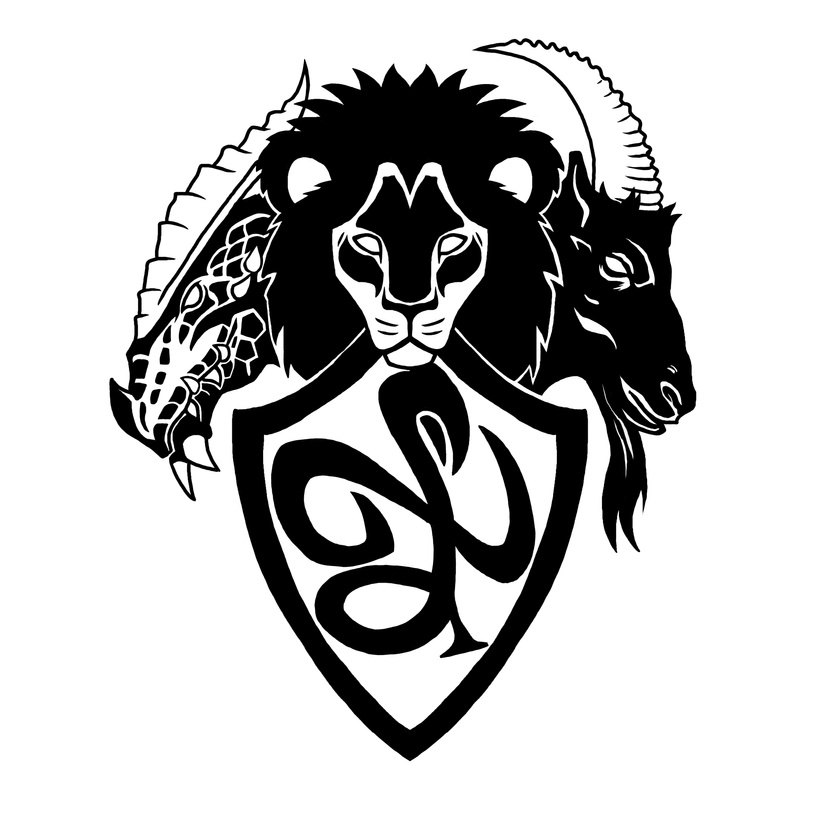
House Deneith was forged from the alliance of Deneith, Ravan, and Wyrn. The chimera seal of the house blends the heraldic emblems of each family, and the traditional placement is a map of their origins within Karrnath. The Deneith family is represented by the lion in the center position. The Wyrn wyvern (often mistaken for a dragon) is to the left of the Deneith lion, as Korth is west of Karrlakton. And the Ravan goat is to the right—even though the Ravan family no longer dwells in its original seat, now known as Vedykar. Bear in mind that in Eberron, chimeras in the wild are not always amalgams of these three specific creatures; it’s possible to encounter a chimera with aspects of bulls, serpents, or other beasts. So everyone recognizes the Deneith seal as a chimera, but it’s not a remarkable coincidence that they used the exact sigils necessary to create such a beast.
While the Defender’s Guild is restricted to direct heirs of the house, the Blademark is open to anyone with sufficient skill and respect for the traditions of the house. It’s common practice for a Blademark who serves a long and distinguished term to be granted honorary membership in House Deneith; while this is typically granted upon retirement, it can be bestowed on an active Blademark who performs remarkable deeds. This honorary membership is a source of respect and gives a Blademark access to Deneith enclaves… and also makes the honoree eligible to marry into the house, if they find a willing companion. Compared to many Houses, Deneith heirs have a relatively free hand in choosing their partners, but they can only marry other members of the House—honorary or otherwise. This is the origin of the lesser families; the founding house they are associated with reflects their common heritage and the values they choose to embrace. A few of the lesser families are mentioned below, but it’s not a comprehensive list.
Something to keep in mind when considering Deneith’s founding families is that Karrn the Conqueror was a driving force behind the Sovereign sect known as the Three Faces of War, and the Sentinel families were a part of that. The Mark of Sentinel was considered to be a blessing from the Sovereigns of War, and each of the ancient families believed they were favored by a particular Sovereign. Karrn’s three advisors and constant companions were priests devoted to the Sovereigns of their lines. Osheva Wyrn (also said to have been Karrn’s queen) was devoted to Dol Arrah, Drego Deneith was dedicated to Dol Dorn, and Azhaar Ravan was sworn to Dol Azur. The Three Faces of War have a strong presence within the house today, but the faith isn’t forced upon heirs. Nonetheless, the families do broadly reflect the values of their associated Sovereign; the Wyrns are most concerned with honor and duty, while the Ravan have the most flexible approach to war.
Deneith
Symbol: The Lion
Common Traits: Courage, Strength, Confidence
Lesser Families: Balthus, Dunan, Harn
The Deneith family is the heart of the House that bears their name. They aren’t as idealistic as the Wyrn or as clever as the Ravan, but they are devoted to the principles that have brought prosperity to their house—courage and discipline, never allowing personal opinion to stand in the way of their duty. Beyond this, the culture of Deneith has a knack for producing natural leaders. Charisma is a factor in this, but confidence may be the key to it. Deneith heirs typically have strong self-esteem and trust their abilities and instinct; they are quick to make decisions, and others respond to that confidence. Deneith heirs typically identify with Dol Dorn—trusting in courage, strength and steel.
The Deneith family values strength and endurance, and casual tests of strength and courage are common ways to pass the time; go to a Blademark garrison and you’ll probably see a Harn and a Dunan armwrestling. Within the Defender’s Guild heirs tend to follow the path of strength, favoring heavy armor and straightforward assignments. Despite the ancestral importance of the house, relatively few Deneith heirs become Sentinel Marshals. They lack the Wyrn drive to see justice done or the Ravan cunning that helps hunt down a tricky foe; as such, they typically pursue leadership roles in the Blademark instead of chasing after the title of Marshal.
Overall, Deneith heirs tend to be solid and reliable allies. They typically speak their minds and stand by their words. A Deneith knows not to pick a fight where none is required; there’s no point to wasting energy if you don’t stand to profit from the battle. But they are never afraid to stand up when there’s reason to do so. A Deneith may not have a Wyrn’s devotion to personal honor, but they still despise treachery; for the Deneith, a contract is everything. Once you commit to a task, you see it done.
Deneith Characters. Fighter is the archetypal path of the Deneith heir. The classic role for Deneith is the Battle Master, blending versatility with leadership; a Blademark might choose Commander’s Strike and Commanding Presence, while a Defender gets good use from Disarming Strike, Bait and Switch, and Parry or Riposte. Alternatively, Eldritch Warrior provides spellcasting slots and allows an heir to make more use of their Spells of the Mark. A more exotic option for a Deneith character would be a World Tree Barbarian, with “Rage” reflecting a remarkable manifestation of the Mark of Sentinel that temporarily shields the character from harm; this could even physically manifest as a shield formed from the blue-purple threads of the Mark itself.
Notable Deneiths. The leaders of the House have almost always come from the Deneith family, and Baron Breven d’Deneith is the latest of these. Breven rose through the ranks of the Blademark Host and saw plenty of action during the Last War before being raised to the rank of Baron. He’s a brave man and solid tactician who stands by his family’s ancient maxim that the Mark of Sentinel is meant to be a shield, not a crown. He’s been challenged both by the end of the Last War and the rising tensions with House Tharashk, but he resists the words of advisors urging for sharper action against Tharashk or for the House to make its own bid for power.
Ravan
Symbol: The Goat
Common Traits: Cunning, Finesse, Innovation
Lesser Families: Coldwin, Durrn, Stilling
Duty and discipline are cornerstones of House Deneith. Everyone knows that a Deneith Defender can be trusted to give their life for their charge, that they can be set to watch things of great value with no fear of theft or treachery. This is true even of the Ravan. They know how important that absolute trust is to the prosperity of the house, and that anyone who endangers it faces excoriation or worse. So the Ravan can be trusted to fulfil their contracts and to honor their commitments. But beyond that, the Ravan are noted for their cunning. Those that follow the traditions of the Three Faces of War usually seek the blessings of Dol Azur, known elsewhere as the Mockery. They know that courage and honor aren’t always enough to ensure victory, and they’re always looking for unorthodox paths to success. While the concept of a family devoted to the Mockery might seem to be a problem, again, the Ravan never shirk their duties. But they’re always considering new ways to do things and clever ways to defeat an enemy—and over the centuries, the House has found ways to use this. Kolas Ravan d’Deneith is a legendary Sentinel Marshal who managed to track down the most challenging quarries; many said “he must be half Medani” due to his knack for investigation and his clever stratagems. Within the Defender’s Guild, Ravan heirs excel at the Swift path—wearing light or no armor and relying on speed and precision instead of strength and endurance. Defenders of the other families excel at standing bold and firm in the face of danger; but if you need a Defender who remains unnoticed until the precise moment they’re needed, you want a Ravan. The Ravan may have a knack for intrigue and deception, but they use those instincts on behalf of their House and their clients; they are no more prone to corruption than any other family in the house.
While they’ve served the united House faithfully for over a thousand years, the Ravan family still feels the sting of their ancient rivalry with the Deneith. Sentinel Tower is the pride of the Deneith family and the Wyrn celebrate their roots in Korth, but the Ravan were driven from their ancestral seat by Karrn the Conqueror and many Ravan see Vedykar as a point of shame. Again, the family is devoted to the success of the House and to fulfilling their contracts, but many Ravan heirs carry out casual rivalries with Deneith cousins, seeking to prove that their cunning is more effective than the courage and brawn of the Deneith. No wise Ravan would endanger a contract by interfering with a rival’s job—the goal is to outshine the rival with exceptional success, not to sabotage the enemy and thus burden the house with failure. Where Deneith often fill their down time with physical pursuits, the Ravan take pride in their cunning and are more likely to be found playing Conqueror or cards; it’s a classic maxim of the house that you’ll never know when a Ravan is bluffing.
A Ravan heir can be a tricky companion. They’re sure to keep secrets, and may be carrying out multiple romances, rivalries, and intrigues. But they largely use their charm and wit for the greater good of family, House, and friends.
Ravan Characters. The Ravan emphasize speed and cunning over brute strength. The classic Ravan is a Gloom Stalker Ranger, focusing on Dexterity and Charisma. Their spellcasting allows them to employ Spells of the Mark, and the Gloom Stalker’s ability to cast Disguise Self can be quite useful for an undercover Defender or a Sentinel Marshal tracking a clever enemy. Having abandoned Vedykar, the Ravan have a strong presence in Sharn, and the heirs there have been experimenting with the techniques of the Psi Warrior Fighter; the psychic damage of the Gloom Stalker’s Dreadful Strike ability could also be presented as a Sharn technique. The Ravan are also the family that developed the monastic techniques of the Peacekeepers, which can be reflected by the Warrior of Mercy or Warrior of the Open Hand Monk. A final note on the Ravan is that they make efforts to develop a broad range of contacts, seeing the value in having friends in low places when hunting down criminals. As a result, a Ravan heir could take the Criminal, Charlatan, or Wayfarer background not as a reflection of an actual criminal career, but rather representing time spent making contacts in the criminal underworld.
Notable Ravans. Sadran Ravan d’Deneith is the Seneschal of Sharn, and the Sharn enclave is a stronghold of the Ravan family. Following the Ravan drive to experiment with new traditions, the Sharn enclave has been experimented with psionic disciplines. Lalia and Tasra Ravan d’Deneith are twin sisters born in the Sharn enclave. Both are respected Sentinel Marshals known for playing with their prey; Lalia specializes in tracking enemies in the wilds, while Tasra excels at urban intrigue. Shirin Ravan d’Deneith is Lord Commander of the Blademarks—the first Ravan to hold that rank—and has been working to build connections with the Order of the Emerald Claw, the dissident warlords of Karrnath, and other powerful allies.
Wyrn
Symbol: The Wyvern
Common Traits: Honest, Altruistic, Wise
Lesser Families: Halar, Olkanus, Stone
The Wyrn are idealists, raised to believe that House Deneith is a powerful force for justice that helps maintain order throughout society. Where all of the Deneith families emphasize the importance of discipline and fulfilling a contract, the Wyrn charge their heirs to be honest and honorable throughout their lives, not simply when serving a contract. Sentinel Marshals aren’t obliged to enforce the law unless they’re being paid to do so, but Wyrn heirs are likely to stand up to bullies or challenge criminals simply because it’s the right thing to do. Alone of all the Sentinel Families, the Wyrn never sought to use their gifts to gain power; they always chose duty over personal glory. As a family, the Wyrn believe they are blessed by Dol Arrah and seek to follow her example. This is reflected by their devotion to honorable behavior, but Dol Arrah is also the Sovereign of Wisdom in War. Wyrn are taught not to act impulsively, not allowing raw courage to overcome common sense. While they may not be as cunning as the Ravan, they understand the importance of strategy and are careful to evaluate their enemies, searching for weaknesses and developing a plan before launching an attack.
Wyrn has always been the smallest of the founding families. In part, this is because of their utter commitment to the job; more than any other line, the Wyrn are willing to die to protect a client or to complete a mission, and over time that has an impact. But it’s also the case that the Wyrn have lost more heirs to defection—that is, voluntarily leaving the house to serve another force or cause—than any other house. Over the course of the Last War, a significant number of Wyrn heirs left the house in order to fully serve the nation in which they were raised. Beyond this, the Wyrn are the most religious members of House Deneith. While many are devoted to the Three Faces of War and Dol Arrah, a number of Wyrns have felt the call of the Silver Flame. Some Wyrns have left the house to serve as templars or Knights of Dol Arrah; others balance their faith with their mercenary service, and their handlers are careful to assign them missions that won’t come into conflict with their beliefs.
Wyrn heirs are unquestionably loyal companions, but their altruism and commitment to honesty and justice can be challenging if a group of adventurers prefers to walk a morally gray path. On the other hand, there is another iconic Wyrn character: the hero who gave their utter devotion to a cause only to be let down so dramatically that it shattered their faith in justice. This is the case with a number of Wyrn Deneith who left the house to serve Cyre, only to see that nation utterly destroyed; but it can also be driven by relentless encounters with small-scale corruption that have undermined the character’s optimism. Can such an heir overcome their cynicism and reclaim their young idealism?
Wyrn Characters. Fighter remains a solid option for Wyrn characters, whether Champion or Battle Master. However, Wyrn is also the family most likely to produce a paladin. This could be driven by faith in Dol Arrah or the Silver Flame, but it could be framed as power drawn purely from the blend of the Mark of Sentinel and the character’s absolute devotion to justice. While Wyrn paladins are an iconic concept and while there have been a few of them throughout the history of the House, they’re by no means common—in part because individuals called to serve as paladins often feel a drive to leave the House and serve that greater cause instead of working for gold.
Notable Wyrn. Endira Wyrn d’Deneith is a proud Sentinel Marshal who’s often invoked as a face of the house due to her courage and heroic deeds. She’s quoted in Rising From The Last War: “Galifar lies in ruins, destroyed by its own folly, but our rights and duties cannot be set aside. Our oaths bind us still. Let those who would oppose the law know us, and end their days in fear.” Daine Halar, a protagonist in the Dreaming Dark novels, is a Deneith heir who left the house to serve in the Cyran army, and who lost his Wyrn idealism in the course of that service and the fall of his nation.
FINAL THOUGHTS
Where any Dragonmarked House can play a role in a story, House Deneith is unusual in that its heirs can regularly be encountered as antagonists without actually bearing the adventurers any ill will. An Aurum Concordian, a secret cult leader, a mind-seeded agent of the Dreaming Dark—anyone can have Deneith Defenders sworn to protect them from harm. If the adventurers break the law in the course of their travels, a Sentinel Marshal could be set on their trail. A squad of Blademarks may show up to escort adventurers to a “friendly meeting” with a local power broker. In these cases, the Deneith are just doing a job. They don’t want to kill the adventurers. Should combat break out, will the adventurers kill them? Assuming that the answer is no—that the adventurers are willing to pull their blows and to spare their defeated enemies, it can be fun to have a particular Deneith Defender who shows up again and again. Whoever it is they’re fighting, when the adventurers finally get to the big boss, there’s Bob d’Deneith at their side moaning not you again!
House Deneith doesn’t need a nefarious scheme to be placed in opposition to adventurers; it’s a natural consequence of the services they provide. As noted earlier, while they don’t have a historical menace like the Hurricane Harvest or the Feral Heart, it’s easy to drop a cult into a Deneth garrison. The Vigilant Eye of Belashyrra causes cultists to see “hidden fiends” and other threats. A town could be policed by Deneith forces who truly believe they’re defending the people from supernatural threats, and maybe they are; how can the adventurers determine the truth? On a grand scale, Shirin d’Deneith dreams of a second War of the Mark and a world where the Houses openly rule; is that something you wish to explore? Having presented all of these negative possibilities, a thing to consider with Deneith is that they can just as easily appear as allies. When the adventurers are facing a war criminal, a Sentinel Marshal could show up with the task of taking them down. For inexperienced adventurers, that Marshal could serve as an early mentor and strong ally. If the adventurers are more powerful than the Marshal, they can still provide useful information and the backing of the law. There could be a Deneith defender serving as the bouncer at the adventurers’ favorite tavern, or protecting their beloved patron; in either case, they could end up fighting alongside the player characters.
Here’s a few ideas for Deneith characters you could play or meet.
- The Old Soldier. You served in the Blademark and fought on every side of the war. You became a Sentinel Marshal, but there came a day when you realized that justice for gold weren’t no justice at all. So you took your gold shield and retired to a quiet place where you thought you’d never have to draw your sword again… But Olladra laughs at your plans. As a player character, the Old Soldier may start at the same level as the other adventurers, but the idea is that they’ve already seen amazing things. In their prime, they WERE higher level—but age, inactivity, and that old war wound have slowed them down to whatever level you’re starting out as. The Old Soldier has countless war stories and may have old friends and enemies scattered across Khorvaire.
- The Celebrity Defender. You may be young, but you earned your Writ of the Watchful Eye. When you dealt with that assassin at the Tain Gala, the Sharn Inquisitive put you on the front page, and suddenly every celebrity in Sharn wanted you as their bodyguard. You’ve defended Fairhaven Ghallanda, the bard Kessler, Ruken ir’Clarn. If you’re an NPC, this might be as far as your story goes. You’re the square-jawed, clean-cut poster child for the Defender’s Guild who’s sure to be escorting someone at any major event. On the other hand, if you’re an adventurer… WHY are you an adventurer, instead of bodyguarding for the stars? It could be that you’re still doing that in your down time. Or it could be that something went terribly wrong and ruined your perfect life. A celebrity was killed dramatically on your watch and you haven’t had a job since then… and the killer’s still at large. Maybe… maybe if you can catch that killer, you can redeem yourself in the public eye.
- The Young Marshal. You’re the youngest heir of the House to be appointed to the rank of Sentinel Marshal. Why is that? What did you do to earn this privilege? And more important, can you live up to it? Depending on your level, you may be relatively inexperienced compared to your fellow Marshals. Can you get the job done? Marshals choose their assignments, so you should be able to work around your adventuring career. But your deeds will reflect on the House as a whole, and they expect great things from you—can you deliver?
- The Champion of Justice. You’re a Wyrn Paladin and you believe that House Deneith is a force for order in a chaotic world. You served your tour with the Blademarks, but then you felt a greater calling. You’re a tool of Dol Arrah and Aureon, and you will root out injustice wherever it can be found. By default, this character is an heir of Deneith who served an honorable term in the Blademark and is now acting independently. You haven’t cut ties with the House and you’re still a member in good standing, but you aren’t currently working for a House Guild; your QUEST FOR JUSTICE is more important.
- The Jaded Ex-Merc. The Old Soldier served for decades before retiring. You only served a single tour. But even in that short term, something happened that shook you to your core. Was it something about the job itself? Were you forced to fight a friend, or to retreat from a fight when you knew you could have made a difference? Whatever it is, you’ve cut ties with the House. Were you dishonorably discharged, or did you leave of your own choice? If the latter, do they want you back? Is it possible you could change your outlook, or is the rift too wide?
- The Cruel Marshal. House Deneith punishes corruption. But a Sentinel Marshal can do their job and enforce the law, and still be a terrible person. They might employ cruel tools or techniques in the pursuit of their quarry. They could cause collateral damage without remorse or intimidate innocents. House Deneith relies on its reputation, and an heir who engages in behavior that will harm the house will be punished. But if a Marshal is operating on the edge of civilization, they may simply trust that word of their misdeeds will never reach the House… or in a truly extreme case, a corrupt Marshal could murder innocents to cover up their crimes. Such a character is a bad choice for an adventurer, but could make a compelling adversary for adventurers—especially if they are initially assigned to work together!
In making a character from House Deneith, it’s important to establish your relationship to the House. Looking at the examples above, the Old Soldier and the Jaded Ex-Merc have cut their ties to House Deneith; it’s part of their past and they may have friendly contacts, but they aren’t part of the House and can’t be called to duty. The Celebrity Defender and the Young Marshal are still part of the House, but work independently; a job offer could be worked into the campaign, or it could be something that happens during downtime.
That’s all for now… Thanks for your support!