House Cannith and the Mark of Making

The coldfire lantern hanging from the ceiling? That flickering’s due to a poorly etched sigil. Give me five minutes and a crown’s worth of residuum and I could have it steady and brighter. There’s a crack in the cleansing stone, and if it continues another inch it’s going to start soiling instead of cleansing. But that’s not the worst of it. In my mind I can see a better design. I could make a cleansing stone that’s half the size, using half the shards, that would make colors even brighter. I can see it. I could make it. I know I could. I just don’t have the time.
The Mark of Making provides an intuitive bonus to any ability check made using Artisan’s Tools. This isn’t Proficiency, though it stacks with it; it’s an intuitive understanding of tools. Weaving, painting, baking, smithing—you instinctively know how to make things. This guidance goes beyond the mundane. The Mark of Making provides the same intuitive bonus to any Intelligence (Arcana) check, and anyone who carries the Mark has the ability to cast Magic Weapon once per day. Magic comes naturally to you, and one of the first things you learned to do was to weave it into wood and steel. So when you look at a weapon, you know you could improve it. When you see a broken object, you know you could mend it. And if you had the tools and the time, you know that you could make something better.
For some Cannith heirs, this knowledge becomes an obsession. They can’t pass by a broken object without Mending it. Others may seem socially awkward or absent minded, because the designs they’re working through in their minds are always more interesting than the conversations around them. But for most Cannith heirs it’s a background detail and a point of pride. They are confident in their skill, and find it soothing to create things; Cannith heirs often have some project they’re working on, something small that keeps their hands busy. But they don’t have to work on it at all times; they can set it aside to focus on the needs of the moment.
House Cannith has long been seen as the most powerful Dragonmarked House and the heart of the Twelve. In part, this is due to the commercial success and wealth of the house. Cannith goods have long been part of everyday life across the Five Nations, from the Everbright Lanterns that light the streets to the coaches that drive along them. Cannith supplied the armies that fought in the Last War, producing arcane artillery, armor and weaponry for soldiers, and with the warforged, soldiers themselves. But beyond that, many Houses rely on Cannith for the tools that are integral for their success. The Lightning Rail, Elemental Airships, Speaking Stones—all of these were designed with the assistance of Cannith artificers and produced in Cannith factories. This in turn has nurtured a cultural arrogance within the House itself; Cannith heirs consider themselves the equals of any noble, seeing their House as the greatest power in Khorvaire. At least they did until the Mourning. The loss of Eston and of the Patriarch Starrin d’Cannith has sown the seeds of chaos. Almost every heir supports one of the three leading candidates to replace Starrin, and no compromise has emerged in the last four years. The divided House was unable to block the edict in the Treaty of Thronehold that shut down the creation forges, further weakening House Cannith. The House continues to move forward, sustained by its infrastructure and its momentum, but pressure is building. If the House can’t mend itself and unite behind a single leader, it could soon splinter into three.
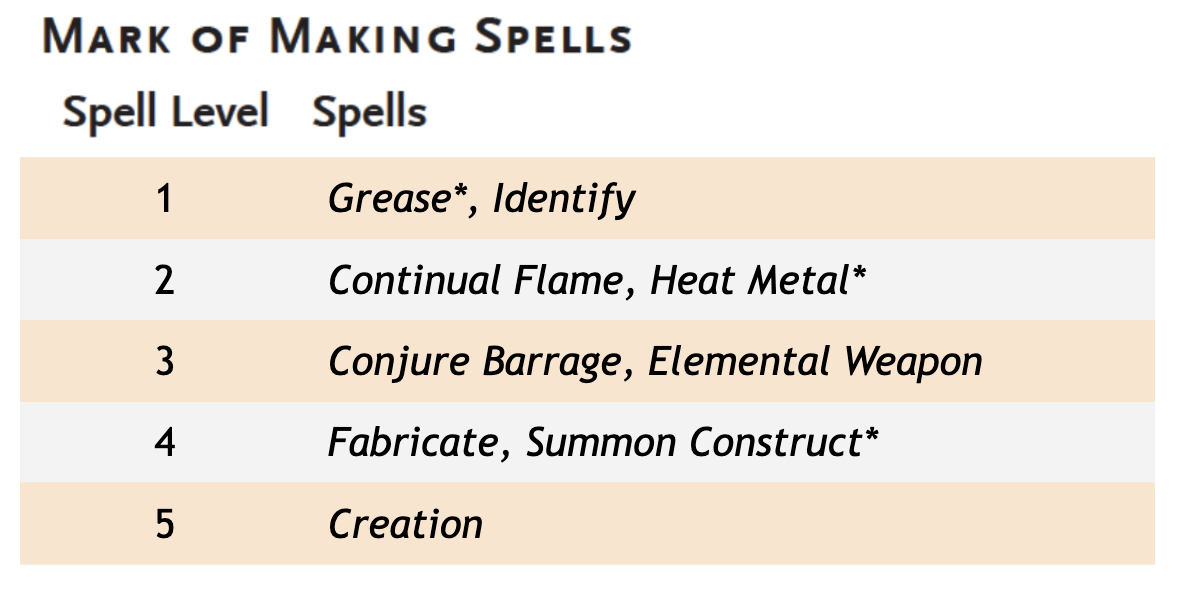
THE MARK OF MAKING
The most basic gift of the Mark of Making is Mending—the ability to repair things that have been broken. While the most obvious manifestation of this cantrip is repairing a break or tear, in my campaign I also allow it to undo other sorts of minor damage: smoothing out dents, restoring burnt cloth or leather, lubricating rusted metal, and similar minor transformations. Cannith Tools amplify these gifts in small and sustainable ways, while the Spells of the Mark allow a Cannith Heir to perform instant, dramatic effects. Some say the Mark of Making draws on Onatar’s Forge while others claim it’s tied to the Fires of Fernia. Whatever the truth, a Dragonmarked heir can instantly Heat Metal or Grease a surface. Fabricate allows an heir to visualize a creation and use the Mark to impose their vision upon raw materials; while the ultimate power of Creation manifests matter from pure arcane essence to make the vision real. This is also the basis for the dramatic Conjure Barrage, which allows a Cannith heir to temporarily create a swarm of weaponry.
Summon Construct lies between Fabricate and Construction. While the spell normally requires “a lockbox worth 400 gp” as a nonconsumable material component, when cast with the Mark of Making the caster instead needs to be holding a set of Artisan’s Tools with which they are proficient. While no materials other than the tools are required to cast the spell, Canith heirs usually draw on raw materials in the area and fill in the gaps with manifested matter; the final appearance of the construct depends on the materials used and the imagination of the heir. Many younger heirs manifest constructs similar in appearance to warforged, because they are used to working with warforged; but others could create animated armor, metal insects, or even clockwork beasts. When the spell expires, the manifested matter dissipates and the construct collapses back into raw components. Regardless of the materials used to create the construct, when it is summoned the caster decides whether it possesses the Heated Body, Stone Lethargy, or Berserk Lashing trait.
An heir capable of casting Spells of the Mark can cast Identify as a ritual. Here again, the heir needs to have a set of Artisan’s Tools they’re proficient in rather than the traditional pearl component; when casting Identify, the heir is essentially running a series of tests on the object they are studying. Meanwhile, Magic Weapon is a fundamental power of the Mark that any heir can cast—while those with access to Spells of the Mark can master the more powerful Elemental Weapon.
Kanon vs Canon. Three of the spells on the list above are marked with asterisks, and that’s because they vary from what’s presented in Forge of the Artificer. In the original Eberron Campaign Setting, two of the Mark of Making’s spells were taken up with Repair Damage; Mending was a full spell rather than a cantrip; and Creation was split into two spells. So in translating the Mark of Making to 5th Edition, there’s a lot of space to fill… but I don’t love the choices made in canon. I associate Cannith with metal, so using the Mark to lubricate and heat metal makes sense to me—more sense than Floating Disk and Spiritual Weapon, both of which are more about projection of force and levitation. At 4th level, I prefer Summon Construct to Stone Shape. I don’t feel like stone is something we’ve called out as playing a major role in Cannith, while constructs have been part of its story since the first Gorgon!
ARCANE FORGES AND CREATION PATTERNS
The most iconic tool of House Cannith is the Creation Forge used to create the Warforged. These eldritch machines draw on the full potential of the Mark of Making, working with the principles of Creation and Fabricate to manufacture construct bodies and draw the spark of life into them. The Treaty of Thronehold demanded that House Cannith shut down its Creation Forges and cease the production of Warforged, and the House appears to have done so. But the Creation Forges are just one of the many arcane tools House Cannith employs to streamline its production process. Arcane forges are stationary tools that amplify the powers of the Mark of Making. The standard arcane forge can only be operated by someone with the Greater or Lesser Mark of Making—which is to say, someone who can cast Fabricate as a Spell of the Mark. Arcane forges are limited in a number of ways.
- A forge requires a Schema, which is a blueprint for a particular object. The forge has to be attuned to the Schema, which takes time; so on a typical day, an arcane forge is only producing a specific thing.
- Most arcane forges are specialized tools that can only work with a particular type of material—metal, wood, stone.
- Likewise, most arcane forges are limited in the size and complexity of object they can fabricate.
- An arcane forge requires a small amount of residuum (refined eberron dragonshards) to operate. This is a minor cost that’s far outweighed by the speed and efficiency of the forge, but it is a requirement nonetheless. In the past, this has been a limitation on how many forges the house could operate. The rise of House Tharashk ensured a steady flow of dragonshards, which has allowed Cannith to expand its use of arcane forges.
A Grand Forge provides access to the full scope of Fabricate, allowing an heir to, for example, produce a fully formed longsword from the raw materials presented. However, the more common Base Forge is typically used to produce components which are then assembled by workers on a line. It dramatically speeds production and helps to ensure uniformity of product, but it’s still a process that requires a significant amount of human labor. Whether using a Base Forge to produce simple elements or a Grand Forge to produce finished goods, the heir operating the forge is required to be proficient in the type of tool that would normally be used and to make a check to ensure the quality of the product. In essence, the heir walks through the process of production in their mind and the forge uses the Mark of Making to make it real. While the operator has to have the ability to cast Fabricate through their Mark, they don’t actually cast the spell when using a forge; like a Sivis heir operating a Speaking Stone, it’s something that they can repeat indefinitely—provided they have rare materials and residuum.
Arcane Forges are a form of Eldritch Machine. They’re large, stationary objects tied to a specific f. However, Cannith has smaller tools that help them accelerate production. Creation Patterns are metal rods or tablets engraved with arcane sigils. A Creation Pattern holds the imprint of a particular magical device. This reduces the time and cost to create the item embedded in the Pattern by 33%, provided the artisan has the Mark of Making and has access to the Pattern throughout the creation process.
FOCUS ITEMS
House Cannith is the primary source of Dragonmark Focus Items in Khorvaire. Cannith heirs regularly make use of Dragonmark Channels, Dragonmark Reservoirs, and Channeling Rods. Exploring Eberron calls out that House Cannith can produce objects that duplicate effects of existing magic items but with the additional requirement of having the Mark of Making to use them. A few examples of these…
- Onatar’s Gift has the powers of an All-Purpose Tool. A +1 Onatar’s Gift is standard issue for any capable Cannith Artificer, and is generally shortened to Ony—as in, “You got your Ony?”
- Cannith’s Marvelous Miniatures are identical in effect to Quaal’s Feather Tokens, but they appear to be small metal objects in the shape of the token effect (Anchor, Bird, Fan)
- Talin’s Compact Constructs duplicate the effects of Figurines of Wondrous Power, but they appear to be articulated metal models rather than statuettes; they expand in size when activated.
- Merrix’s Instant Fortress works like Daern’s Instant Fortress; the Cannith model was created by the same artificer who developed the Warforged Titan (the grandfather of the current Merrix d’Cannith).
- The Apparatus of Cannith is similar in effect to the Apparatus of Kwalish. Cannith developed the Apparatus over the course of the last decade as a potential submersible for use in the Last War, but has been unable to produce a version that doesn’t require the use of the Mark of Making.
The idea is that all of these items are drawing on the power of the Mark of Making. In the case of the Compact Constructs, Instant Fortress, and Onatar’s Gift, the item literally builds itself when activated, using the principles of Creation to fabricate temporary matter. In the case of the Apparatus, the idea is that the heir has to use the power of the Mark of Making to keep the Apparatus stable and functioning. I might allow a player character Artificer (especially a Battle Smith) to operate an Apparatus of Cannith, with the idea that they can use their own remarkable skills to hold things together. So in choosing Focus Items for Cannith, look in particular for things that are used to create objects or that could be depicted as creating themselves. The Rod of Lordly Might is another example of this, with the idea that the Rod constructs and deconstructs the various weapon forms it can take.
Here's a few additional focus items drawn from canon...
Cannith Goggles
Wondrous Item, Uncommon (Requires attunement by a creature with the Mark of Making)
Cannith Goggles amplify the Identify power of the Mark of Making, allowing the wearer to perceive wavelengths of magical energy. It provides the following benefits.
Arcane Sight. You have Darkvision out to sixty feet. There is no additional benefit if you already have Darkvision.
Spells. The Goggles have 7 charges. If you possess the Mark of Making, you may cast one of the following spells from them: Detect Magic (1 charge), Identify (1 charge), See Invisibility (1 charge).
Regaining Charges. The Goggles regain 1d6+1 expended charges daily at dawn. If you expend the last charge of the Goggles, roll a 1d20. On a 1, the lenses shatter and the goggles are destroyed.
Collapsible Shield
Wondrous Item, Common
The Collapsible Shield is a leather wristband with a small metal disk affixed to the back of the wrist. If you possess the Mark of Making, you can use a Magic Action while wearing the bracelet to transform it into an equipped shield. You can use a second Magic Action to return it to its bracelet form.
Sky Forge
Wondrous Item, Rare (Requires attunement by a creature with the Mark of Making)
A Sky Forge amplifies the innate abilities of the Mark of Making. If you cast Fabricate while touching the Sky Forge, you can create an object of up to Huge size; if you’re working with minerals, you can create a Large object. A Sky Forge is a thick steel ingot inlaid with patterns of silver and siberys dragonshards; it weighs 35 pounds. While a Sky Forge is free of many of the limitations of the stationary arcane forge—it doesn’t require a Schema or burn residuum—the user has to actually cast Fabricate themselves, while other arcane forges don’t require the operator to cast the spell.
THE HISTORY OF HOUSE CANNITH
Cyre was said to be the heart of Galifar, and with good reason. The central region of Khorvaire is blessed with a blend of fertile soil, abundant resources, and beneficial manifest zones. When humanity spread across Khorvaire, the Metrol League was quick to prosper. Initially a single city, the League expanded to include the city-states of Metrol, Eston, and Tolan. The Mark of Making appeared approximately 2,500 years ago, appearing in three families. The Harns of Tolan traced their roots to Nulakesh in Sarlona, and had established a reputation as armorers and weaponsmiths; the first marked heir, Costa Harn, forged a set of magic swords that would feature in countless legends and tales in the centuries to come. The Vowns of Eston were Pyrinean. Eliasa Vown declared her Dragonmark to be a blessing from Onatar, and she crafted reliquaries and Octograms charged with mystic power. The Jurans were wanderers with Rhiavhaaran roots. They traveled the roads between the great cities, carrying goods and news and using their skills to repair broken things. Ellos Juran gained renown for his ability not just to fix broken things, but to transform wood and steel into finished goods. Each family prospered in their own way; the most dramatic moment came in the following century when the heirs of Costa Harn led a coup in Tolan and seized control of the city. They placated the other leaders of the Metrol League by promising a tribute of Harn weaponry. They shifted the city itself to support their vision, fortifying it and building up its foundries and its forges; it was Castela Harn who changed the name of the city to Making as a celebration of her family’s skills.
The reputation of the Making families grew over the course of decades, as their goods spread out to distant markets; the warlords of Karrlakton and Korth prized weapons forged in Making. It was Dedra Vown who engineered the alliance of the Making families. A charismatic woman with a grand vision, Dedra wooed the Jurans and Harns with stories of the marvels they could create if they pooled their resources and diverse talents—not to mention the economic advantages to building a regional monopoly. Cannith was the name of a legendary shrine of Onatar in Sarlona, and Dedra convinced the others to join together as the House of Cannith. Castal Harn and Dedra Vown were wed, and it was said at their time that they gave birth to a Gorgon, as this was the first joint product they unveiled. As centuries passed, the House of Cannith prospered. They developed the first Arcane Forges, which were initially used primarily to refine ore—turning raw iron into ingots of fine steel. They developed the earliest form of Magecraft. As the house extended its reach across Khorvaire, they eagerly sought out new arcane techniques and tools, sending adventurers into ancient ruins and adapting any innovations they found in other cities (as they would one day use Desa Cane’s Truelight Lamp as the model for Cannith’s Everbright Lantern). One of the most remarkable forces they encountered were the Edoros of Thaliost, a family of innovative alchemists. Though the Edoros didn’t carry the Mark of Making, their skills and techniques were so valuable to the House that it slowly absorbed the entire family. Today the Edoro are considered one of the founding families of House Cannith, and the Mark of Making is firmly rooted in their lines.
House Sivis and House Cannith both claim credit for the early unification of the Dragonmarked Houses. Cannith accounts say that the Vowns considered the Dragonmarks to be blessings of the Sovereigns and thus thought it logical to bring them together—not to mention profitable—inspiring others with their own structure and organization. Whoever laid the bricks, it was the War of the Mark that served as the mortar, laying the foundation of the Houses as we know them today. As the Houses initially spread, it was natural for them to forge alliances through marriage. The Harn line of House Deneith is one of the few concrete relics of this time, reflecting strong ties between the weaponsmiths of Metrol and the warlords of the north. This blending of bloodlines produced a wave of Aberrant Dragonmarks. It took generations for people to truly recognize the impact of this—critically, that someone who manifested a “mixed mark” lost all connection to the Dragonmarks of their parents and couldn’t pass either Mark to their own children. While this was a general concern to all of the Dragonmarked families, the Vown in particular saw it as an act of blasphemy. If the Dragonmarks were gifts of the Sovereigns, and crossing the lines both produced an unpredictable, dangerous Mark and stripped the bearer of their former connection to the Sovereigns—how could this be anything but the work of the Shadow? While the Vowns were driven by religious fervor, the Lyrrimans of House Sivis recognized the power of a manufactured enemy to bring people together and willingly embraced and amplified the Vown message. This was the beginning of the War of the Mark. Sivis and Phiarlan propagandists worked together to spread terrifying tales of Aberrant Dragonmarks, some based in truth and others entirely false. As Deneith troops armed with Cannith weapons pursued Aberrants across the land, most people believed that the Dragonmarked forces were heroes defending them from a deadly threat. The War of the Mark showed what the Houses could accomplish when they worked together, and the leaders of the houses weren’t about to let that go. Hadran Vown Cannith and Alysse Lyrriman Sivis forged the proposal for a permanent alliance between the Dragonmarked Houses—though it was the architect Alder Juran who pushed to have that alliance named The Twelve.
The next great shift came with the rise of Galifar Wynarn of Karrnath. House Deneith strongly supported Galifar’s ambitions, believing he would succeed where Karrn the Conqueror failed. Deneith arranged negotiations between Galifar and the Twelve, and pushed the other Houses to accept the terms of the Korth Edicts. This placed significant limits on the political and military power of the Houses, but promised them vast economic influence. House Cannith was severely impacted by this, as the Harns were the Lords of Making and the House had vast holdings in Eston. But while the House would have to give up its absolute claim, Galifar promised they would retain their enclaves and forgeholds. This was accomplished in part by Galifar’s dismantling of the nobility of Metrol, a more severe restructuring than took place in any of the other Five Nations; Galifar built his new nation of Cyre around the pillars of House Cannith.
House Cannith prospered during the golden age of Galifar, helping to support the expanding infrastructure of the united kingdom. Cannith steel and the Flying Buttresses supported the great towers of Sharn. New enclaves and forgeholds were established throughout the Five Nations; while Making continued to thrive, the House shifted much of its heavy industry to Breland. While the House made a slow and steady profit, this period also saw it splinter into what Baron Starrin d’Vown once described as “The hundred kingdoms of Cannith.” Viceroys and ministers built their own tiny empires, diverting funds for their personal projects. Rivalries escalated between forgeholds. This was never so severe as to threaten a true splitting of the House itself, and some of the Barons even encouraged these little wars; overall, House Cannith continued to grow and prosper. But it’s a key aspect of Cannith’s culture that can be seen throughout the Last War and in the present day. A strong Baron could hold the House together and force it to move in a single direction—but the Cannith Seneschals were always looking out for their own projects and interests.
As centuries passed, Cannith helped construct the Orien trade roads and spread everbright lanterns throughout the kingdom. Speaking Stones, Elemental Galleons, the Lightning Rail—these were remarkable innovations that transformed daily life. And yet, these advances occurred slowly. Cannith and Galifar both grew at a careful, steady pace. It was King Jarot ir’Wynarn who shifted this tempo. Some say Jarot was shaken by the events of the Silver Crusade, or even by reflection on the Year of Blood and Fire that had rocked Thrane centuries earlier. By some accounts, Jarot feared armies rising up from Khyber; others claim he was certain that the forces of Riedra were preparing to invade. Whatever nightmares drove him, King Jarot demanded that the Twelve provide him with weapons. Not just arms and armor for common soldiers; Jarot urged Cannith to devise new forms of arcane artillery and to “Change the face of war.” Across Khorvaire, forgeholds devoted to civilian goods shifted to produce tools of war. Soon the hundred kingdoms of Cannith were competing, each seeking to shine. Hungry for inspiration, Cannith Viceroys launched a new series of expeditions to search for forgotten secrets; Cannith teams traveled to Xen’drik, explored Dhakaani ruins, and even made their way into the Demon Wastes.
Cannith’s achievements over the course of the Last War are too numerous to list here. With each decade, they improved the design of their Siege Staffs, Long Rods, and Blast Disks. The development of the Warforged forever changed life in Khorvaire; what began with the semi-sentient Warforged Titan ended with the terrifying Warforged Colossus. Throughout the course of the war, the competition within the house continued, with each Viceroy vying for resources, each determined to make the next stunning breakthrough. Of course, Cannith didn’t want to create a weapon that would end the war; the perfect weapon was one that required rival nations to purchase their own counter to it. Cannith thrived in the Last War… until the Mourning.
The Mourning devastated House Cannith. The death of Baron Starrin created a crisis of leadership. But beyond the loss of a leader, Cannith lost its oldest and most important enclaves—the centers where young heirs of the House were raised and trained. It lost a host of forgeholds and factories, the full impact of which is yet to be seen. Cannith forgeholds aren’t interchangeable. White Knight was a small forgehold near Kalazart that focused on the creation of Focusing Nodes. While these have no function on their own, they are crucial to maintaining the flow of power through large-scale arcane systems—and as such, are necessary for the creation of a Lightning Rail engine, an Elemental Airship, a Warforged Colossus, a Floating Fortress, or anything of similar size. This is just one example of a specialized facility that supplied Cannith forges across Khorvaire; the wounded house is scrambling to repurpose existing facilities to compensate for what was lost in Cyre. Other forgeholds were engaged in research that had been intentionally held in isolation by the Holdmaster—potentially decades of specialized work now lost to the House. Beyond forgeholds and enclaves, Cyre held countless Cannith warehouses filled with raw materials and finished products. The Mourning claimed vital resources, facilities, skilled staff, and House officers, along with historical records and relics of the House; it was a shattering blow.
The surviving officers of House Cannith—the Seneschals and Viceroys—gathered in Sharn at the end of 994 YK. Over the course of a week of meetings, these ministers developed plans that would allow the Fabricator’s Guild to continue to operate, redirecting supply lines and resources to account for the loss of Cyre. But try as they might, there was no consensus on a replacement for Starrin d’Cannith. There was a formal process for succession that traditionally occurred in Eston, with relics, rituals, and a vote amongst the officers. But Eston and its relics were lost, and many of the ministers were dead and had yet to be replaced. In addition to a bitter divide over the proper candidate, many ministers insisted on filling the empty offices first and attempting to reclaim lost relics, either out of a legitimate loyalty to tradition or a belief that more time would help their chosen candidate gain additional support. Ultimately, the Sharn Accords split House Cannith into three administrative regions, each overseen by a Baron; the Accords dictate that the officers of the House shall gather at Vult each year to discuss the process of succession.
This is the state of things in 998 YK. The House remains divided in its loyalty to the three Barons. It remains to be seen if one of them can restore the House to its former glory, or if the House will fracture. But should House Cannith break apart like the Shadow Schism of Phiarlan and Thuranni, the smaller Houses would be far weaker than the Gorgon of old. Cannith South and Cannith East rely on alchemical solutions produced by Cannith West, while Cannith South has the bulk of the steelworks; a full separation would dramatically limit what each of the smaller factions could produce.
What Happens Next?
- Just How Bad IS House Cannith? Eberron is a setting in which the DM is expected to make key decisions about their version of the world. One of those questions is whether House Cannith is a villainous force. Cannith can be presented simply as a resource that produces useful tools for adventurers. Its inventions are a vital part of everyday life. On the other hand, it’s possible to present House Cannith as a force that acts with ruthless efficiency to maintain its monopolies, stifling or stealing independent arcane resources, acting carelessly in its dangerous research (IE did it cause the Mourning?), and using its economic power to demand favors from governments, criminal organizations, or others who rely on its services. You can present the typical Cannith heir as feeling remorse for the fact that the House treated Warforged as weapons, or you can present the House as having no sympathy for the Warforged and scheming to regain control of the Creation Forges and the Warforged themselves. Canon material generally walks a middle line between these extremes; it’s up to the DM to decide what’s true in their version of the world.
- The Three Headed Gorgon. The Sharn Accords split power between three Barons: Jorlanna Edoro in Fairhaven, Merrix Vown in Sharn, and Zorlan Harn in Korth—has a strong case and a faction that supports them. But Cannith is a machine that needs all its pieces working together to prosper. The Sharn Accords have kept it going so far, but if the three factions can’t come to an agreement soon it may begin to break down. Any of the three Barons might employ a capable group of adventurers to help with their schemes, whether they seek to elevate their own standing (recovering treasures from the Mournland, completing an arcane breakthrough, performing a major act of philanthropy) or to sabotage their rivals.
- Profiting from Prophecy. House Cannith’s leadership crisis could be a key decision point in the Draconic Prophecy, with the future taking different paths based on which Baron claims the crown. If this is the case, each Baron could have a greater power promoting their cause. Canon has already suggested that one of the Lords of Dust is influencing Jorlanna. But there could be a different Lord of Dust backing one of the other Barons—perhaps Mordakhesh is supporting Zorlan, knowing that his leadership will lead to devastating war—while the Chamber may be supporting the third Baron. On the other hand, it could be that the fall and dissolution of House Cannith is the outcome an immortal faction is seeking.
- The Bounty of the Mournland. There are countless Cannith facilities in the Mournland, ranging from warehouses stocked with mundane goods to hidden forgeholds where secret weapons were being designed. Perhaps the Mourning itself was the result of an accident at just such a facility—and if that’s the case, the weapon responsible could be there just waiting to be found. Adventurers already exploring the Mournland could stumble onto such things, or they could be hired to recover Cannith goods from the Mournland. The patron could be a Cannith heir, or it could be someone with nefarious intent. The dwarf who pays the adventurers to recover a sealed chest—an extradimensional locker filled with Blast Disks—could be an Aurum arms dealer looking to resell them for a prophet, or they could be one of the Swords of Liberty planning to blow up King Boranel. The lost forgeholds weren’t spared from the effects of the Mourning, and Cannith ruins might contain warped constructs, living spells, tormented ghosts, or even greater dangers.
- Endless Rivalries. House Cannith has always suffered from corporate intrigues and internal divisions. While Zorlan, Merrix, and Jorlanna vie for control, there are countless lesser intrigues between rivals fighting over resources, contracts, and simply for prestige. Adventurers could be employed to steal a rival’s research, to embarrass them at a gala, or any sort of minor scheme.
- The Fate of the Forged. House Cannith created the Warforged and sold them into servitude as weapons. Some heirs of the House seek redemption by helping the Warforged in the present day. Some are indifferent to the overall plight of the Warforged as a species, but seek to continue their research—secretly creating new Warforged, whether using hidden Creation Forges in violation of the Treaty of Thronehold or pioneering new means to create sentient constructs. And then there are those who still consider Warforged to be assets of House Cannith, villains who seek to impose their will on Warforged with tools like the Master’s Summons. On the other side of the equation, there are Warforged who yearn for vengeance on their creators, and others who seek Cannith aid in solving the challenges faced by their species.

THE STRUCTURE OF THE HOUSE
There is little separation between House Cannith and its guilds. While it’s not required, almost every heir of House Cannith starts out by working in either the Fabricator’s Guild or the Tinker’s Guild. House Enclaves conduct research and business on behalf of the Fabricator’s Guild, and even if they aren’t working directly for the House, every Cannith heir is expected to keep the interests of the Fabricator’s Guild in mind.
The Three Factions
The terms Cannith South, Cannith East, and Cannith West have two meanings. Legally, these are administrative regions within the House that fall under the authority of one of the three Barons. A magewright who works at the enclave in Fairhaven works for Cannith West. However, these three regions were established by the Sharn Accords and are all still part of the united House. They are cogs in a single machine and they work together. The three Barons all want to claim the sole leadership of the House, but there is a process in play, albeit a slow one; the Cannith officers will convene to discuss succession on the first of Vult. So Cannith East concretely refers to Cannith operations in Karrnath, the Mror Holds, and the Lhazaar Principalities, and Baron Zorlan d’Cannith is responsible for this region.
With that said, these terms are also used to reflect political allegiance, which may be entirely distinct from an heir’s place of employment. A Cannith heir who works at the Fairhaven enclave works for Cannith West; but if they support Merrix as the leader of the House, they are politically aligned with Cannith South. This is a choice every heir makes for themselves, regardless of their family or place of work. Merrix Vown d’Cannith is the Baron of Cannith South, but the adventure Shadows of the Last War finds adventurers in Sharn working for a Vown Cannith who supports one of the other factions. Most of the heirs in Korth support Zorlan, but this isn’t absolute; any Cannith heir can support any of the three factions, or none of them. Ultimately, the House is still united and heirs should work together for the greater good, regardless of which Baron they support.
In creating a Cannith character, consider which of the three factions they support. Here’s some key facts.
- Cannith East covers Karrnath, the Mror Holds, and the Lhazaar Principalities. Baron Zorlan Harn d’Cannith is cold, calculating, and cruel. He is celebrated for his genius at creating artillery and weapons of mass destruction, and this is a focus of the Karrnathi forgeholds; Zorlan has also proven to have a great talent for combining necromancy with traditional artifice. Zorlan is known for his discipline and ruthlessness, and those who support him believe he will increase the power of the House. His loyalists respect him but also fear him. Zorlan has embraced the faith of the Seekers of Divinity Within and encourages other heirs to follow this path. Specifically, he’s latched on to the idea that there is a spark of divinity in mortal blood, and he is conducting strange experiments as he seeks to isolate and harness this power.
- Cannith South covers Breland, Zilargo, Droaam, and Valenar, in addition to Cannith operations in Droaam and Stormreach. It holds many of the House’s foundries and steelworks, not to mention the facilities for creating Lightning Rails and Elemental Airships… and, some say, the last operational Creation Forge. Baron Merrix Vown d’Cannith is a prodigy with the greatest raw talent and charisma of the three Barons. Merrix has specialized in constructs, but he’s a polymath who could come up with something entirely new and unexpected at any time. Compared to Zorlan, Merrix lacks discipline but is much more charming—not unlike Karrnath and Breland themselves. Merrix’s greatest weakness in his bid for leadership is that he’s a far better Artificer than administrator, lacking patience for paperwork. Merrix is thus known for innovation and charm, and those who support him believe that he will lead the house to greater profit. Notably, Zorlan is seen as a war profiteer, while those who support Merrix believe he is more likely to invent new things that can improve civilian life—the next Everbright Lantern. Canon has presented a range of views of Merrix. He might be a ruthless monopolist who uses the warforged as tools. On the other hand, the liveplay Legacy of Worlds presents an older Merrix who has had a change of heart and seeks to improve the lot of the warforged. A final note is that Cannith South is a stronghold of the Cannith followers of the Traveler; whether Merrix himself has ties to this sect is left as a mystery.
- Cannith West covers Aundair, Thrane, and the Eldeen Reaches. It is the center of Cannith’s alchemical facilities. While House Cannith produces potions, one of the most important functions of Cannith alchemy is creating components that are used in the creation of more complex items—mystical oils, gases, and crystals that channel or transform arcane energies. In addition to her talents as an alchemist. Baron Jorlanna Edoro d‘Cannith is respected for her diplomacy and common sense. Her followers believe that she offers the greatest promise for the long-term stability of the House and that she will maintain and strengthen its foundational role within the Twelve and throughout the Five Nations. Jorlanna is unquestionably the least arrogant of the Barons and the best actual administrator of the three. While she isn’t personally as innovative as her two rivals, Jorlanna has also been investing strongly in physical research, seeking out ruins tied to the Age of Demons, Khyber passages, and points of power in the Eldeen Reaches in hopes of finding inspiration in the past. Jorlanna is rumored to be romantically involved with an heir of House Orien; this is reflected by her desire to spread acceptance of Aberrant Dragonmarks and to end the persecution that began with the War of the Mark. Finally, one of Jorlanna’s greatest strengths is her ability to work with others. She’s used her Alchemical knowledge to help House Ghallanda develop artificial flavoring and preservatives, worked with Jorasco on medicinal salves, and helped Vadalis with magebreeding. As a result, Jorlanna has a lot of friends outside of Cannith.
Looking to the Artificer subclasses, Cannith East is strongly associated with Artillerists, Cannith West with Alchemists, and Cannith South with Battle Smiths and Armorers (as well as the Maverick of Exploring Eberron). This isn’t a hard restriction, and all of the subclasses had strong representation in Cyre itself. But it’s something that can be used to flesh out the backstory of a Cannith Artificer if there’s no story driving things in a different direction. A Cannith Alchemist likely studied in Fairhaven early in their career, while an Artillerist may have been trained in Korth.
Enclaves, Workshops, and Forgeholds
Outposts of House Cannith are divided into a few distinct categories. Enclaves are population centers where Cannith heirs live. They also include schools—both general schools for young heirs and highly specialized trade schools—and administrative offices. Workshops are centers for arcane research. Forgeholds are production facilities, so named because each contains at least one arcane forge. Enclaves and forgeholds may include workshops, combining research with production or administration. Beyond these official outposts of the House, the Fabricator’s Guild licenses and supplies storefronts, smithies, and artisans. A black Cannith forge stamped on a trade sign indicates that the smith maintains Cannith standards of quality and pricing.
Most outposts of House Cannith are well known to the people of their community. Forgeholds typically employ workers from outside the House, and Magewrights who don’t learn their trade directly as apprentices likely study at a Cannith enclave. However, House Cannith has always maintained a number of hidden enclaves and workshops. Many of these are fortified, subterranean facilities, designed to be able to sustain themselves without outside contact for extended periods; others are smaller workshops hidden in plain sight in a city or town. The isolated facilities are where Cannith conducts its most dangerous experimental work. Because this work is often kept secret from even the bulk of the House, this is what leads to the “hundred kingdoms of Cannith,” where these forgeholds often operate with a high degree of autonomy. They are named in a pattern of [Color][Object], which is tied to a secret mapping system that allows heirs to locate the hidden facilities. Whitehearth, Red Knight, and Black Dragon are all hidden Cannith forgeholds. While most Viceroys and Seneschals know the basic list of hidden forgeholds, each of the current Barons knows about at least one hidden Forgehold that their rivals know nothing about. And there are a few hidden Forgeholds that even the current Barons know nothing about—facilities that were known only to Starrin d’Cannith, or to other long-dead Barons. Some of these were simply abandoned, in which case a former worker might have left records of the facility and its location. Others may have come to a sudden and deadly stop when a project went disastrously wrong and killed the staff. A few could still be working, staffed by warforged or other constructs who know nothing about the state of the outside world and who are waiting for their creators to return…
House Cannith was born in the heart of Khorvaire, and there were many forgeholds and enclaves in Cyre. The cities of Making and Eston were both almost entirely devoted to Cannith; both contained multiple Forgeholds and major enclaves, along with wonders like the Steel Gardens of Eston. Here’s a few notable Cannith outposts.
- Cannith Tower is a massive enclave in Sharn, spanning all three levels of the city; thus Cannith has a presence in Granite Halls (Lower Central), Dragon Towers (Middle Central) and Highest Towers (Upper Central). This is the home of Merrix Vown d’Cannith, the Baron of Cannith South. The House maintains Forgeholds in Granite Halls and in the Cogs below it, and there are whispers of a secret forge hidden even deeper. The schools in Cannith Towers specialize in constructs, steelworks, and the arts of the Battle Smith.
- The College of Flame, aka “The College,” is a fortified enclave in Korth. The name is derived from its focus on siege staffs and long rods. The College teaches people how to create and operate arcane artillery; the adjacent Harnhold is a forgehold devoted to producing them. The College of Flame is the administrative seat of Zorlan Harn d’Cannith, the Baron of Cannith East. However, Zorlan spends much of his time at a hidden forgehold where he conducts necromantic research. While the location of this hidden hold is secret, many theorize that it lies beneath Atur.
- The Font is a Cannith enclave in Fairhaven. It is the ancestral seat of the Edoro family and the current home of Jorlanna Edoro d’Cannith, the Baron of Cannith West. It includes one of the finest schools of alchemy in Khorvaire, along with a remarkable alchemical workshop.
- Gorgon Steel is a forgehold in Starilaskur in Breland. It’s a refinery that produces steel in a range of forms that are then shipped to other facilities. Longrail is a second forgehold in Starilaskur; it’s devoted to the production of Conductor Stones and Lightning Rail coaches. There’s a lingering rivalry between the two forgeholds; Longrail workers imply that the work done at the Gorgon is simplistic and that it’s a dumping ground for heirs and magewrights who don’t have the skill for more complex work.
- Red Knight is believed to be a hidden forgehold personally established by Starrin d’Cannith during the Last War. If the story is true, Starrin hid its existence from the officers of his own House. It’s possible that rather than developing weapons of war, Red Knight was experimenting with advances that would shift the balance of power in other ways—for example, a teleportation network that doesn’t require the Mark of Passage, or a method of resurrection that doesn’t draw on the Mark of Healing. At the moment, Red Knight is just a rumor—a story shared by someone who heard it from an adventurer who saw a scrap torn from a map found in Eston. More information can be found in this article.
- Whitehearth is a hidden Forgehold in Southern Cyre, now lost to the Mourning. Far from any town or city, it was tasked to study manipulations of arcane energy deemed too dangerous to be conducted near populated areas. Toward the end of the Last War, magewrights at Whitehearth were working on a number of different weapons of mass destruction. Some Cannith leaders wonder if the work at Whitehearth could have caused the Mourning; at this point, no one knows. No one knows what’s become of Whitehearth since the Mourning; the 3.5 adventure Shadows of the Last War involves a party of adventurers being sent to find and investigate the lost forgehold.
- Whiteheart, on the other hand, was an enclave in Eston—the ancestral seat of the Vown family. Whiteheart showcased many of the wonders created by Cannith over the centuries, and was the location of the legendary Steel Gardens of Eston. The semantic similarity between Whitehearth and Whiteheart has caused a number of humorous mixups, including in our world. When the Dragonmarked sourcebook refers to Cannith heirs mourning the loss of Whitehearth, it actually means Whiteheart; Whitehearth was a hidden, secret facility whose existence was known only to viceroys and other officers of the House.
The Fabricator’s Guild
Many people don’t realize just how vast the Fabricator’s Guild is—the range of products House Cannith produces. Everyone knows that Cannith produced swords, artillery, and Warforged during the Last War. But Cannith also produced the uniforms worn by the soldiers and the boots on their feet. Smiths, cobblers, woodworkers, weavers—the Fabricator’s Guild trains and employs them all. The Guild has four primary divisions. The Foundry refines raw materials and produces the components used by the other divisions, turning cotton into cloth and ore into steel. The Assembly turns refined materials into finished goods. The Binding enchants finished items. And the Bazaar is the arm that focuses on the work of the Guild that’s not concretely making things, managing the many trade schools, licensing independent artisans, and maintaining the Guild’s own storefronts. Each of these divisions splits into branches based on the products involved, so someone would identify themselves as I’m in the Fabricator’s Guild; I’m an Assembly Weaver.
It’s important to note that the Foundry and the Assembly use magic to accomplish their tasks, but they primarily produce mundane items. While Cannith is the primary source of magic items, it also produces boots, blankets, and hammers. The Foundry produces copper ingots, the Assembly turns them into copper rings or inlays copper into wood to create the basic shell of a wand, and the Binding then infuses magic into the wand or ring. The Foundry and the Assembly are increasingly working with assembly lines and mass production, but the work of the Binding still requires a skilled Magewright to weave an enchantment. Forgeholds are typically devoted to either the Foundry or the Assembly, but where appropriate the Binding may have facilities alongside either one—so there’s a leatherworking forgehold where the Assembly workers are making boots and leather armor, and these are passed directly to Binders who enchant them on the premises. The Binders are also the division associated with arcane research.
Independent businesses licensed by the Fabricator’s Guild have access to the materials produced by the Foundry (at a fair price, of course) and are backed by the reputation of the House. However, they are expected to maintain Cannith standards of quality and to follow Guild pricing guidelines. As has been called out elsewhere, this is what establishes the baseline values and costs of equipment in the Player’s Handbook: the fact that a longsword does 1d8 damage, weighs 3 pounds, and costs 15 GP are all based on the Cannith standard. A longsword produced by an unlicensed smith could vary on any of those aspects. Perhaps it’s poor quality and only does 1d6 damage. Perhaps it’s got a good edge and deals 1d8 damage, but weighs 4 pounds… and the merchant wants 20 gold for it! The point is that the Cannith seal means that gear is reliable—you know what to expect and how much it should cost. While goods purchased from a Cannith-licensed merchant will meet Cannith standards, goods produced by the Assembly are mass-produced and virtually identical. If a Cannith forgehold is producing longswords, it’s using the same components and molds and the same leather for the hilt; two longswords from that forge will be virtually indistinguishable. With this in mind, one reason people work with independent artisans (even if they ARE Cannith licensed) is in order to get something that is unique. This ties to the fact that Cannith, at the moment, doesn’t do fashion. During the war, the Assembly devoted textile factories to creating uniforms for the armies of the Five Nations, and now that the war is over they need to find new uses for those forgeholds. This has led to a series of Cannith clothing designed for specific purposes. There’s a Cannith “uniform” for a number of basic trades—smith, cook, fire-fighter—Cannith raingear, and a few basic outfits for daily use. These outfits are functional and durable, but they are also identical; as such, there’s still a need for legendary designers like Davandi and Clebdecher. While this applies to clothing produced by the Assembly, the BINDING often purchases finished goods from independent artisans for enchantment. Consider Cloaks of Billowing. The Zephyr Cloak is a standard model that uses a uniform Assembly-made cloak; but the Binding also purchases Glamerweave cloaks from Davandi and enchants those, selling them at a significantly higher price.
The Tinker’s Guild
For centuries, Cannith tinkers have traveled the back roads of the Five Nations, traveling between villages and farms. Tinkers specialize in repairing things that are broken. This is often more complex than mere Mending; Guild-trained tinkers learn how to restore fading enchantments and recharge exhausted magic items. Tinkers are proficient in a range of tools and most can serve as smiths, woodcarvers, leatherworkers, or jewelers if required. They carry news and gossip between the communities they serve. And finally, a traveling tinker carries a form of Handy Haversack filled with Cannith goods, things they can sell to the communities they travel through—usually basic goods, but things that aren’t always easy to come by on the back roads. A Tinker’s Haversack can only be opened by someone who carries the Mark of Making or the Mark of Warding. Throughout history, Cannith has shown a willingness to employ Sentinel Marshals and Tharashk Hunters to pursue anyone who harms a tinker. Because of this, bandits and brigands are more likely to engage a tinker’s services than to rob them.
While the traveling tinker is a romantic figure that every citizen of the Five Nations knows from countless stories, not every tinker follows the back roads. Most Cannith enclaves or forgeholds have one or more dedicated tinkers who keep things running. In major cities, tinkers may follow daily routes that run through different neighborhoods. The Tinker’s Guild is far smaller than the Fabricator’s Guild and tinkers have relatively low status within the House itself. However, most traveling tinkers love to wander the open roads and pity the Foundry and Assembly workers who spend their lives in one place, doing the same thing over and over.
Travelers
The roots of House Cannith are tied to the Sovereign Host. The first Vowns proclaimed the Mark of Making to be a gift of the Sovereigns, and Cannith is the name of an ancient shrine to Onatar. However, over the centuries Cannith has put arcane science ahead of religious zeal. While many Cannith heirs—especially those of the Vown family—are casual Vassals, House Cannith doesn’t have a religious arm like Medani’s Voice of Aureon. However, individual heirs can always choose their own paths. A Cannith adventurer could be a Forge Cleric drawing on the blessings of Onatar, a Warlock who’s bargaining with Hektula and Sul Khatesh, or a Battle Smith devoted to the Silver Flame. And there is one sect that has lingering in the heart of House Cannith, always in the shadows but never fully disappearing: Devotees of the Traveler. These Travelers believe that the Sovereign of Change offers inspiration to those willing to challenge established paradigms. Hadran d’Cannith forbade any Cannith heir from trafficking with the Traveler and established protocols whereby any innovations produced by Traveler cultists would be destroyed along with all schemas and records, so in the present people know very little about what the Cannith Travelers have done. Oblique references hint at self-replicating constructs; a weapon of mass destruction exponentially more dangerous than anything seen in the Last War; and a method of time travel. Despite this, there are always a few heirs who believe that the fears are irrational, either saying that the claims are overstated and the techniques of “trafficking with the Traveler” are simply a highly effective form of brainstorming and introspection, or that if such a supernatural source of inspiration exists it’s foolish not to embrace it; surely modern artificers are capable of handling arcane advancement in a safe and careful way. And perhaps these doubters are correct! An adventurer could be a Cannith Traveler, in which case the DM could present them with occasional inspiration—the occasional opportunity to create a remarkable, paradigm-shifting magic item—and see if they can use it wisely. Or a hidden sect Cannith Travelers could be a dangerous force adventurers have to deal with, creating things that could unbalance or even destroy the civilization of the Five Nations.
House Cannith and The Twelve
It’s often said that House Cannith and House Sivis willed the Twelve into existence. House Sivis has always delighted in mediation and in facilitating communication between the Dragonmarked Houses, helping to establish shared customs and the common traditions used by most of the Houses today. House Cannith, on the other hand, has long focused on the concrete benefits of cooperation between the Houses—the tools and Eldritch Machines that can only be created when heirs of different Houses work together. House Cannith designed most of the Dragonmarked Focus Items used by the Houses, and it was the driving force behind innovations that have changed the shape of modern life: the Kundarak Vault network, the Lightning Rail, the Speaking Stone network, Elemental Airships, and more. Because of this, Cannith heirs have often had an arrogant attitude that members of other houses find annoying or condescending. On the other hand, that attitude is somewhat justified by the fact that the other Houses have profited tremendously from Cannith’s work. And so, Cannith has long enjoyed its status as the first among equals within the Twelve.
Lady Dalea Juran d’Cannith is the Cannith Viceroy of the Twelve; she also holds the title of “Minister of the Dragonmarked Cooperation Initiative.” Dalea has held this position for fourteen years and while some people resent Cannith’s influence, Dalea has earned the trust of her counterparts; she truly seeks to lift the fortunes of every House. Starrin’s death and the destruction of Cyre have shaken House Cannith, but Lady Dalea remains at her post; her position was affirmed in the Sharn Accords. The challenge now is that she has to negotiate with three Barons instead of one, and she has to deal with three times as many requests as the Cannith factions seek to leverage her influence with the other Houses. Combined with the crippling amount of resources lost in the Mourning, Lady Dalea has had to shut down a number of promising projects and to delay deals she’s made with other Houses. Dalea prides herself on her neutrality and refuses to take sides in the factional conflict within her House. This could be her undoing; surely at least one of the three Barons is working to have Dalea removed and replaced by someone who favors their cause.
CANNITH CUSTOMS
Cannith heirs are almost always working on something. This could be an arcane project—scribing a scroll, mixing alchemical reagents, preparing a wand to channel elemental energies. But it can also be entirely mundane. Some Cannith heirs enjoy knitting. Wandcarvers often whittle when they aren’t working on practical projects. Tinkers almost always have some tricky thing they’re trying to repair. Any act of creation is deeply satisfying for a Cannith heir, and it’s comforting to work with a tool. A side aspect of this is that it’s polite to ask an heir What are you working on? Most Cannith heirs love to discuss their current projects, talking through the process and the potential—especially with someone who understands the elements involved and can offer insight or advice. Refusing to discuss a personal project is considered rude, though it’s understood that an heir may not be able to discuss their professional work.
Within the Fabricator’s Guild, the “hundred kingdoms of Cannith” attitude comes into play. Fabricators are often territorial, and there are often rivalries between individuals, divisions, and forgeholds. These tensions are balanced by the understanding that everyone wants the House and the Guild to prosper; rivalries should never be the cause of costly accidents or threaten the success of a project. But it’s common for directors to compete for resources and to prioritize their favorite projects. And at the lower levels, these rivalries play out as competition. The goal isn’t to sabotage a rival, which threatens the overall success; it’s to outshine them, to prove your superiority by exercising your own remarkable skills.
The Fabricator’s Guild doesn’t produce food, as that’s the domain of House Ghallanda. But Cook’s Utensils are a form of Artisan’s Tools, and cooking is an act of creation. Many Cannith heirs love to cook or to bake, and while it’s very rare for an heir to pursue this professionally, the House has a host of fine chefs. Within an enclave, heirs often take turns overseeing food preparation. Bake sales and cooking competitions are both frequent events in Cannith communities. The Edoro delight in the creation of cocktails, and Edoro alchemists regularly invent new concoctions that might have magical properties.
CANNITH FAMILIES
House Cannith is an alliance of four ancient families: Juran, Harn, Vown, and Edoro, each with a web of smaller families in their orbit. While each family is famously associated with a particular craft and region, Cannith heirs often follow their interests and talents instead of simply embracing their family traditions. The Edoro family of Fairhaven were the first Cannith Alchemists, and today many of the greatest Alchemists in the House—including Baron Jorlanna—are Edoro. But there are also Edoro smiths working in the Cogs of Sharn and Edoro wandcrafters carving Siege Staffs in Korth. Family provides a basic blueprint that some heirs choose to embrace, but many heirs prefer to chart their own course and most Cannith enclaves and forgeholds have workers drawn from a wide range of families. This can also be seen in the factions aligned with each of the Barons. Merrix is Vown, Zorlan is Harn, and Jorlanna is Edoro, but each of them have supporters from all four families. When it comes to bringing outsiders into the House, Cannith looks for talent. Remarkable artisans, artificers, or inventors may be invited to join House Cannith through marriage, and there are apocryphal tales of “Shockrod Weddings” in which magewrights who’ve made remarkable breakthroughs are compelled to marry into the House.
In the following discussion of the four families, the suggestions for “Harn Characters” reflect the archetypal traditions associated with each family. However, as described above, Cannith heirs aren’t bound to follow the traditions of their families. So while the Battle Smith is an iconic role for a Harn Artificer from Making or Starilaskur, if they grew up in Fairhaven they might just as easily be an Alchemist.
Harn
Traditional Role: Armorers and Weaponsmiths
Ancestral Seat: Making
Common Traits: Martial Skill, Stamina, Strong Will
Lesser Families: Brass, Cavren, Marharn, Smith
Long before Galifar, Harn was a weaponsmith in the Sarlonan empire of Nulakesh. The Iron Emperor had heard of the riches of Lhazaar’s land, and yearned to stake his own claim in this new realm. The Emperor had infernal allies—devils from Daanvi, Shavarath, and Khyber—and through foul bargains he acquired the plans for a ship of Shavarath, a warship that sailed through the air. The Iron Emperor orders his smiths and artificers to construct this vessel, warning that those who failed to meet his expectation would fuel the engines with their souls. Harn built the weapons of the Ship of War, completing a siege staff of unprecedented power… but Harn warned the Emperor that the weapon was so powerful that only he could keep it running. And so Harn was assigned to accompany the Ship of War, chained to his cannon. But Harn had tricked the Emperor. He had long sought to escape the cruel empire… but he had no intention of allowing the Iron Emperor to claim another land. The Ship of War sought out the finest realm in Khorvaire, but when it sailed over the green valleys of what would one day be Cyre, Harn turned his weapon on the ship itself. The ship broke apart and rained down upon the earth, but Harn was chained to his staff—and the mystical shields designed to protect the weapon saved him from the fall. Harn gathered other survivors who despised the Iron Empire. They found a settlement where the fire burned with the heat of Fernia, a place where a smith could craft wonders. There they prospered, and when the time was right, the descendants of Harn claimed that place and called it Making.
This is an apocryphal tale, and no evidence of an infernal airship has ever been found. But it’s unquestionably true that the Harn family are exceptional weaponsmiths with roots that run back to Nulakesh. They settled in the city-state of Tolan, which contains a manifest zone tied to Fernia. And some time after manifesting the Mark of Making, the Harns seized control of Tolan and changed its name to Making. So who knows? Perhaps the wreckage of a Shavaran airship is buried somewhere in the Mournland…
The Harn family are renowned armorers and weaponsmiths. This includes weapons of steel and weapons of wood; the Harns have always been known for their wands and staffs. While many Cannith heirs abhor physical violence, the Harns often train with martial weapons and armor, and casual sparring matches are common in Harn-dominated enclaves and forgeholds. But the Harns value strength of will over physical strength. Some might say Harns are stubborn; they would respond that they refused to be swayed from the path they choose. The Harns are also celebrated for their stamina and endurance, and some say “The Harns are forged from steel.” While the city of Making has always been the heart of the Harn family, they spearheaded Cannith expansion into Karrnath and have always had the strongest presence in Cannith’s Karrnathi enclaves. In general, Harn heirs get along well with heirs of House Deneith. However, the alliances that created the Harn line of Deneith took place before the War of the Mark, and mixed marks long ago severed the Deneith line from the Mark of Making. As such, the Cannith Harns and Deneith Harns have no close bond in the present day.
Harn Characters. Harn traditions split down two paths—weapons of steel and weapons of woods. Harn adventurers who work with metal typically embrace martial training as Battle Smiths or Armorers, while those who work with wood become deadly Artillerists or Wizards. Some split the difference and become Eldritch Knight Fighters, equally comfortable fighting with sword or wand. Many Harns believe their line carries the blessing of both Onatar and Dol Dorn, and while there is no entrenched sect within the House, the family has produced a handful of Forge or War Clerics in the past.
Notable Harns. Baron Zorlan Harn d’Cannith leads Cannith East from his stronghold in Korth. Zorlan has made remarkable breakthroughs with arcane artillery and necromancy, and has embraced the Blood of Vol. Zorlan is a cold man who argues that the best weapon is the one that breaks the spirit of the enemy—should you terrify them into surrendering, there’s no need to shed their blood. Delara Harn d’Cannith is a legendary champion better known as The Shield of Making. Active in the Seventh Century, Delara was a Battle Smith who protected the city of Making but also fought for the greater good of Galifar; she clashed with Cults of the Dragon Below and helped capture Castal Vown d’Cannith. Dela Harn d’Cannith is a Maverick Artificer in the present day, part of the band of adventurers known as The Badgers; she is inspired by the legends of the Shield of Making and seeks to follow in her footsteps.
Edoro
Traditional Role: Alchemists and Herbalists
Ancestral Seat: Fairhaven
Common Traits: Cunning, Diplomacy, Empathy
Lesser Families: Candelyn, Idola, Rosewater, Talo
The Alchemist Edoro claimed to have walked in “a world beyond this one” where she learned the true names and properties of plants and minerals, and how to transmute one into another. Cannith sages continue to debate whether Edoro explored Lamannia or Thelanis. Whichever plane she visited, Edoro used the knowledge she’d gained to establish the basic principles of alchemy as it is typically practiced in the Five Nations. Edoro established a small school in the Rhiavhaaran colony of Fair Haven. The legend of Edoro’s wisdom spread, and her children and grandchildren continued to build on her work. In time Edoro—who had extended her life with powerful potions—was approached by Baron Adalan Vown. The Cannith patriarch was impressed by the family’s accomplishments, and initially sought to marry the widowed Edoro. After long negotiation, it was agreed that Edoro’s entire family would join House Cannith, maintaining its own identity. This came to pass, and while the founding Edoro were unmarked, their children with the heirs of other families brought the Mark of Making into the bloodline. Today the Edoro are considered the equals of the original founding families.
Today, the Edoro family continues to produce the finest Alchemists in the Five Nations. While the Edoro produce powerful potions, their most crucial contribution to House Cannith is collaborative. Alchemy is used to produce many vital components and reagents used by other products of the House. Edoro’s work is equally important to other Houses they collaborate with through the Twelve. Edoro works with House Jorasco to produce medicinal potions. Edoro alchemists have developed products that help Vadalis with its innovative magebreeding. House Ghallanda has worked with Edoro to develop additives that enhance flavor, add color, preserve food and more. With this in mind, the Edoro teach their heirs to be excellent collaborators. The Edoro value empathy and diplomacy, recognizing the motives and capabilities of others and rallying teams to accomplish their goals. They typically appear to be humble, eschewing the spotlight and never acting solely for glory. However, there is a sharper side to these virtues. While the Edoro strive to achieve success through cooperation, they’re taught to try to ensure that they reap the greatest benefits from that shared success. There is also a general drive to see others as tools. Edoro empathy is about recognizing what others are capable of and knowing how to convince them to work towards your goals. Beyond this, while the Edoro don’t chase fame and glory, this seeming humility is also a shield that allows them to shift blame for failures or negative consequences of success onto other members of a team. So the Edoro seem to be kind, humble, and always working toward shared goals, and some truly are all these things; but others are making cold calculations behind their warm smiles. Urban legends maintain that the Edoro have developed a wide range of subtle poisons—many nonlethal, but able to disorient a rival or otherwise weaken them at a critical moment.
As an Edoro heir, you likely appear to be a humble team player. It’s up to you to decide if you’re exactly who you appear to be, or if your humility masks a scheming mind.
Edoro Characters. The iconic Edoro adventurer is an Alchemist Artificer. However, there’s a variety of other ways someone could reflect the diplomatic Edoro and their talent for Alchemy. An Edoro Bard could present their Bardic Inspiration as an invigorating pill, and describe their spellcasting as being delivered through a medium of potions or poisons—perhaps using a vaporized mist. An Edoro Barbarian could take a Jekyll and Hyde approach, saying that they’ve created a serum they ingest when they Rage (the formula is tailored specifically to them, so they can’t share it with others).
Notable Edoros. Baron Jorlanna Edoro d’Cannith leads Cannith West from Fairhaven. A daughter of Starrin d’Cannith by his second wife, Jorlanna chose to embrace her mother’s Edoro heritage and grew up at The Font; she was never close to her father. There the other aspiring barons have oversized personalities, Jorlanna is quiet and competent. Of the three, Jorlanna has the best head for business and the sharpest sense of what will ultimately benefit House Cannith. Canon sources suggest that Jorlanna is being manipulated by an agent of the Lords of Dust, but DMs should consider the possibility that Jorlanna is no unwitting pawn. She may be fully aware of the true nature of the rakshasa in her orbit. If so, she could be pretending to be duped while advancing her own agenda, or she could be actively negotiating with the fiend and using the connection to achieve her goals.
Juran
Traditional Role: Tinkers
Ancestral Seat: Central Cyre
Common Traits: Genial, Resourceful, Whimsical
Lesser Families: Dovelys, Greenway, Mendalyn, Rolling
Juran the Mender didn’t come to Khorvaire on a boat. Born in the Sarlonan nation of Rhiavhaar, he was a restless child who was always wandering the woods. One day he followed a path that hadn’t been there the day before and found himself in a vast and wondrous workshop—the domain of the archfey known as Mother of Invention. The Mother told the child that he was trespassing, and that this crime was punishable by death; but she would spare him if he could fix a Music Stone that had fallen silent before the sun rose on the following day. This continued every day, with the Forge Maiden offering the boy another day of life as long as he could repair something that was broken. Day after day, Juran succeeded at his task; and day after day, he learned something from watching the Mother of Invention at her work, and from studying the tools and plans spread around the workshop. One morning he said “What must I fix today?” and the Mother of Invention said “You must fix your world, for it’s filled with sorrow and pain. It will take more than one day and more than one lifetime. But you must take what you have learned here and mend what’s broken, wherever you can.” When Juran left the workshop he found himself in a different land, far from his home. He began to walk, and soon he found a teamster crying by the side of the road, for her wagon had a broken wheel; Juran mended the wagon and she rewarded him with a smile. He walked further, and found a farmer with a broken fence; Juran fixed it and the farmer laughed with joy. Juran walked the world, fixing broken objects and lifting wounded spirits. And when he finally died, his children carried on, and their children after them. We continue his work today. And someday, perhaps, we shall fix the world.
The Jurans are a founding family of House Cannith; some scholars believe the Jurans were the first family to manifest the Mark of Making. And yet, they have never truly fit within the House itself. While Vown and Harn were influential and wealthy families with deep roots in thriving cities when they manifested the Mark of Making, the Jurans were wanderers traveling a circuit between farms and villages, fixing things and sharing stories. While they weren’t wealthy or powerful, the Jurans were beloved by the people they worked with. When Dedra Vown imagined her House of Making, she was determined to create a monopoly of power—uniting all those who carried the Mark of Making. She won the Jurans with promises both of the wonders they might create working together—things that could make the world a better place—and the promise of security for the traveling tinkers. Over the centuries, Jurans have helped with some of Cannith’s greatest creations. But most Jurans aren’t interested in wealth or glory, and they don’t want to work in a forgehold doing the same thing day after day. Most of the resources of House Cannith are focused on the Fabricator’s Guild, and most of the profits of the House flow from it. But the Jurans maintain the Tinker’s Guild. They may not bring much gold to the coffers of the House, but in small towns and villages, people are always happy to see a traveling tinker, and that itself has value.
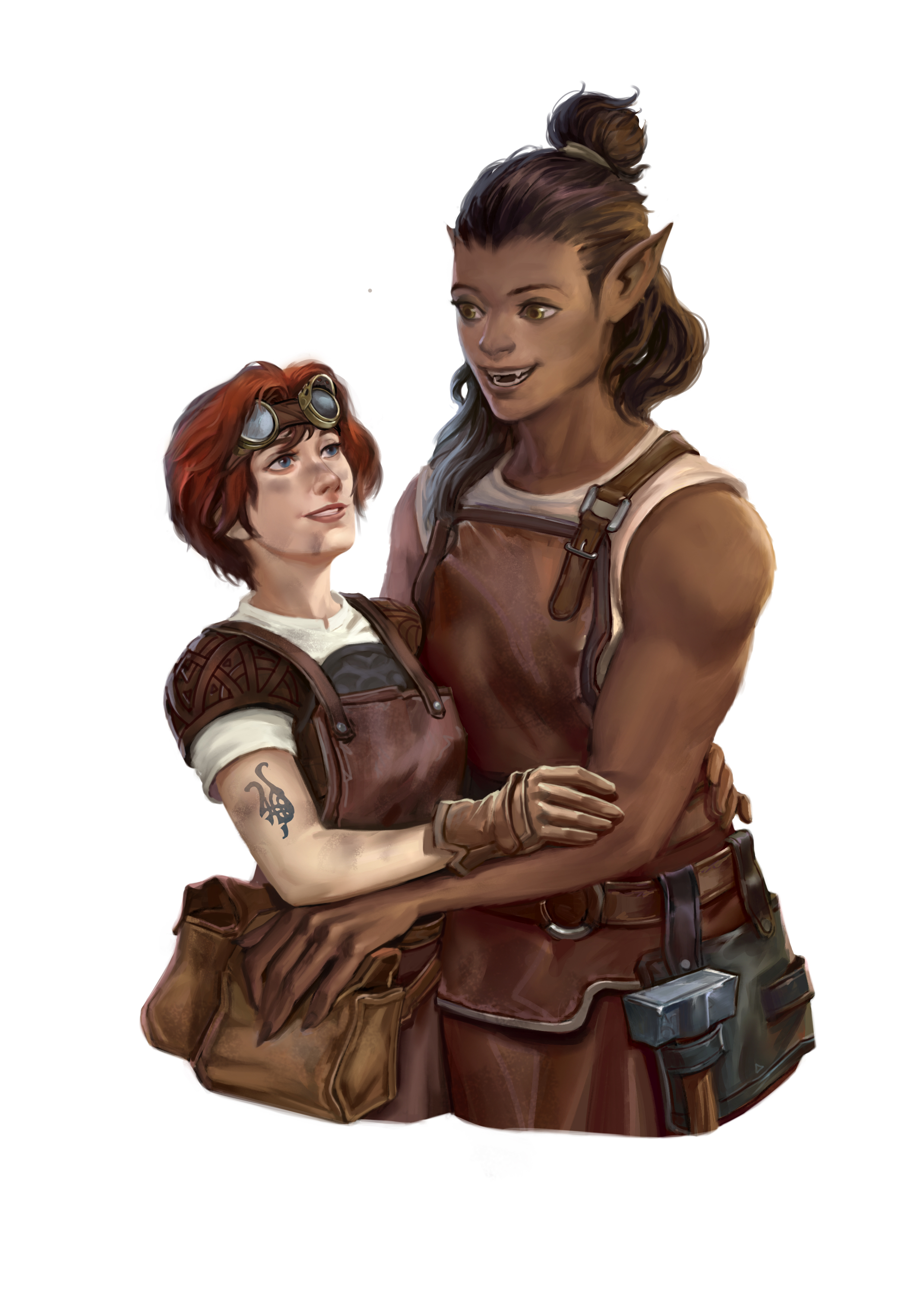
The Jurans are the smallest of the founding families. While they’re famously traveling tinkers, Jurans often settle in small villages or towns to raise their children and some prefer this life to the road. As such, when Cannith heirs are found in small towns—such as “Jury” d’Cannith in Frontiers of Eberron: Quickstone—they’re typically Jurans. As a whole, Jurans are known for being amiable and kind; while most could make more gold working in forgeholds, they prefer the satisfaction of helping to fix people’s problems. As suggested by their founding story, the Jurans are also known for being whimsical, and they often cultivate relationships with minor fey along their routes. In a twist that still mystifies modern scholars, there’s a branch of the Juran family that manifests Khoravar traits—pointed ears, large eyes and darkvision—despite having no records of an elf ancestor; and stranger still, these “fey-touched” Jurans can manifest the Mark of Making. Khoravar Juran are rare to begin with, and very few manifest the Mark of Making, so this has had little impact on the world as a whole—but a Juran adventurer could be a Khoravar with the Mark of Making.
As a Juran Cannith, consider what you’re seeking in life. Are you trying to find problems to solve, or is there a specific thing that is broken that you’re hoping to mend—whether that’s the pieces of a legendary magic item or a damaged relationship with a former friend? Jurans are rarely driven by profit or fame, but they enjoy fixing things that are broken.
Juran Characters. While Juran Artificers can follow any path, the Maverick from Exploring Eberron is a solid choice. Jurans are renowned for their resourcefulness and their ability to make remarkable things without access to the resources of a forgehold. Aside from Artificer, College of Lore Bard is a solid option for a Juran adventurer. While they aren’t typically musical, Juran tinkers often fill the traditional role of the bard, sharing stories and lifting spirits wherever they go. Bardic spellcasting allows the character to use their Spells of the Mark, and other spells could be described as tinkered devices. A Juran could also choose to embrace their storied roots as an Archfey Warlock, whether they have a pact with the Mother of Invention or a different fey.
Notable Jurans. The Juran family has no candidate vying for leadership of House Cannith, and most Juran heirs aren’t that interested in the struggle. Jury d’Cannith is an inventive tinker who co-owns The Anvil in Quickstone. She worked with a Cyran unit during the Last War, which is where she met her partner Bel Thiel. “Jury” is a nickname derived from her being Juran, but she doesn’t share her true name; the reasons for this reticence remain a mystery. Marudrix Juran d’Cannith, better known as “Drix,” was a wandering tinker in Cyre who stumbled upon the feyspire of Shae Tiraleth. Marudrix is a talented artificer and one of the rare Juran Khoravar who carry the Mark of Making; his adventures are chronicled in the novel The Fading Dream.
Vown
Traditional Role: Jewelers and Construct Makers
Ancestral Seat: Eston
Common Traits: Ambitious, Charismatic, Innovative
Lesser Families: Crown, Ester, Golden, Travor
The Vown family were powerful and wealthy before they ever set foot on Khorvaire. They were part of what scholars call the Sovereign Surge—a wave of settlers from the Sarlonan nation of Pyrine. The high priest Gallus Adon, better known to history as The Speaker of the Nine, declared that it was the duty of the Pyrinean Vassals to spread their faith to distant lands, and that those most blessed by the Sovereigns should lead the way. The Vowns were accomplished jewelers, but they didn’t merely produce mundane ornaments. The Vowns wove both divine magic and arcane magic into their creations, and most Pyrinean priests wore Vown Octograms. House records claim that Onatar guided the settlers to a blessed valley, and this became the colony of Eston. Initially, the Vowns were deeply devout and proclaimed the Mark of Making to be proof of Onatar’s favor. Over the course of generations, the religious fervor of the Vown family faded. In part this was due to the shift in location. The ancestral home of the Vown family was an Irian manifest zone which made it easier to bind celestial energies to objects, while Eston is in a Fernian zone that facilitates the creation of arcane magic items. But more than that, with each century Vown’s growing ambition and hunger for worldly success undermines their spirituality. Divine magic can’t be harnessed and industrialized as easily as arcane power, and Vown focus slowly shifted to forces they could absolutely control as opposed to powers that relied on faith. Most Vown Cannith are still casual Vassals, holding to the broad idea that their family is blessed by Onatar and Aureon… but few have deep faith, and the House as a whole doesn’t produce divine magic items. The Travors are the exception to this rule. An offshoot of the Vown family, the Travors maintained their deep devotion to the Sovereigns. Some Travors focused on Onatar and the act of creation, while others were devoted to Kol Korran and worked on the mercantile aspects of the House. The Travors were a small family based in Eston, and most died on the Day of Mourning. Some may have survived, though the Mourning may have shaken their faith.
The Vown family have always played an important role in the leadership of House Cannith. It was Dedra Vown who drove the initial unification of the House, and Hadran Vown was instrumental in establishing the Twelve. A majority of the Barons of House Cannith have been Vown, including Starrin, who lead the House on the Day of Mourning. There’s no rule about this; even now, only one of the three rivals vying for power is a Vown. It’s simply that the Vown have a hunger for power and they’re effective leaders. Where the typical Juran is looking for things they can fix and the typical Harn is thinking about the next weapon they themselves will build, Vowns are taught to think big—to come up with ideas that might require dozens of Magewrights working together—and then to rally the people they need to see it through. While the Edoro are also inclined toward collaboration, Vowns aren’t content to lead from the background; they want to be seen and recognized for their genius. So Vown heirs tend to be charismatic and dynamic. They’re always ready to seize the initiative and to set plans in motion.
The Vowns have a diverse range of talents when it comes to artifice. They’re well known for the creation of Wondrous Items and Eldritch Machines… both things that can take many forms and produce a broad range of effects. But the Vown family has also long been known for the creation of constructs. The Clockwork Menagerie and the Steel Gardens are two of the wonders of Eston; both involve imbuing metal with a sort of life. The Warforged were an exponential advance in previous work, being both truly sentient and able to be produced in large quantities, but Vown heirs have always had an interest in homunculi, golems, and other forms of constructs.
In creating a Vown character, consider their ambition. What is the dream they wish to make real? Do they seek personal power, perhaps a leadership role within House Cannith? Or is their ambition tied to something they wish to create—a glorious invention that could change the world, if only they had the vast resources needed to see it through. How do they feel about the warforged? Some Vowns feel empathy for the warforged and regret how they were used by the House; others see them purely as tools.
Vown Characters. The Vowns are another family with a diverse range of talents, and there’s no single path that defines them. The Battle Smith Artificer is a sound option for a Vown with an interest in constructs. The Maverick is another good option for a Vown Artificer. Where a Juran Maverick comes up with ways to solve problems, a Vown Maverick is typically bursting with so many ideas they can’t commit to a single path. The Travor family is an option for a Cannith Vassal Cleric or Paladin.
Notable Vowns. Baron Merrix Vown d’Cannith leads Cannith South from his tower in Sharn. Merrix is part of an arcane dynasty; his grandfather and namesake created the Warforged Titans, while his father Aaren Vown made the breakthroughs that produced the Warforged. Merrix is brilliant and ambitious, and wants to leave his own mark on the world. It’s up to the DM to decide if that leads him down a dark path. Starrin Vown d’Cannith, also known as “The Gorgon,” was the sole Baron of House Cannith until he died on the Day of Mourning. Elaydren Vown d’Cannith is a House Agent working to advance the cause of her faction, and she has been known to employ adventurers in pursuit of her goals; Elaydren appears in the 3.5 adventures “The Forgotten Forge” and “Shadows of the Last War.” Castal Vown d’Cannith is believed to be the most brilliant artificer the House has ever produced; some claim that he’s “The Traveler incarnate.” Born in 645 YK, Castal produced items of artifact quality; even today, his arcane techniques have yet to be replicated. However, he used his gifts to sow chaos and proved to be a threat to Galifar itself. He was petrified and imprisoned in the Stone Ward of Dreadhold in case his knowledge is ever needed again. Castal has been revived twice over the last three centuries. The first time he helped deal with planar instability that threatened to collapse Sharn into Syrania. The second was to deal with a threat that’s been stricken from the records (... in order to allow you, the DM, to make it whatever suits the needs of your campaign), and while he helped resolve the threat, he nearly escaped. Castal remains in the Stone Ward today, but anyone who releases him is taking a terrible chance.
FINAL THOUGHTS
House Cannith is an important part of everyday life in Khorvaire. Beyond serving as a source for adventuring equipment and magic items, House Cannith facilitates the services of many of the other Dragonmarked Houses. In its quest to profit off of the Last War, Cannith engaged in its own personal arms race, forever seeking to create the next must-have weapon or defense. And of all the Houses, Cannith was hit the hardest by the Mourning. All three of these elements can influence how the House appears in a campaign. Cannith is a ubiquitous presence that adventurers can deal with purely as a provider of goods; in a Quickstone campaign, Jury d’Cannith can be an invaluable source of equipment. On the other hand, Cannith forgeholds lost to the Mourning can drive a story; can the adventurers stop the Emerald Claw or the Lord of Blades from finding a terrible weapon that should never have been created? Cannith can be helpful, or it can be presented as a ruthless force determined to maintain its monopolies and oppress independent innovators. Or it can be both of these things at once: if one of the three Barons is called out as wanting to take the House in a positive direction while the others will be cruel, adventurers could play a critical role in shifting the balance of power!
The creations of House Cannith are an easy way to add powerful magic into a story. Adventurers can always stumble across an Eldritch Machine Cannith was developing during the Last War. An enemy faction that needs a power boost could be receiving items from a Cannith patron; can the adventurers expose this connection? On the other hand, House Cannith can also be a powerful resource. If a player character is an heir of the House, they could gain vital arcane knowledge from their elders. And House Cannith is always eager to study ancient and forgotten artifacts. If adventurers find items from the Age of Demons or the Cul’sir Dominion, Cannith will pay handsomely for them… making sure that they’ll be safely handled by top men in the field.
Here’s a few ideas for Cannith characters you could play or meet.
- The Eager Explorer. This is fascinating! The Dhakaani Daashor used techniques to create and shape adamantine that we’ve never been able to replicate. Just look at the patterning on the blade. It’s completely different from adamantine created using the Colari Technique. You’re fresh out of the enclave, you’ve got proficiency with Arcana, and you are excited about EVERYTHING. You want to study every magic item you’ve never seen before, and to explain the finer points of arcane history to all your friends. Feel free to make up a lot of arcanobabble.
- The Unhinged Excoriate. You were on the verge of revolutionizing the basic principles of Siberyan science when you were cast out of the House and excoriated. The fools! If you only had access to a Creation Forge and a thousand pounds of residuum, you could change everything! You’re a genius who was thrown out of House Cannith for pursuing dangerous research, and whatever you might say, they might have been right to do so. Now, instead of changing the thrice-damned world, you’re working with this band of ratcatching adventurers for a measly handful of gold. But someday, someday you’ll show them all!
- The Fugitive Inventor. You still see their faces—all the people that died because of the weapon you created. You can’t undo what was done, but perhaps an act of great good can balance the scales for the evil you unleashed upon the world. During the Last War you played a key role in developing something terrible. Perhaps it was a weapon of mass destruction that was used to kill thousands of innocent civilians. Perhaps—with the DM’s permission—you know what caused the Mourning, because you were part of it. Now you’re seeking some kind of redemption. The question is whether your work is known only within House Cannith—in which case you’ve cut ties with the House, but no one else is hunting you—or if you are wanted as a war criminal. If so, you’ve surely changed your name and had cosmetic transmutation to conceal your appearance, but the Basilisk’s Gaze still has you on their list.
- The Travor Zealot. Praise Onatar! No one realizes that all of these tools that support the everyday life we’ve become accustomed to are gifts of the Sovereigns. Let Onatar guide my hands and Aureon enlighten me, and I shall do what must be done. As a member of the Travor family, you blend artifice with deep devotion to the Sovereigns. Make sure that people remember that arcane science itself is a gift of the Sovereigns, and that they appreciate the hand of the Sovereigns guiding them in everyday life.
- The Big Dreamer. You can fix the Mournland. You know it. It’s just a simple equation. Yes, it’s probably going to take a series of Eldritch Machines, each one built in a different manifest zone, each burning a massive amount of residuum, but it’s POSSIBLE. You have an idea that could change the world. Perhaps it’s a way to restore the Mournland. Maybe it’s a source of infinite food and water, or a way for the Warforged to reproduce. It’s beyond your current skills and resources, but it’s your arc over the course of a campaign, as you slowly get closer and closer to achieving your dream.
- The Warforged Advocate. You worked with Warforged during the Last War, and you know your House was wrong to sell these sentient beings as weapons. You may have a particular Warforged companion you care about, but you also want to do what you can to help the wider warforged population. If you wanted to go down a darker path, you could be a supporter of the Lord of Blades; you believe that your House, and perhaps humanity itself, needs to be punished for what was done to the Warforged.
- The House Agent. You believe in House Cannith. Your House and your family have made the world a better place, and they’re far more efficient than the ridiculous monarchies. What’s good for Cannith is good for the world, and you’re going to do whatever they need done. You’re Burke in Aliens: the corporate representative who’s always looking out for things that could profit House Cannith. You’re happy to work with these adventurers, especially because your Cannith faction might have a use for their talents in the future. But your loyalty to the house comes before everything else.
A number of these character concepts are implied to have scientific skills that may seem beyond what you’d expect from a low-level Adventurer. The idea here is to separate academic skill from practical skill. The Unhinged Excoriate, the Fugitive Inventor and the Big Dreamer may have the ability to design weapons of mass destruction or Eldritch Machines, but doing so would require a year of intense research in a top-notch Cannith facility with unlimited resources. Their Class Features reflect what they’re capable of doing out in the wild; their other skills are purely part of the story, because they can’t be put into practice under their current circumstances.
That’s all for now… Thanks for your support!