Frontiers of Eberron Preview: Gargoyle Characters
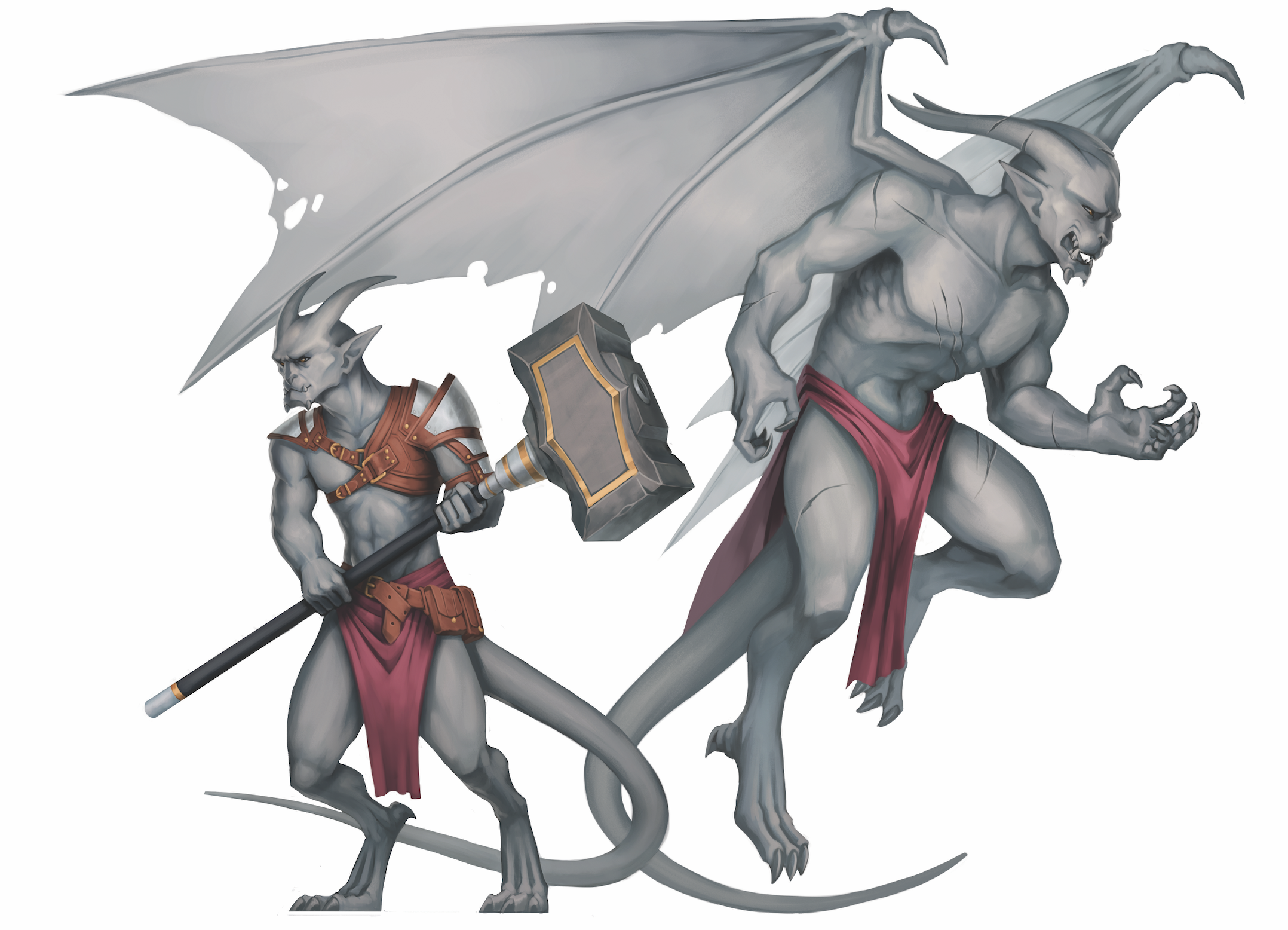
My upcoming book Frontiers of Eberron: Quickstone focuses on the region that lies between Breland and Droaam—a region where interaction between humanity and creatures often considered “monsters” is far more common. As such, Frontiers includes traits for a number of the species of Droaam, including gargoyles, harpies, worgs, and more. This preview presents the current iteration of an iconic Droaamite species: the gargoyles of the Stonelands, as developed by myself and Imogen Gingell. This is an unedited first draft that will continue to evolve until the final release. With this in mind, there's no need to point out typos that will be caught by an editor, but comments on the comments and mechanics are welcome.
THE GARGOYLES OF GRIMSTONE
The ruins that run along the edge of the Byeshk Mountains are remarkable in many ways. They are almost perfectly preserved, seemingly shunned by the brutish creatures found in this region. Friar Alasant attributes this to the “guardians”—every ruin has a host of statues, posed as sentries on walls and at strategic points within. The friar says Dhakaani statuary typically depicts goblin champions, but these figures are fiendish creatures with horns and wings. Alasant believes that these guardians were carved during a period of great upheaval and intended to terrify prospective enemies. They are indeed fearsome, but it takes more than stone to frighten templars of the Flame. Brightstone Keep will soon be operational.
Until recently, gargoyles were virtually unknown in Khorvaire. When the Church of the Silver Flame established Brightstone Keep in 870 YK, the friars were intrigued by the guardian statues. As Friar Alasant speculated, the denizens of the region shunned these ruins due to the kurarguls—”deadly stones.” The templars weren’t frightened by these stories, and they ignored the fearsome statues, dwelling in the keep for over a century. Then Sora Katra came to Brightstone Keep. She came alone. The wind carried her whispers through the stone, and the gargoyles perched on the walls and crouching in the corridors of the keep turned on the templars.
With no need of sustenance, the gargoyles of Grimstone and the Stonelands had been slumbering for thousands of years. Katra’s voice called them back to the world. Many now serve the Daughters directly. Others have signed on with house Tharashk, and can be found as couriers and scouts across the Five Nations, especially in Sharn. And a few follow their own paths, driven by curiosity or by the bonds they’ve formed with places or people. Some are tireless workers, while others spend days at a time resting on a wall or in a square. The denizens of Droaam have gotten used to gargoyles and their quirks, and the stone folk are generally seen as being stoic and reliable.
Old Stone
Until recently, gargoyles were all but unknown in Khorvaire. Evidence suggests that Dhakaani stoneworkers in the region became obsessed with these “guardian statues” in the decades leading up to the first open conflict with daelkyr forces… and it was during that battle that the daelkyr Orlassk breathed life into the countless guardians. Orlassk never controlled the gargoyles directly, but they came into existence with an instinctive revulsion for organic life, a reaction much like most humans have to encountering mold or viruses. Creatures of flesh are fundamentally repulsive, rotting monstrosities filled with disgusting fluids and leaking foul excrement. The first gargoyles lashed out against the dar surrounding them, and claimed the fortresses they once guarded as their own. But they soon realized that they were vastly outnumbered by the creatures of flesh. Beyond this, they didn’t need anything from the world beyond their walls. They didn’t need food or other supplies. So they remained at their posts, and eventually fell into a deep torpor. In this state their spark of life was so weak that they couldn’t even be sensed by detect good and evil, which is how the templars of Brightstone Keep failed to recognize them for what they were. But they were still aware of their surroundings on a deep level. When Katra spoke to the gargoyles of Brightstone, each heard something different, the perfect story to pull them from their slumber. Some heard tales of the wonders waiting to be seen out in the world. For others she painted pictures of the excitement to be found in battle, or the satisfaction to be found in protecting someone one cares about. Her magic roused them, but not all of the stone host joined the hag. A small force of gargoyles had heard the songs and teachings of the Silver Flame even while they slept, and found the vision of the Flame to be compelling. These gargoyle helped a group of friars escape and return to Flamekeep, where they have embraced the Silver Flame and fight alongside the templars to this day; these gargoyles are now known as the wingwyrds.
Brightstone wasn’t the only place where Sora Katra woke slumbering gargoyles. There were a handful of other shunned keeps along the edge of the Byeshk Mountains, and Katra roused the gargoyles in each tower. And there was one place where some gargoyles were already awake: Cazhaak Draal, the city at the heart of the Stonelands. When the medusas laid claim to the city, their queen spoke to the slumbering gargoyles. Some chose to remain in their torpor, but a handful awoke and were eventually convinced to work with the medusas. It was through this alliance that the gargoyles learned how to reproduce, as described later in this article. Medusa and gargoyle alike prefered to remain isolated from the warlike denizens of the Barrens, and the gargoyles of Cazhaak Draal rarely left the fortress city. But the Cazhaak gargoyles have been awake for over a century; they are more used to the world and to working side by side with organic creatures, and some have adopted the Cazhaak faith. When the Daughters of Sora Kell established a new province centered on the newly-christened Grimstone Keep and appointed Cairngorm to serve as warlord and guardian of the province, many of the gargoyles of Cazhaak Draal flocked to their new prince.
In creating a gargoyle, consider which of these categories you fall into. Did you slumber in the ruins for thousands of years? Did you live alongside the medusas of Cazhaak Draal? Are you a newborn, hewn in the gravel pits of Cazhaak Draal and still crafting your final form? Or are you a gargoyle with no connections to Droaam whatsoever… a statue infused with life elsewhere in the world? Additionals options are discussed later in this article.
To be clear: while scholars have come to the conclusion that the Grimstone gargoyles were created by the daelkyr Orlassk, the gargoyles themselves feel no connection or loyalty to Orlassk; they largely don't care about what scholars say. And the initial revulsion that cause them to battle the Dhakaani isn't a supernatural compulsion. The Grimstone gargoyles still find organic creatures to be squishy and strange, but they've gotten used to dealing with them and some even find organics intriguing.
Stone In Form
Gargoyles are elemental creatures, and their physiology defies all natural law. When a gargoyle stands still, it is indistinguishable from a stone statue. They are made of light, inanimate stone… and yet, when they choose to move, they can. This same illogic applies to their wings. Gargoyle wings can take many forms, but the vast majority couldn’t possibly keep a gargoyle aloft, and yet somehow they fly. Some scholars believe the gargoyles fly through an instinctive manipulation of elemental air, but nothing has been proven. With that said, the fact that gargoyles have the elemental type doesn’t mean that they have any planar connection or any bond to other elemental creatures. They are elementals because they are creatures of animate stone.
The vast majority of gargoyles follow the model of the Dhakaani guardian statue—the classic horned, bat-winged humanoid. However, this is only due to the fact that these statues were produced in mass quantities. First of all, the Dhakaani gargoyles weren’t stamped out of a mold. The horned, winged design is common, but some gargoyles have ram’s horns, tribex horns, or no horns at all. Likewise, gargoyle wings can be long or ridiculously small, stone carved in the likeness of leather or feathers. Someone exceptionally versed in the history of Dhakaan could potentially identify the ruin a sleeper gargoyle comes from based on their artistic design. And yet, when Orlassk animated the statues of the Barrens, it affected more than just the guardians. There are wingless gargoyles carved in the shape of ancient Dhakaani heroes. The Dhakaani were especially infuriated by this mockery of their champions and made an extra effort to destroy these creatures, but there are still a few scattered among the host of Grimstone. In creating a gargoyle character, consider how your appearance reflects your choice of class. Unlike warforged, gargoyles weren’t built for a specific purpose; the Dhakaani artisans had no idea their creations would come to life. But the material used or design of a gargoyle could influence its capability. A gargoyle druid could be carved from densewood instead of stone, while a gargoyle sorcerer could have dragonshards incorporated into its stone body.
This highlights the fact that not all gargoyles have wings. The classic Dhakaani guardian—represented by the gargoyle stat block in the Monster Manual—has wings, claws, and is formed from dense stone. But a gargoyle with the shape of a bugbear hero or a Cazhaak newborn may be made from softer stone and lack both claws and wings. These traits are reflected by the feats Wings of Stone and Hewn for Battle. If your gargoyle character begins at a high level, you may start with these traits. If you’re playing a 1st level gargoyle character, you have yet to assume your final form, or perhaps you’ve simply chosen not to add wings to your design.
This choice is reflected in the way gargoyles reproduce and grow. Gargoyles have no functional reproductive organs. To reproduce, two or more gargoyles work together to carve an egg. During this ritual, they infuse the egg with a fraction of their own lifeforce. The egg is buried in a pit of gravel or stone shards… and over time, it absorbs the surrounding chunks of rock, instinctively assimilating these and reshaping them to build its own body. The appearance of a newborn gargoyle usually reflects a blending of its parents, but this is a foundation. Gargoyles don’t need to eat, but a growing gargoyle will consume chunks of stone that will be added to its mass… and as it continues to grow, its appearance will shift to match its own evolving self-image.
Hearts Of Stone
An immobile gargoyle is inanimate stone. In creating a gargoyle character, the crucial question is why do you move? You could sit in one place for centuries without moving, and there are gargoyles who have ignored Katra’s call. What is it that drives you and gives you a reason to move and to interact with the world? Here are four of the most common gargoyle drives—but this is a starting point, not an absolute list!
- Seekers are driven by curiosity. They want to see new things, to have new experiences and meet new people. As a seeker, you could be driven by a broad delight in the countless wonders of the world. Or, you could have a few specific things you’re searching for. Perhaps you like birds, or strange weather conditions, or humanoid hairstyles; you’re always delighted to encounter a new variation of one of your interests. Seekers often work with House Tharashk, as they are interesting in travel and exploring distant lands.
- Movers delight in action. After centuries of stillness they love flying, fighting, and any form of action. Gargoyle movers are often fighters, rangers, rogues, or monks; they yearn to move. Movers often serve the Daughters as scouts and soldiers, but a mover could just as easily yearn to fly as far away as possible.
- Guardians are driven by love of a person, place, or thing; their lives revolve around defending their wards. Guardians are typically stationary; these are the traditional gargoyles found on fortress walls, remaining perfectly still until something threatens their charge. However, a guardian could form an attachment to another character or even to an idea, like the wingwyrds of the Silver Flame. When playing a guardian gargoyle, consider: what drove your choice of ward? Could anything break this devotion?
- Thinkers are rarely encountered, because even more than guardians, they often have no reason to move. A thinker enjoys contemplating weighty concepts. This could be religion, philosophy, arcane science, or any other topic. As a gargoyle thinker, you are likely adventuring to gain access to new sources of information related to the topic that interests you. But whenever there is no need to move, you may fall into a still reverie; during downtime, you could spend days without moving, as you consider the information you’ve gained.
Most gargoyles have little interest in clothing or material possessions. There’s very little that they need. However, one of the greatest challenges for a gargoyle is boredom. Rather than gold, gargoyles often want to be paid in stories, songs, or jokes; they then use these as social currency in dealings with other gargoyles. Most gargoyles are tone-deaf and struggle to master musical pursuits, but the rare gargoyle bards and entertainers are held in high regard.
Gargoyles Beyond Grimstone
Grimstone and the Stonelands are the largest single source of gargoyles in Khorvaire, created en masse during the days of Dhakaan. But this isn't the only source of gargoyles in Khorvaire. The elemental version of gargoyles presented in 5E reflects a creature of living stone; but there are many ways this can occur. Consider these ideas when creating a gargoyle character.
The Still Lord. The daelkyr Orlassk can imbue life onto any statue. Anywhere you find a cult of Orlassk you may find gargoyles working with it. You might even find a cult entirely formed of gargoyles. Remember that when it stands still, a gargoyle is indistinguishable from a statue. Think of all the statues in your town. What if they were all working together, just waiting for the right moment to move? The gargoyles of Grimstone have no knowledge of or loyalty to Orlassk, but those aligned with a cult might knowingly serve the Still Lord. On the other hand, the actions of the daelkyr are inexplicable. As a gargoyle character you could be a statue that simply awoke to life one day, with no knowledge of why you were animated. Does the Still Lord have a plan for you, or were you created on a whim?
Demonglass Gargoyles. Historians have concluded that the daelkyr likely planted the seed driving Dhakaani stonesmiths in the barren to carve a horde of stone guardians. But why do they look like fiends? The secret that scholars have yet to realize is that they were carved in the shape of something people in the region knew to fear—creatures of living stone that were infused with infernal power. The Lords of Dust can animate gargoyles by implanting them with shards of demonglass... or even, potentially, a shard of an overlord's prison. Due to the nature of the animation, the gargoyle still registers as an elemental rather than a fiend... but demonglass infuses the gargoyle with the essence of a fiend and can grant them greater abilities. Lesser demonglass gargoyles can use the standard stat block; the demonglass simply affects their personality. More powerful demonglass gargoyles could use the stat blocks for Horned Devils, Nabassus, or other fiends; simply change the creature type to elemental and add the False Appearance trait. Demonglass gargoyles can be found anywhere in Khorvaire; some are ancient, but the Lords of Dust can create new ones whenever they wish. Any number of demonglass gargoyles may be hidden among the gargoyles of Grimstone; it's quite possible that the Warlord Cairngorm is a demonglass gargoyle wielding terrifying powers. However, it's also possible for a demonglass gargoyle overcome its fiendish influence. If you want to play a gargoyle warlock, you could be a demonglass gargoyle; your "patron" is the fiendish shard within you. Can you harness its power without giving in to its influence? Do the Lords of Dust have plans for you?
Eidolons. Statues are often made to commemorate great heroes or revered figures. Adoration is a powerful force; the Undying Court of Aerenal are sustained by the devotion of their people. Throughout history, there have been a number of times when commemorative statues have spontaneously animated. As an eidolon gargoyle, you are carved in the likeness of a revered figure. You could be a figure of Galifar I, Karrn the Conqueror, or even a beloved sage or philosopher. However, you don't have the memories of that figure. Eidolons are an arcane mystery. No one yet knows why they animate or what sustains them; as an eidolon, it's possible that you could revert to unliving stone at any time. Why do YOU think you were animated? Are you trying to emulate the deeds and personality of the hero you represent, like a Tairnadal warrior? Or do you want to follow your own path?
Lorghalen Elementals. The gargoyles of Grimstone are elementals, but there's nothing natural about them. However, there are places in the world—typically Lamannian manifest zones—where elemental power is intense and the stone and wood are ALIVE. The island of Lorghalen is infused with such elemental energies. The rocks may roll about as Lorghalen cannonballs. But sometimes a Lorghalen artificer will find a piece of stone or wood that calls out to be worked; that, when carved, becomes an animate gargoyle. Lorghalen gargoyles are few in number and entirely unique in appearance. If you're a Lorghalen gargoyle, what's your story? Who carved you, and what meaning do you have to them? What's your form, and why did they carve you in this way? Why are you out in the world now? Do you have your creator's blessing? Are you working for the good of Lorghalen? Or have you just run away in pursuit of adventure?
Gargoyle Names
Gargoyles are inorganic creatures that reproduce asexually. Most creatures assume that gargoyles have no concept of gender. However, it’s possible that gargoyles have a complex and subtle understanding of gender that transcends their physical forms and simply don’t try to explain the complexities of this to their organic companions. Likewise, among themselves gargoyles use names that can only be formed by the subtle grinding of stone teeth. Any other name is chosen for the purpose of interacting with other creatures. Some gargoyles choose descriptive terms, often related to the form of stone their body is formed from. Others use nicknames given to them by their organic associates. A few just pick random words they like, even if there’s no obvious connection to them; as such, you could meet a gargoyle named Spoon, Sunset, or Breland.
Gargoyle Names: Alabaster, Basalt, Boulder, Chip, Cliff, Crag, Devotion, Flint, Granite, Graywall, Lime, Marble, Maul, Obsidian, Peak, Pebble, Rift, River, Rocky, Serpentine, Shale, Shard, Slate, Sunset,
Gargoyle Traits
Your gargoyle character has the following traits.
Lifespan. Gargoyles suffer no detrimental effects from aging, and you are immune to magical aging effects. Some gargoyles are thousands of years old; however, most have spent the majority of that time in meditative inactivity.
Creature Type. You are an Elemental.
Size. You are Medium.
Speed. Your walking speed is 30 feet.
Darkvision. You can see in dim light within 60 feet of you as if it were bright light and in darkness as if it were dim light. You discern colors in that darkness only as shades of gray.
Elemental Nature. You are a creature of living stone, which provides the following benefits.
- You have advantage on saving throws against being poisoned, and you have resistance to poison damage.
- You don’t need to eat, drink, or breathe.
- You are immune to disease.
- You don’t need to sleep, and magic can’t put you to sleep.
- You cannot be petrified against your will.
False Appearance. While you remain motionless, you are indistinguishable from an inanimate statue.
Sentry’s Rest. When you take a long rest, you must spend six hours in an inactive, motionless state, rather than sleeping. In this state, you appear inert, but it doesn’t render you unconscious and you can see and hear as normal.
Stoneskin. Your thick stone hide provides you with natural armor. While you aren’t wearing armor, your base AC becomes 13 + your Dexterity modifier. A shield's benefits apply as normal while you use your natural armor.
Gargoyle Racial Feats
Wings of Stone
Prerequisites: Gargoyle
You have manifested your stone wings and achieved mastery of the air. You have a flying speed equal to your walking speed.
Hewn for Battle
Prerequisites: Gargoyle
You have shaped your stone body to be a more effective weapon of war. You gain the following benefits.
- Increase your Strength or Constitution by 1, to a maximum of 20.
- When you finish a short or long rest, you can choose the thickness of your natural armor. While you aren’t wearing armor, your base AC becomes your choice of 18 or 14 + your Dexterity modifier. A shield's benefits apply as normal while you use your natural armor.
- Your hide can be enchanted or infused as if it were nonmagical armor.
You have shaped your hands into fearsome claws. Your claws are natural weapons, which you can use to make unarmed strikes. If you hit with them, you deal slashing damage equal to 1d6 + your Strength modifier, instead of the bludgeoning damage normal for an unarmed strike.