ExE: Cults of the Dragon Below
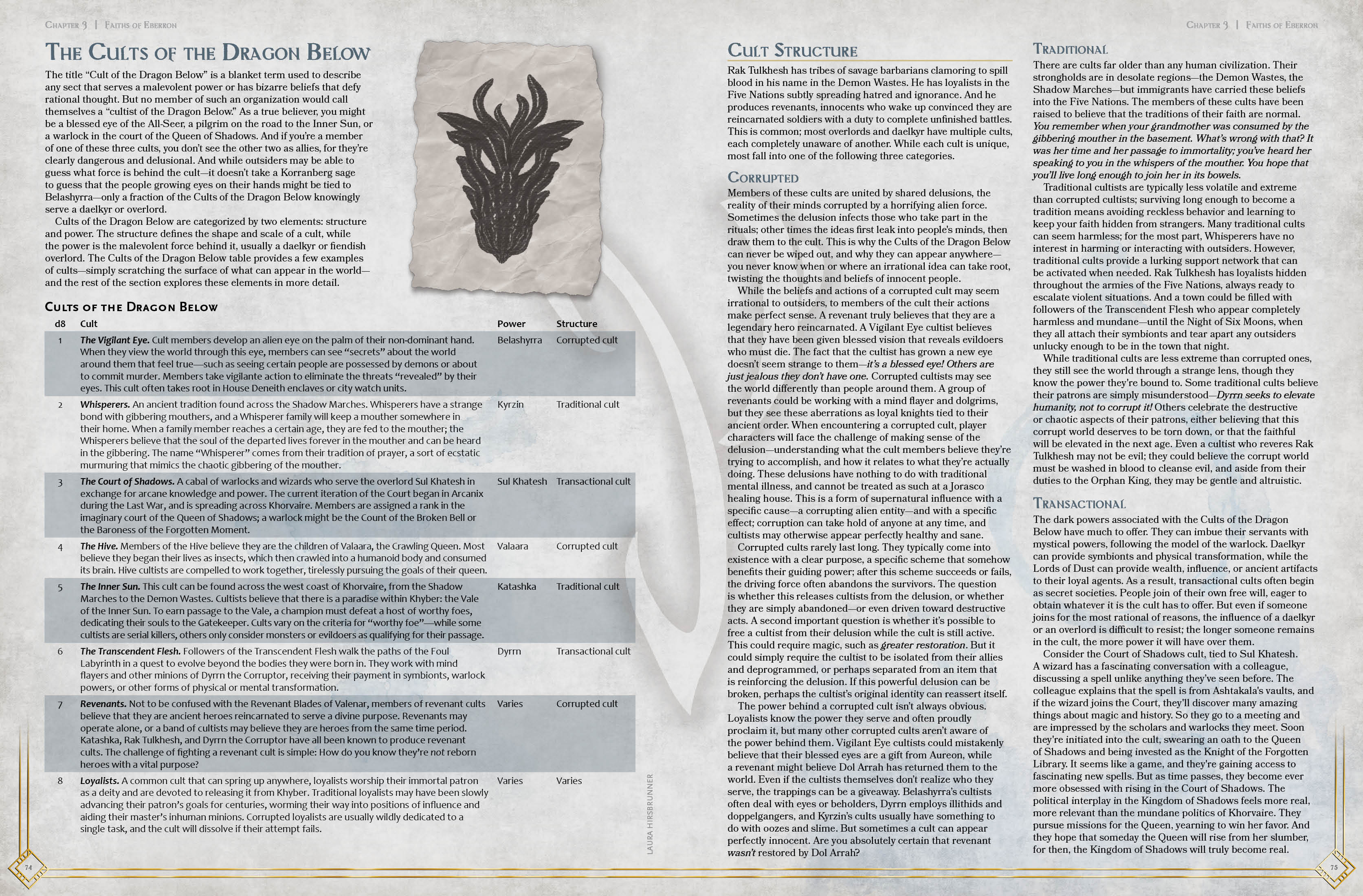
The Cults of the Dragon Below have been a part of Eberron from the very beginning, but there's never been much detail about them. The basic idea has always been that "Cult of the Dragon Below" is a general term applied to a vast array of disparate sects driven by delusions or by ties to a dark power (typically a daelkyr or an overlord). But there's only been a few cases where we have concrete examples of specific Cults of the Dragon Below. The Whisperers and the Inner Sun have both been mentioned in Dragon articles, while the cult in Khyber's Harvest are traditional loyalists tied to Belashyrra. In Exploring Eberron, I wanted to go deeper—to give very concrete examples of cults and the powers behind them. How do the cults of Dyrrn differ from the followers of Valaara or Sul Khatesh? Beyond the basic introduction shown above, this section presents ten of the dark powers that create Cults of the Dragon Below and explores their goals, methods, and beliefs.
One statement that may come as a surprise to people is the idea that "Only a fraction of the Cults of the Dragon Below knowingly serve a daelkyr or overlord." There's basically three levels of this understanding.
- Many corrupted cults are influenced by a dark power but don't recognize this and don't worship that power. In the example given above, the Vigilant Eye is a cult that is connected to Belashyrra, and SOME Vigilant Eye cults recognize this and offer prayers and bloody sacrifices to the Lord of Eyes. But you could easily have a Vigilant Eye cult in the Sharn Watch whose members believe that their new eyes are a blessing from Aureon, and that its visions reveal hidden evils in peoples' hearts. This is a threat, because these false visions may guide the cultists to murder innocents—but the cultists don't worship Belashyrra and truly believe that they are serving a righteous cause.
- Traditional cults worship an entity... but they may not acknowledge the true nature of that being. In the Shadow Marches, most people know Kyrzin as a dangerous threat; in local folktales it's typically known as the Prince of Slime or the Bile Lord. The Whisperers worship Kyrzin by the name the Regent of Whispers, and say that the Regent grants the gift of immortality to the faithful through the medium of the Gibbering Beasts. Neither of these two groups—common Marchers, Whisperers—may know that the creature they are worshipping or cursing is a daelkyr. The daelkyr incursion took place thousands of years ago, long before humanity even arrived on Khorvaire. So the Whisperers knowingly worship a being that others fear, but a) they believe that Kyrzin is benevolent force and b) they don't know that it's a daelkyr. Because that's not relevant to their beliefs; what matters is that the Regent creates gibbering mouthers and shows them the path to eternal life.
- Loyalists and most transactional cults knowingly traffic with dark powers and may well know the name and nature of the being they are dealing with. This is your path for the Carrion barbarians who howl prayers to Rak Tulkhesh as they charge their enemies, or the warlock bargaining with Sul Khatesh for forbidden arcane secrets.
These are the fractions—those with no real knowledge of the force they serve, those who interpret that force in a different way than others, and those that knowingly embrace a daelkyr or overlord. Ultimately, it's up to the DM to decide the balance between those three, and which is the most common.
As you can see, editing and layout is continuing (thanks to the tireless efforts of Wayne Chang and Laura Hirsbrunner). However, I am also still writing: the various complications I've been dealing with are ongoing (... and the book is getting longer...) and I don't have a firm release date yet. I'll post a date as soon as I have one I'm sure of.
In the meantime, thanks again to my Patreon supporters who keep this blog going—a gnoll article is on the way soon!