Dragonmarks: House Orien
You’ve got roots, my friend. You’re Aundairian, through and through. Not I. Orien? We’re everywhere. We deliver your mail. We transport your goods. We bring Aundairian wines to Wroat and Nightwood Ale to Flamekeep. Today we’re dining in Fairhaven, but tomorrow I’ll eat dinner in Thaliost. I may have been born in Passage, but the road is my home.
One of the key aspects of a dragonmark is often described as intuition—a natural talent for a particular set of skills. An heir to the Mark of Making is comfortable using any sort of artisan’s tools, while someone who carries the Mark of Detection has sharp senses and a knack for reading nonverbal cues. Consider then the gifts of the Mark of Passage. At its most basic level, it makes its bearer faster—able to run with remarkable speed, with an intuitive talent for athletics and acrobatics. The mark compels its bearer to move, and to do so with grace and precision. Heirs of the Mark of Passage are infamous for fidgeting and pacing, finding it almost unbearable to stand still. Many struggle with an insatiable wanderlust, an urge to move across the world. This is especially strong when the mark first manifests, and because of this Orien has a tradition called The Wander. When an Orien heir completes the Test of Siberys and develops the Mark of Passage, they undergo a month of intensive training, learning to harness their dragonmark’s gifts and brushing up on geography and customs. Once this is complete, the heir is given a set of traveling clothes, a good cloak, a backpack, a bedroll, and nine platinum pieces—a coin for each of the Sovereigns—and sent out into the world. They may travel for as long as they wish, whether that’s days, weeks, or years. But when they next set foot in an Orien enclave, their Wander is over, and it’s time to join a guild and get to work.
So when considering the heirs of House Orien, remember that raw physical energy—the speed coiled within them, waiting to be unleashed. Consider the base gift of the Dragonmark, Misty Step. This is a manifestation of that same energy, that drive to move and be unbound, so strong that it can tear through space itself. In any encounter with an Orien heir, consider if there’s a way that they could be moving instead of standing still. And if you’re playing a scion of House Orien, don’t just think about where you’re going now; consider where you’ve been, how far you’ve traveled, the things you’ve seen and the people you’ve met. Discuss this with your DM: how long did you wander, and where did you go? How do you feel about the path that you’re on today? Or are you still on your Wander—technically an heir of the house, but still refusing to enter an enclave and join a guild?

The House of the Unicorn. For many of the Dragonmarked Houses, the beast in the house sigil is merely a symbol. Few members of House Thuranni have actually seen a displacer beast, and House Sivis doesn’t cultivate cockatrices. House Orien is a special case… because every dragonmarked heir has their own unicorn! For over a thousand years, House Orien has carried goods and messages across Khorvaire. The most basic gift of the Least Mark of Passage is Expeditious Retreat; while this burst of speed is useful, it’s not going to help you travel a hundred miles. But an heir who unlocks the full potential of the Least Mark—whether on their own or by using a focus item—gains the ability to cast Find Steed. Which is to say, they gain the ability to summon their unicorn. When an Orien heir casts Find Steed through their Dragonmark, the creature emerges from the dragonmark itself, a tangle of blue and purple energy that solidifies into a mount. For at least 99.9% of heirs, this steed takes the shape of a unicorn. Orien lore maintains that the mount is the bearer’s mark made manifest—a reflection of their personality, their potential, and their destiny. While the overwhelming majority of Orien steeds appear as unicorns, the precise details can vary tremendously from heir to heir. As an Orien heir, consider the form of your unicorn. Is it lithe and graceful, or does it have the build of a draft horse? What is the shape, length, and material of your unicorn’s horn? Does it have a lion’s tail or a beard? Is its mane made from horsehair or from sparkling dragonmark energy? If you possess the Lesser Mark and can summon your unicorn using a 4th level spell slot, it gains the ability to fly. Does it simply run on the air—which is the most common manifestation of this within the house—or does your unicorn have wings? While it is manifested, your unicorn can communicate with you telepathically. While it has its own personality and identity, its memories are drawn from yours; it only knows what you know. It is a part of you—the manifestation of your Dragonmark.
Find Steed conjures a creature with the Fey, Fiend, or Celestial creature type. This reflects the abilities, demeanor, and appearance of the unicorn, but it doesn’t imply any sort of extraplanar connection; an Orien steed is tied only to its Dragonmark, and if banished it returns to it. The vast majority of Orien heirs manifest Fey steeds; this fits with the fact that the Fey gift of teleportation echoes the power of the Mark of Passage. The Celestial steed has the power to heal, while the Fiend steed instills fear. If an Orien heir manifests such a steed, it is a reflection of their own nature. An heir with a Fiend unicorn is likely to be ruthless and cruel, dominating the people around them; while an heir with a Celestial unicorn is more likely to be kind and empathetic. Beyond creature type, while 99.9% of heirs conjure unicorns, that still leaves a rare few who manifest steeds of other shapes. Often this is seen as an ill omen, but there have been a few Orien heirs in history who have earned fame due to their unusual mounts. Iliana d’Orien, better known as the White Hart, accompanied Galifar I into battle while riding her celestial stag; in the Sixth Century, Castal d’Orien hunted brigands astride his Fiend tiger. If you are playing a character with the Mark of Passage, consider the shape and creature type of your steed. Even if you can’t cast spells and don’t have the Potent Dragonmark feat, a Channeling Rod or Dragonmark Reservoir from Exploring Eberron can give you access to Find Steed. Even if you don’t have such an item yet, some day you may summon your steed—what form will it take? Once “found,” an Orien steed is tied to you for the rest of your life. Its appearance is a reflection of your Dragonmark and your own subconscious mind. Generally, its appearance or creature type shouldn’t change unless you yourself go through a dramatic shift in personality, or if something alters your destiny.
Phantom Steeds. Bearers of the Lesser Mark of Passage can cast Phantom Steed, but this is quite different from Find Mount. Once summoned, a Phantom Steed only remains for an hour. The summoned steed is faster than the standard Orien steed, but has no ability to fly and doesn’t communicate telepathically. Most heirs only use Phantom Steed when they need a short, intense burst of speed—or to provide an ally with a mount, while the Orien heir rides their unicorn. Phantom Steeds can manifest as unicorns, but they can take other forms. The summoning heir can’t precisely shape the steed, but they can give a general direction—unicorn, horse, tribex.
All Orien Heirs With Dragonmarks Have Unicorns? Why Haven’t I Heard About This? This aspect of the Mark of Passage isn’t new; the original powers of the Mark of Passage as presented in the 3.5 Eberron Campaign Setting include the ability to cast Mount (3.5’s version of Find Steed) and Phantom Steed. It’s just not something that was explored in canon. And part of the reason for that is that many Orien heirs don’t NEED a unicorn in their everyday life. There’s no room for a unicorn on a lightning rail or in the cabin of a thunder coach. An Orien negotiator hiring crews to lay conductor stones doesn’t need her unicorn crowding her office. Even a courier carrying messages through Sharn might find a mount to be more trouble than it’s worth in the crowded streets. Beyond this, while anyone with the Least Mark of Passage potentially could summon a unicorn, many can’t do it without a Channeling Rod or Dragonmark Reservoir. So Orien heirs can summon unicorns, and most have at some point in their life; they know the shape of their unicorn and it means something to them. But even those who can summon a steed at will rarely do unless they actually need its speed.
Other Spells of the Mark. Most of the spells associated with the Mark of Passage are straightforward. Expeditious Retreat and Jump enhance the speed of the heir. Blink and Dimension Door expand their iconic power of teleportation. Freedom of Movement highlights the idea that an Orien Heir (at least, one with the Lesser Mark) cannot be restrained. And Pass Without Trace reflects the idea that in addition to moving swiftly, they can move lightly, dancing through the world without making sound or leaving tracks. All of these are well known and long-established. With that said, there are other spells that make sense for the Mark of Passage. Expeditious Retreat is great for a burst of speed, but Longstrider makes sense for someone who’s regularly traveling long distances on foot. The Blades of Orien (from the 3.5 Dragonmarked sourcebook) possess an ability similar to the Vortex Warp spell. This is why we’ve called out the idea that a spellcasting character with a Dragonmark could describe any logical spell as being drawn from their Mark; a talented wizard with the Mark of Passage could say that they are using their Dragonmark to teleport in a Cloud of Daggers, propelled by the kinetic energy of the Mark.
HOUSE ORIEN TELEPORTATION CIRCLES
Under the original third edition rules, the Greater Mark of Passage provided a single daily use of the 5th level spell teleport. Under fifth edition rules, teleport is a 7th level spell, and the Greater Mark (as I described in this article, if you can cast a 5th level Spell of the Mark, I say you have the Greater Mark) provides access to teleportation circle. Eberron Rising From The Last War says “For those with no time to spare and plenty of money to spend, House Orien also has teleportation circles in each of its enclaves in cities across Khorvaire. At significant cost, a member of the house will transport passengers instantaneously from one enclave to another.”
To understand the limitations on teleportation in the Five Nations, it’s vital to remember that a teleportation circle has no power of its own. The circle is a destination. But the power comes from the Passage-marked heir who actually casts the spell… and heirs that possess the Greater Dragonmark are few in number. A major enclave that serves as a hub for teleportation might have two or three Greater heirs. An enclave in a large town may have a single heir, and typically they can only cast the spell once per day. In a smaller town, it’s possible that there is a circle in the enclave but that there’s no one at the enclave who can cast the spell; they are a viable destination, but once you’re there you can’t teleport out… though if you have both time and money, the enclave can use a message station to call in an heir from another town, who will be able to teleport you out after they rest to restore their power; in this case, you’ll be charged twice the price, as they’ll charge you for the heir’s trip to your location. So the point is that teleportation exists, but it is an exotic, expensive service—not a standard option or something used every day for freight. Orien enclaves have teleportation circles, but unless you book in advance, there’s no assurance that the service will be available on any given day, even in a major city.
So, how do we reconcile the shifting mechanics of editions with the lore? The simplest answer is simply to ignore them, especially if you’ve only played in fifth edition. However, this is an opportunity to explore the idea that Teleportation Circles are a recent development. The Greater Mark of Passage has always allowed teleportation, but before the development of the Teleportation Circle, it was extremely unsafe and unreliable. If I decided to embrace this, I’d introduce a spell called wild teleport—a bonus Orien spell of the Mark available at 5th level. This is identical to teleport, but it uses a 5th level spell slot; it can only be attempted if the caster is very familiar with their destination; and the DM uses the following table to determine success.
| d100 | Destination |
| 01-49 | Mishap |
| 50-59 | Similar Destination |
| 60-79 | Off Target |
| 80-00 | On Target |
These have the same effects that are described in Teleport, but a Mishap inflicts 5d10 force damage. A Mishap requires the DM to roll again, which could produce another Mishap and inflict more damage; if the caster drops to zero hit points then they and their fellow travelers are lost forever. So the point is that Orien could teleport, long distances, but it was very dangerous. They worked on focus items to improve this, and this allowed them to produce the first Helms of Teleportation seen in the Five Nations. But these helms are expensive and fragile (and only someone with the Greater Mark of Passage can attune to one of them); the House continued to search for a better solution. Working with House Cannith and the Twelve, they eventually developed the Teleportation Circle, creating a safe anchor any Greater Heir can use to reach their destination.
My personal inclination is to say that the circles have been in use for a little over a century. As a result, most Orien heirs only know how to cast Teleportation Circle; they were never taught the techniques to perform the risky Wild Teleport. Meanwhile, a foundling would have access to Wild Teleport instead of Teleportation Circle, because they’ve never been trained to use the circles. An Orien adventurer could potentially learn to cast Wild Teleport—perhaps by working with a foundling—and a foundling taken into the house could learn to cast Teleportation Circle. But in either case, it would be a story.
Another point on Teleportation Circle. In THEORY, the spell allows you to travel to “any destination you know the sigil sequence for.” In MY campaign, teleportation circles created by different cultures and especially different styles of magic are not instantly interchangeable. The giants of Xen’drik used teleportation circles. Riedra uses teleportation circles created using psionic disciplines. Learning to connect to one of these isn’t as simple as memorizing a phone number. For most people it simply isn’t possible; a typical Orien heir can only connect to Orien circles. A remarkable individual—such as a player character—could learn how to bridge the gap. So it’s possible that an Orien adventurer (or a nefarious villain) could figure out how to use Teleportation Circle to reach a circle in Riedra. But this would be an ADVENTURE. It would require the sigil code, certainly. But it would also require the would-be teleporter to have a significant amount of time studying a circle of the type they are hoping to travel to, and I would likely also require them to either work with a mentor from the discipline in question (so, working with a Kalashtar psion to learn to have a psionic circle) and/or to possess a focusing item that allows them to bridge the gap. The point being that a typical Orien heir can’t just hop into Riedra—and that likewise, under normal circumstances the Inspired can’t use their gates to suddenly teleport into Orien enclaves. On the other hand, if a clever Kalaraq Mind Seeded a prominent Orien heir and gained extended access to an enclave, maybe they COULD develop a way to connect the two networks…
What does this mean for you? House Orien has been providing teleportation for approximately a century. This service only allows teleportation to Orien enclaves. Only large enclaves will have a teleporter in residence, and unless you reserve a jaunt in advance, there’s no way to know if the service will be available on any particular day. In particular, if a villain escapes from the adventurers, reaches an Orien enclave, and teleports away, the adventurers will likely have to wait a day before they can pursue them, because the local heir’s just cast their only use of the spell! House Orien is actively trying to improve their teleportation services—this is discussed in the What The Future May Hold section of this article.
What about the Kundarak Vault Network? The House Kundarak Vault Network allows people to create an extradimensional safety deposit box that can be opened from any Vault outpost. This operates on the principle of Leomund’s Secret Chest; notably, it cannot contain living material, and any attempt to place a living creature in the chest results in it being spat back out. The first thing to understand about the Kundarak Vault Network is that while it’s operated by House Kundarak, it’s created and maintained by Kundarak, Cannith, and Orien. It was exactly the sort of breakthrough that the Twelve exists to facilitate—using the combined abilities of the marks to create things no house could create alone. So a Vault station is operated by an heir with the Mark of Warding, but maintaining the system requires the efforts of both Cannith and Orien, and the network has become an integral part of the Unicorn Post, allowing the house to pass bags of mail through from one hub point to another.
What happens when a PC caster chooses to learn Teleportation Circle? Does Orien charge the PC for usage of circles?
In my campaign teleportation circles aren't universally accessible. Orien circles are designed to interact with the Mark of Passage, while Riedran circles tap psionic energies; an Orien heir couldn't just beam into a Riedran citadel. Likewise, an unmarked wizard who knows Teleporation Circle can't automatically use either Riedran or Orien circles. However, an exceptional mage could essentially hack the system. This is something we specifically see in my novel The Fading Dream, where one of the protagonists does just that—noting that the Circle network is designed to interact with the Dragonmark, but that he can essentially "pick the lock" by manipulating arcane energy. The point here is that it's something that takes time and access to an Orien circle, and that it's NOT supported by the house. Just like House Lyrandar won't invite your druid to steer the airship, House Orien won't be happy about your wizard using their teleportation circles. Consider that there's very few people actually capable of doing this in the Five Nations, so again, it's not like it's a big market they'd want to cater to. If your wizard pops up in an Orien circle you'd likely have to do some very fast talking to keep from being charged with trespassing.
That's my default position: Orien won't share access to its circles with people who aren't part of the house, and would treat anyone who accessed the circles without permission as a criminal. But perhaps you WANT your PCs to have access to the Orien circle network. There's three easy ways you could make this happen.
- One of the adventurers is an heir of the house in good standing. If they at least vouch for the teleporting wizard, I'd probably allow it.
- The adventuring party has a Orien patron or ally with significant influence (such as a viceroy) who authorizes their use of the circles, giving them ID papers they could show on arrival.
- The teleporter joins the Transportation Guild as a licensed independent operative of the Portal. This would allow them to use the circles when on their own time, but it would mean that during downtime the Guild would expect them to put in some hours providing services through the guild. Which could be a hook for an adventure, if the teleporter is paid to teleport someone interesting to a specific location, and the adventuring party wants to follow after them!
So in short, in my campaign House Orien doesn't provide access to its circles to members of the general public, but an adventurer could gain access by having a connection to the house—whether that’s through blood, friendship, or employment.
FRONTIERS OF EBERRON AND UNEARTHED ARCANA
In Frontiers of Eberron we introduced a set of backgrounds and feats that provide a form of Dragonmark that works with the 2024 rules. Since then, Wizards of the Coast has released an Unearthed Arcana article with a different approach to Dragonmark feats. The biggest difference between the two is the approach to Spells of the Mark. The official UA approach follows the model of Rising From The Last War, meaning that a Dragonmarked character needs to have a Spellcasting class feature or the Potent Dragonmark feat to cast any Spells of the Mark; the version in Frontiers of Eberron provides access to lower level spells, but lets the bearer of the mark use them regardless of class.
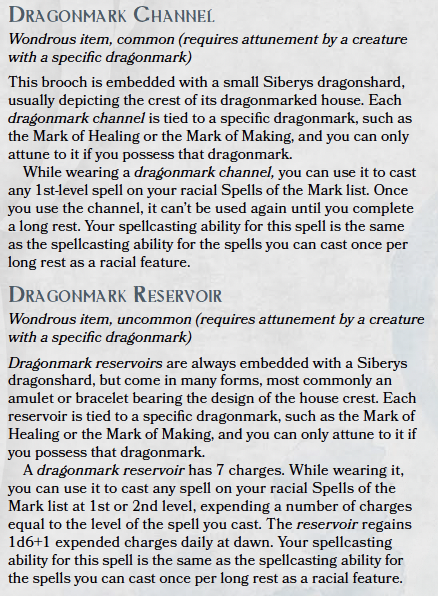
Personally, I’d allow a player in my campaign to choose either form of the Mark, though it would have to be one or the other. However, the UA/FotA version is what will be officially supported going forward and for that reason, it’s like the best choice. With that in mind, I did want to share two things. Exploring Eberron introduces a few magic items that allow a Dragonmarked character to make use of Spells of the Mark; I’m sharing two of these here. If you’ve got a Dragonmarked Reservoir, at least you can summon your unicorn!
I also want to share the Orien Step cantrip we introduced in Frontiers of Eberron. The point of this cantrip is to give an Orien heir a limited ability to teleport all the time. In my campaign, I’d make this an additional Spell of the Mark for the Mark of Passage: if you can cast spells, you can add this to the list of cantrips you can choose. So not every heir can do it, but it’s a talent you can develop. When used in this way, I would expand it in the following ways.
- It doesn’t allow the caster to escape from manacles or bonds, but it will allow them to escape from a grapple.
- The caster can’t go through solid objects, but I’d allow them to pass through any barrier that has some form of opening (similar to an amorphous creature). So you can’t pass through a solid wall, but you could pass through a portcullis or the bars of a prison cell.
However, as always this is Kanon material and a DM may choose not to allow this cantrip in their campaign.

THE HISTORY OF HOUSE ORIEN
Most people of the present day know the names of the nations that preceded Galifar—Daskara, Metrol, Thaliost, Wroat, and of course Karrnath. But these names give the deceptive impression that the basic structure of the present day—the cultural dominance of five nations—has always been the case. When the Mark of Passage first appeared, the northwest was a patchwork of lords and leagues. People prospered based on their ability to harness the supernatural resources of the land, and on the bargains they made with fey and other forces. There were a host of freeholds, farm lords, and self-declared kings, and all of them needed something. And in this age, there were those who realized that their path to prosperity lay not in standing still—in tilling the soil or mining for ore—but rather in travel, carrying goods and news between communities. Nineteen hundred years ago, the Mark of Passage bloomed along the roads of this region, taking root in those families that traveled for a living. By this time, people knew what dragonmarks were; the deeds of the House of Cannith and the Sentinel Lords of the north were known far and wide. The new bearers of the Mark of Passage celebrated their good fortune and carried on with their work. Over the course of the next two centuries, most of the marked coalesced around three forces. The Thorn Post was the most reliable system of communication in the region. The Baynes were the most successful merchants in the northwest, while Cordamar caravans were renowned for their reach and safety. While these forces prospered on their own, the example of the House of Cannith inspired Orien Bayne to build something similar. He found a valuable ally in the Nhuli, a family known both for its missionaries and bards; Afki Nhuli declared that Orien was the vessel of Kol Korran, and the Nhuli used their persuasive voices to promote Bayne’s cause. With both gold and his golden tongue, Orien Bayne wooed the Thorns and the Cordamars to his endeavor, promising prosperity for all. It says something of talent that the alliance came to carry his name—not that of Bayne, for no one family was to be placed above another, but of Orien, whose vision paved the way.
The Orien Alliance grew and prospered over the next two centuries. Soon the Unicorn Post was known across Khorvaire, and Orien caravans pressed further east with every year. While Hadran Vown Cannith and Lyosa Lyrriman Sivis devised the concept of the Twelve, it was unicorn riders who spread the word of it far and wide, and the Orien Alliance embraced the proposed traditions and became House Orien. Five hundred years later, House Orien supported Galifar Wynarn, providing invaluable logistical support to his campaign of unification. And as that united kingdom took shape, Baron Agate Bayne d’Orien presented the grateful Galifar I with a vision of a system of roads that would help to maintain communication and commerce throughout the new kingdom. So Orien established the great trade roads with the blessing and financial support of Galifar. These roads were indeed a boon for Galifar, and even moreso for House Orien. As noted in Frontiers of Eberron:
The even, well-maintained surface of the road helps travelers maintain a swift pace—while traveling exclusively on Orien trade roads, travelers gain a 10% bonus to their travel pace. A vehicle or mount carrying a passenger with the Dragonmark of Passage can add an additional 10% to its pace; the passive enchantments worked into the road are triggered by the Mark of Passage, enhancing the momentum of the Orien heir and their mount.
Throughout the history of Galifar, House Orien has been a reliable part of everyday life. Every house and nation relies on Orien shipping, and the Unicorn Post allowed people across Khorvaire to stay in touch even during the worst days of the Last War. The Passage Ring provided the invaluable (albeit very limited) service of teleportation to the rulers of Galifar. The greatest leap in the history of the house came in the Ninth Century, when Cannith and Orien unveiled the Lightning Rail. Over the course of the next century, Orien’s star grew ever brighter. And then the Last War came and shook the house to its core. On the one hand, every nation depended on House Orien to help maintain supply lines—and recognizing this invaluable service, leaders initially pledged not to target Orien infrastructure in the war. But a century of war knows no promises. Some roads and rails were intentionally targeted; others were unintended collateral damage. The rise of Darguun devastated Orien’s operations in the region, but this was merely a precursor to the horror of the Mourning. Orien is still reeling from the loss of its Cyran routes. The house is negotiating with Thrane and Karrnath in the hopes of rebuilding the White Arch Bridge. For now it is relying on temporary solutions—but the humiliating truth is that Orien usually has to rely on Lyrandar services to cross from east to west. This tension is exacerbated by the emergence of the Lyrandar airship, a development that threatens to completely upend travel and shipping. For a thousand years, Orien has been a stable foundation of life in Khorvaire. But this last decade has left it shaken, and leadership is desperately searching for a path forward.
What Happens Next? House Orien continues to play a crucial role in the daily life of the Five Nations. Thunder coaches and the Unicorn Post rumble along the trade roads. Orien crews work at all hours repairing the damage that lingers from the Last War. But this isn’t enough. Orien leadership believes they need something to counter the rise of House Lyrandar. These are a few of their prominent projects.
- The Passage Ring. House Orien believes that teleportation is the future of the house. Who needs to fly if you can get to your destination in the blink of an eye? However, as discussed earlier in this article this is limited by the number of heirs with the Greater Mark of Passage and the fact that most such heirs can only cast Teleportation Circle once per day. The Passage Ring is working to develop a more affordable form of the Helm of Teleportation; to find a way to maintain a Teleportation Circle for an extended period of time, so more passengers could cross in a single casting; and to create a form of Teleportation Circle that draws from an independent power source. This work is dangerous. Orien heirs could easily be lost in this research; in a serious mishap a chunk of Passage itself could be teleported across the world. Adventurers could be assigned to “test drive” experimental gates, or to help acquire exotic components that could be the key to an extended gate.
- Shortcuts. Khyber demiplanes often have entry points at multiple locations in Eberron, but the space within the demiplane itself doesn’t match the geography of the Material Plane. You can enter the Ironlands in the Demon Wastes, walk three miles, and emerge in Darguun. Baron Kwanti is fascinated by this phenomenon and dreams of finding a way to take advantage of it for commercial purposes—to bore passages into a demiplane, run a lightning rail through it, and be able to cross Khorvaire in under an hour. The nature of an adventure depends on how far along Orien is with their work. If they’re brought in early, adventurers could be scouts hired to investigate a newly discovered demiplane entrance—entering the demiplane, identifying its dangers, trying to locate other exits, and determining their locations in the Material Plane. Alternately, adventurers could be hired as guardians to protect the Orien team that’s establishing transit operations within a demiplane—fighting fiends or aberrations as workers place a warded line of conductor stones. Or, it could be that adventurers are brought in after the maiden voyage of the first demiplane train—because someone needs to enter the train and wipe out whatever’s now on board before it reaches Sharn.
- The Mourning Rail. Baron Kwanti yearns to establish a rail line across the Mournland. He believes that if the conductor stones were laid, the coaches’ speed would protect them from the effects of the Mourning. The consensus of the Twelve is that this is a foolish idea; even if the train itself wasn’t destroyed by the Mourning, odds are good that the new conductor stones would be corrupted or destroyed. Despite these expert opinions, Kwanti is determined to proceed with this project. Adventurers could be tasked with protecting the team laying the conductor stones as they move deeper into the Mournland; with recovering resources within the Mournland that could be repurposed for this cause (notably, wrecks of lightning rails caught in the Mourning itself). Another possibility is that they could be sent to investigate rumors of ANOTHER ’Mourning Rail” that has been sited traveling across ruined rails: Cyre 1313.
THE SHAPE OF THE HOUSE
House Orien is the most widespread of all of the Dragonmarked Houses. It has outposts in virtually every significant town in the Five Nations, as well as most of the Thronehold nations. However, most of these outposts are extremely small—they are designed to support the Unicorn Post and to offer relief or maintenance to Thunder Coaches and caravans passing through the area. Such a post might have a single bunk, a space for storing goods and sorting mail, and a trunk of holding with supplies needed to repair damaged vehicles. The most basic outposts are typically maintained by local, unmarked employees. The Mark of Passage helps people move between towns; in a small town, they don’t need an actual heir to deliver the mail to the door. Larger outposts will have a marked courier ready to run goods to their final destination as soon as they come off the coach. A large outpost will often incorporate a Sivis Speaking Stone, with a courier ready to deliver messages to their intended recipients; they may also have a Vadalis farrier in residence to care for the beasts used by the coaches and caravans.
So House Orien has small outposts all across Khorvaire. It has major enclaves in Sharn, Wroat, Varna, Flamekeep, Korth, Trolanport, Fairhaven, and Krona Peak. The Baron’s seat is the enclave of Journey’s End in the Aundairian town of Passage; House Orien employs nearly half the adult population of Passage. In addition, House Orien has three mobile enclaves—custom lighting rails coaches—that travel along the conductor stones, allowing the house to focus its resources on critical projects (usually, negotiations involving the expansion of the lightning rail). While Journey’s End is the heart of the house, Baron Kwanti d’Orien has the wanderlust that drives everyone who carries the Mark of Passage, and he spends much of his time on his own enclave-train—the Free Passage. Luxuriously appointed, Free Passage contains a Speaking Stone (with a Sivis operator) that allows Kwanti to conduct business wherever he may be. Recently he’s installed a Teleportation Circle in the train itself. Some house artificers fear that invoking the circle while the train is in motion carries risks, but it’s functioning normally… so far.
The Courier’s Guild
Before the Mark of Passage appeared, the Thorn Post served people in what is now Aundair, Thrane, and northern Breland. The Thorn Post was the most reliable delivery service of its age. Its riders were renowned for their determination and their honesty, and they overcame brigands, weather, and countless other challenges in the course of their duties. The Courier’s Guild grew from this seed. While initially there was tension when House Sivis developed the Speaking Stone, today Orien and Sivis are strong allies that work closely together. When you send a message with a Speaking Stone you pay by the word, and even though Sivis has earned broad trust for keeping the contents of its messages confidential, the sender still has to dictate their message and be willing to have it be read by the clerks on both ends. Which means that it’s not the ideal medium for a 25 page love letter or the details of a plan to blow up the Brelish parliament. Beyond this, you can only send messages from one stone to another. If you’re in Clifftop in Sharn, you can use a Speaking Stone to send a message to Ardev, but you can’t send a message to Quickstone; the town doesn’t have a working stone. Beyond that, you can send a message to Ardev, but unless your intended recipient knows to go to the station to pick up the message, how will it get to them? This is where the Sivis-Orien alliance comes in. The Courier’s Guild maintains corps of runners who handle local deliveries within towns; add one gold piece to the cost and your message will be carried from the stone station to its final destination.
With this in mind, the Courier’s Guild has two distinct divisions. The Unicorn Post is the largest component of the guild. This is the postal service of Khorvaire, delivering messages and packages to any community on its service map. While the popular image is of a unicorn rider racing along the road with a bag of mail, guild operations use many different systems to move massive quantities of mail. The enclaves mentioned earlier are major hubs with ties to the Kundarak Vault Network. This allows bags of mail to be passed from one hub to another. From these hubs, bags of mail will be transferred to a lightning rail or Thunder Coach; street runners or unicorn riders will carry the mail to its final destination. While unicorn riders are always marked, street runners usually aren’t. What’s most important for a street runner is knowledge of the town and reliability. As such, Orien prefers to work with families that have proven themselves to be trustworthy and reliable; in many towns, there’s a family or two that has no blood connection to the house, but has worked with the Courier’s Guild for generations.
The Unicorn Post is the main business of the Courier’s Guild, but there is a second branch: the Outriders. These rugged individuals are House Orien’s answer to the Sentinel Marshals. They are the most capable and respected scions of the house, trusted to deliver messages or packages of utmost importance. The Unicorn Post only delivers to Thronehold Nations and only to relatively civilized areas. The Post runs to the Rukhaan Draal, but if you need to deliver a message to a dangerous part of Darguun, or to Blood Crescent in the Demon Wastes, or to someone last seen in Stormreach, you need an Outrider. Outriders will subcontract with scions of other houses as necessary to accomplish their missions; notably, if the target of the delivery is in motion, an Outrider will hire a Tharashk tracker to help locate them, and if the region is dangerous they may employ a Denieth bodyguard. This can be an interesting option for a one shot or even a campaign: the player characters are an Outrider team tasked to deliver messages to some of the most dangerous places across Khorvaire. There is no standard rate for an Outrider delivery; the costs will be set on a case by case basis, reflecting the supplies, staff, and dangers of the mission.
The Transportation Guild
While the Unicorn Post is an iconic aspect of House Orien, the Transportation Guild is far larger and more crucial to the ongoing stability of the house. The guild has a number of major branches; ask a Scion what they do and they’ll say “I work for the Road.” These are the most important branches of the Transportation Guild.
- The ROAD runs the caravans and Thunder Coaches, managing the transportation of goods along roads.
- The RAIL operates the Lightning Rail. Agents of the Rail like to cast themselves as the heart of the house; they see the Road as outdated and the Portal as too small to be relevant.
- The PORTAL oversees the teleportation circles. It is the smallest arm of the Guild, but because the house charges such a high price for its services, the Portal is quite profitable, and many believe it is the future of Orien. The Passage Ring is a separate entity focused on research and development; it works with the Portal, but the Portal deals with the practical business of teleportation services.
- CONTINUANCE maintains the infrastructure that makes transportation possible. The Road and Rail repair their own vehicles, but it is Continuance that maintains the roads, rails, and circles themselves. This requires close interaction with the nations through which the services run, though negotiations are typically handled by the Purse.
- The INITIATIVE develops new rail lines and expands and improves roads. As with Continuance, the Initiative works with local authorities to improve infrastructure and split costs.
- The PURSE manages negotiation and finance. House Orien transports freight for other people, but through the Purse it also engages in simple speculation, buying bulk goods it can resell at a profit elsewhere in Khorvaire. In addition to overseeing these operations, the Purse handles negotiations on behalf of the other branches of the Guild—working with Continuance and the Initiative to secure the rights to build and convince the resident nation to fund the construction (as Orien’s roads and other infrastructure benefit the citizens of the nations). Orien had a long-standing relationship with the united Galifar that covered this, but now the house is having to renegotiate these agreements. Darguun and Valenar have proven especially difficult to negotiate with. While the Five Nations haven’t recognized Droaam, House Orien has been working with the Daughters of Sora Kell—an agreement whose fruits can be seen in the trade road that runs to Graywall and the lightning rail line heading in that direction.
Guild Employees
As the most widespread of the dragonmarked houses, it’s no surprise that House Orien has one of the largest workforces of the houses. However, the vast majority of Orien employees aren’t part of the house or bloodline. The House needs its dragonmarked scions to move things; it needs them on the roads and rails. But this requires a massive support staff—the people who work the warehouses, sort the mail, lay conductor stones, and much more—and these people don’t have to have dragonmarks to do their jobs. As noted earlier, in cities with Orien enclaves there are many families that have served with one of the Orien guilds for generations. While they aren’t part of the dragonmarked bloodlines, these are effectively a secondary layer of the house; as they work closely with the scions, it’s not unusual for members of these families to marry into the house itself. Unmarked Orien heirs often serve in leadership positions in the Guild arms, especially the Purse. But if the task doesn’t require movement, talent and motivation are more important than a dragonmarked bloodline. You need a dragonmark to pilot a lightning rail, but the regional director who makes sure the trains are on schedule could be a shifter or a dwarf with no blood tie to the house. There’s even some outer families that have gained special recognition within the house itself. Here’s a few examples.
- The Roof Runners. The Grigoras are a family of shifters in Sharn that have long served as street runners for the Courier’s Guild, delivering messages and packages within the city. Most Grigora shifters have Swiftstride traits, and they are experts in swift and acrobatic movement, leaping across roofs and bridges.
- The Khaar’paal. While expanding the lightning rail into western Breland, House Orien formed an alliance with a clan of kobolds who dwell in the Graywall Mountains. These Khaar’paal (Spellblood) kobolds have an affinity for electrical energy that helps them set and activate conductor stones. Currently, Orien is employing the Khaar’paal as it extends the lightning rail into Breland, but the House is seeking to hire more Khaar’paal to work across Khorvaire.
- Orlo Matayne. The Mataynes are a family of Aundairan dwarves with deep ties to the Transportation Guild. In particular, Orlo Matayne has been serving with the Initiative for over two hundred years. Tunnels are his specialty. He has helped the house drive passages through hill and mountain, and he has overseen the construction of subterranean facilities such as the supposed location of Shadowstep (see below!). When Orien needs to shift a lot of earth, you can bet they’ll get Orlo Matayne on the next train.
The Baron’s Council
In principle, the Baron is the ultimate authority within a dragonmarked house. Within House Orien, leaders have always sought consensus. The Baron’s Council is composed of nine people: three from the Courier’s Guild, three from the Transportation Guild, and three chosen by the Baron to represent the interests of the house itself—traditionally one from each of the three great families aside from that of the Baron. While in theory this is an advisory council, in practice Kwanti won’t move forward on a project without the support of two-thirds of the members of the council. While the three Councilors appointed by the Baron are always members of the dragonmarked bloodlines, the other six councilors are appointed from within the Guilds themselves; at the moment, there are two councilors who aren’t directly tied to a house bloodline.
COMMON CUSTOMS
House Orien adheres to a basic principle of When in Sharn, do as the Brelish do—which is to say, be flexible and explore the traditions of the people around you. A Thorn dancer can dance the Cyran Tago in the first round and a Karrnathi spear dance in the second. The Orien see this as a way of sharing their story. They pick up traditions everywhere they go, and by playing Conqueror or dancing the Tago they share that experience with the people around them.
This flexibility extends to faith and religion. Overall, House Orien is devoted to the Sovereign Host. The Nhuli proclaim that the house is blessed by Kol Korran, and that as long as its children travel and trade they will prosper. While the Nhuli are the most zealous family within the house, most scions are happy to accept this idea and make offerings to Kol Korran at the start of a journey. But just as a scion can dance many dances, most will accept and explore the beliefs of others. An Orien heir may pray to Kol Korran in the morning and join in the Baker’s Night celebration as the sun goes down. Beyond this, Orien has its roots in Aundair, and scions are always alert to the influence of local manifest zones and fey. The simplest way to look at this is that Orien heirs strive to be flexible. When you expect to spend every night in a new home, it helps to keep an open mind and be willing to try new things. Here’s a few other Orien traditions…
The Wander. As mentioned at the start of this article, when an Orien heir develops the Mark of Passage, they are given nine platinum coins and sent out into the world. They wander as long as they wish, but when they set foot in an Orien enclave it’s time to join a guild and begin working for the house.
Storytelling. The Bayne family are recognized as the finest storytellers in the house, but every Orien heir loves a good story. When two or more heirs find themselves in the same inn, it’s common for them to engage in a storytelling competition, with each sharing the tale of the most wondrous thing they’ve seen in their travels; the losers buy the winner’s food and drink for the evening.
Motion. The Orien love to move. They love to dance, but they’ll also take any excuse to race one another, whether on foot or on a unicorn.
The Unicorn Games. It’s said that the founders of House Orien joined forces on the 12th of Aryth after a series of trials. The heirs continue to honor this day with games and feasting. Every town with an Orien enclave has a small celebration on this day—a foot race, a dance, a storytelling competition. Once every ten years, however, there is a grand celebration in the city of Passage. These Unicorn Games celebrate all the arts of motion, from physical athletics to trials of teleportation, along with storytelling and other festivities. Orien chefs bring recipes learned in distant lands. The games take over the entire city and last for three days. While the most important events—which can earn the victors the right to carry magical heirlooms of the house for the next decade—are limited to Orien heirs, there are many lesser events in which anyone can take part. The next grand Unicorn Games are set to take place on 12 Aryth 1000 YK, but the Purse is already planning the festivities!
Shadowstep. Rumors say that on 23 Zarantyr, all heirs of House Orien capable of teleportation travel to the hidden enclave of Shadowstep, which cannot be reached on foot. Some claim the scions engage in a mystical competition; others say it’s just a wild party. It’s quite possible this event is an elaborate hoax—a tale that grows with each telling, and a way to tease those heirs incapable of teleportation. But it’s possible that there is a hidden enclave—either deep underground, or high on some mountain peak—that is all but impossible to reach except by teleportation. If so, this may be the true seat of the Passage Ring and the heart of Orien’s work with teleportation.

ORIEN FAMILIES
House Orien has a bigger tent than many of the houses. In local communities the Guild families—the families that have long served with a guild despite not having ties to the dragonmarked bloodline—often have just as much respect or influence as the blood families. So Orien is a tapestry made up of dozens of local families and clans who have supported the house for generations, linked together by the scions constantly moving from city to city. However, the founding families—those that carry the dragonmark and trace their roots back to the founders of the house—are the heart of the house. The four largest and most influential founding families of House Orien are Bayne, Cordamus, Nhuli, and Thorn. The descriptions that follow are overviews of these families reflecting common perceptions, but everyone heir is unique; you could meet a sullen Bayne, a manic Cordamus, or a Thorn who’s working for the Rail.
Bayne
Historical Role: Traveling Merchants
Primary Areas of Influence: The Rail, The Purse
Common Traits: Charisma, Ambition, Business Acumen, Storytelling
Study the plays and stories of old Thaliost and you might notice a theme: whenever there’s something the protagonist needs, within moments there’s a Bayne there to sell it to them. The Baynes began as traveling peddlers, turning their wanderlust to a practical purpose by finding new markets for the goods they’d buy along their travels. They first Baynes proved to have a remarkable knack for spotting a need and driving a hard bargain. By the time the Mark of Passage appeared, the Baynes were well established in the northwest. They worked with the Cordamus teamsters to deliver goods in bulk, but they were also known for their traveling markets—wagons filled with wonders and trinkets alike.
From the beginning, the Baynes have been the force that has driven House Orien toward profit. For a Cordamus, hard work is its own reward; a Thorn always loves to be in motion. It’s the Bayne who is always looking for an opportunity, always thinking about the things that people need and how to fill that void. While there is certainly an element of greed to this—some say a Bayne won’t take a breath unless they’ve found a way to make a profit from it—for many Baynes this impulse truly is tempered by a desire to make people happy, to give them what they need. Beyond this, of all the Orien families, the Baynes are noteworthy in that they love people. They are extroverts who are happiest when they’re making new friends. Cordamus loves to see a place they’ve never seen before; Thorn loves the road more than the destination; but a Bayne is always looking forward to the friends they’ve yet to meet.
The Baynes have always been tied to the Purse of the Transportation Guild, bringing revenue into the house through trade and negotiation with nobles and landowners. But they are also closely tied to the Lightning Rail. Baron Shalari Bayne d’Orien was the driving force behind the Lightning Rail, consumed by the dream of a way to move faster. In the centuries that have followed, the Baynes have remained close to the Rail, and for many it is their favorite form of transportation. While the position of Baron isn’t hereditary in House Orien, the post is almost always held by a Bayne, simply because they are the only family that enjoys politicking. With this in mind, if adventurers are approached by an Orien heir with a job for them, there’s a decent chance it’s a Bayne—because they are the planners and schemers of the house, looking at bigger pictures and seeing deals to be made.
Bayne Characters. The classic Bayne adventurer is a bard—charismatic and equally adept at telling a story or making a deal. However, a love of stories and bargains can also lead a Bayne scion down the path of the Warlock. There’s no common path for the Orien warlock. While some draw on their Aundairian roots and make deals with Archfey, more often than not a Bayne warlock seizes a unique opportunity over the course of their travels. As a result there is no common tradition among Bayne warlocks—but there is a shared recognition and respect among warlocks of the family. It’s worth noting that Bayne bards typically aren’t professional entertainers. They sing to while away the hours of a journey, tell stories to entertain friends and family, and use their charisma to negotiate deals. A Bayne bard might have the skill to match a Phiarlan entertainer, but entertainment isn’t their business.
Notable Baynes. The most noteworthy member of the Bayne family is the Baron of the house, Kwanti Bayne d’Orien. Canonically, Kwanti is a sorcerer; in my campaign, his abilities are more in line with those of a bard. Kwanti is devoted to the house, and spends most of his time traveling on the Free Passage visiting places where the house is struggling or working on new opportunities. While he means well, his unexpected arrival can certainly be a shock for the local scions. Kwanti loves a story, and wherever he appears he will want a dramatic accounting of recent events.
Nahira Bayne d’Orien is another noteworthy member of the family. She’s only a few years out of her Wander, but she’s displayed a remarkable knack for showing up just before trouble strikes—a food shortage, a destructive airship catastrophe, a riot over warforged rights—along with a talent for somehow turning a profit on the chaos. Nahira’s magical gifts imply that she’s a warlock. But is she tied to Fortune’s Fool, doing her best to help with the chaos she constantly stumbles into? Or is she actually an agent of the Overlord Eldrantulku… always finding chaos because she sets it in motion?
Cordamus
Historical Role: Teamsters
Primary Area of Influence: The Road, Continuance
Common Traits: Strength, Integrity, Patience, Endurance
Heirs of House Orien are often depicted as energetic and fidgety, quick to talk and to act. The Cordamus family is the exception to that rule. Cordamus heirs tend to be tall and broad, more like draft horses than race horses (or plains tribex rather than riding tribex). In social situations they tend to be silent and still, rarely speaking unless it’s required. But like all heirs of the Mark of Passage, a Cordamus can move with blinding speed when it’s called for—something all the more dramatic due to their bulk. The Cordamus were teamsters long before the Mark of Passage appeared. While they are often quiet and still, most enjoy being in motion; the typical Cordamus heir loves driving a Thunder Coach down a wide trade road, feeling the wind and the rumble of the wheels. Cordamus are known for spending little time in enclaves; most are happiest when out on the open road.
While the Cordamus are quiet folk, they are celebrated for their patience and integrity. They say little, but they stand by their promises and are renowned for their honesty. Cordamus strength and endurance are legendary. The Cordamus have always been the mainstay of the Road, loading caravans and driving Thunder Coaches; they are also a major part of Continuance, doing the hard work of maintenance without complaint. It’s said that Nhuli has dreams and Bayne makes deals, but Cordamus carries the load and makes things real. When a Cordamus heir is silent, it doesn’t mean they’re sullen. They can enjoy the movement all around them, observe the sound and motion without having to be a part of it. A Cordamus heir loves seeing new places and things; when they sit in silence, they’re often remembering things they’ve seen in their travels. Every Cordamus heir has a story in their mind. They just don’t feel a need to share it.
The Cordamus family doesn’t draw as much attention as the talkative Baynes or the enigmatic Nhuli, but they are proud of their contributions to the house and know that their strength has served it well.
Cordamus Characters. The iconic Cordamus adventurer is a Barbarian. Their Strength and Constitution are obvious gifts, but Fast Movement and Danger Sense both reflect the power of the Mark of Passage—allowing them to move with blinding speed when necessary. A Cordamus Barbarian could present their Rage not as anger but as their Dragonmark temporarily enhancing their speed and reflexes. Damage Resistance is due to their being able to roll with a blow; Rage Damage reflects enhanced kinetic energy. Overall this reflects the idea of the man-mountain who seems slow but can move with uncanny speed and precision when needed.
Notable Cordamus. Members of the Cordamus family rarely seek rank or recognition, but they are sometimes drawn into important roles due to their talents and integrity. Corinn Cordamus Orien has served as a member of the Baron’s Council for almost fifty years. Sometimes called the Bear of the Baron’s Council, she is fearless and brutally honest; Baron after Baron have chosen to retain her on the council, appreciating her candor and her common sense.
Nhuli
Historical Role: Magewrights and Priests
Primary Area of Influence: The Initiative, The Portal
Common Traits: Supernatural Talent, Imagination, Curiosity, Devotion
The Nhuli have long been dreamers, with wanderlust fueled by visions of wonders they’ve never seen. Some believe that this assists them in teleportation—that they are less burdened by the weight of reality. Whatever the truth, while the Nhuli are the smallest of the founding families, a remarkable number of Nhuli heirs develop the Greater Mark of Passage. Nhuli heirs are often found in the Portal, and many of the greatest Blades of Orien—the eldritch warriors who hone their teleportation abilities to protect road and rail—have been Nhuli.
While Nhuli are often associated with teleportation, they are more broadly the most magical of the Orien families. Orien is a practical house, and most of the families are focused on getting goods from point A to point B. The Nhuli look beyond the world. Most Nhuli heirs embrace the path of arcane science and become magewrights; while they can’t match the dedicated skills of a Cannith or Vadalis heir, it’s Nhuli who are often found using Mending and other magic to repair damaged vehicles, or using Speak With Animals to soothe a team of tribex. Some do rise to greater heights; the wizards and artificers of the Passage Ring are primarily Nhuli. However, some Nhuli eschew arcane science in favor of divine faith. Overall, the Nhuli are strongly devoted to the Sovereign Host and believe that Kol Korran is the patron of the house; a Nhuli priest blesses every new Lightning Rail line. Of course, there are always rumors floating about. Some say there’s a Nhuli priest who leads a sect of the Three Faces of Coin in the shadows of House Orien, helping smugglers make use of Orien assets. Others whisper that Nhuli studies of Khyber demiplanes have spawned a Cult of the Dragon Below in the family—and that the Passage Ring’s breakthroughs in teleportation are actually dangerous gifts of the daelkyr.
Overall, the Nhuli are noted for their curiosity and imagination—their desire to see places and things they’ve never seen before, and dreams of what could be around the next corner. But they are also respected for their devotion; once a Nhuli embraces an idea or a cause, they will cleave to it through any trial.
Nhuli Characters. Nhuli adventurers are the most mystically inclined members of the house. Following the arcane path, a Nhuli adventurer could be a Diviner Wizard who dreams of possible futures or an Artificer using the Cartographer subclass. A Blade of Orien could be represented as an Eldritch Knight fighter specializing in teleportation magic. A Nhuli Cleric could take the Trickery domain, reflecting Kol Korran’s cunning; or they could take the Life domain to reflect the overall benevolence of the Sovereign Host. A Nhuli Paladin could take the Oath of Glory, tying its enhanced movement and athleticism to their dragonmark and the blessing of Kol Korran; they might be charged to protect travelers.
Notable Nhuli. Though he’s only 33, Davu Nhuli d’Orien has achieved fame as the foremost arcane researcher in the Passage Ring. In the wake of the Mourning he’s been tapped to serve on the Baron’s Council, and has been pushing the house to invest more deeply in experimental teleportation. Davu is certain that teleportation is the key to the house’s survival and is willing to take risks; he might hire adventurers to take dangerous excursions into demiplanes to explore shortcuts. It’s worth noting that Davu is a brilliant arcane scientist but that he is a ritual caster rather than being a full Wizard—though he does possess the Greater Mark of Passage and can cast spells through his Dragonmark. If there is a cult of the Dragon Below in the Passage Ring, he might be the mastermind behind it! Meanwhile, Eshe Nhuli d’Orien is one of the oldest Blades of Orien serving on the Lightning Rail. She has no patience for suspicious behavior or backtalk; if you refuse to answer her questions, you’ll find yourself sitting on the side of the rail.
Thorn
Historical Role: Thorn Post
Primary Area of Influence: The Courier’s Guild
Common Traits: Dexterity, Speed, Precision, Impatience
Scions of the Thorn family truly feel a need for speed. Everyone who carries the Mark of Passage feels a comfort in being in motion, but for a Thorn, it’s not sufficient to be sitting in a coach or riding on the rail; they want the wind against their skin, to feel the surge of adrenaline as they move. This urge took root before the Mark of Passage did; in the days before Dragonmarks, the Thorns established the first postal service in Khorvaire, carrying goods and messages by horseback. The Thorn Post earned its reputation for being fast and reliable, and it was that reputation that helped the young House Orien achieve success. Today the Thorns largely continue to serve with the Courier’s Guild. While the Road and Rail may bring more gold to the house, most Thorn heirs prefer riding a unicorn to sitting on a train.
Thorns are often depicted as being impatient and unable to sit still. While there is some truth to this, it is balanced by the remarkable speed and grace of the typical Thorn heir. While riding is an acceptable alternative, Thorns love to run, leap, and dance. While Oriens take pride in learning new dances everywhere they go, the Thorns do have their own traditions. Whirling is part dance, part sparring session, a dizzying blend of interwoven movements. The Whirlwind is a martial tradition tied to these movements, focusing on volleys of kicks and swift knife blows; it’s beautiful to watch as well as being deadly.
Many Thorns have a chaotic, independent streak, and this further pushes them toward the Courier’s Guild. These mavericks don’t mind serving the overall agenda of their house and family, but they prefer to do so as lone riders or runners as opposed to being part of a rail crew or working in a warehouse. Thorn impatience can also manifest as a quick temper. Cordamus heirs are typically strong but slow to anger; Thorns are more prickly and quick to take offense. Over the last few years, brawls between Lyrandar heirs and Thorn Oriens have become increasingly common; it generally only takes a few barbs about how the airship is going to make Orien obsolete to get fists flying. However, while they are quick to anger, most Thorns don’t hold onto a grudge; they like to live in the moment, racing from feeling to feeling.
Perhaps because of that quick temper, the Thorn family has produced the highest number of excoriates over the history of the house. In the Ninth Century, Ralin “Blood” Thorn gathered a band of dragonmarked brigands that carried out a series of daring robberies, notably pulling off the grandest train heist in history. While Blood Thorn is long dead, there are still a number of Orien outlaws at league in the Five Nations, and most of them are Thorns.
Thorn Characters. Thorn adventurers love to move. An Arcane Trickster Rogue can take spells related to teleportation and speed to reflect the powers of their mark combined with training in Whirlwind bladework. Open Hand Monk is another way to reflect mastery of the Whirlwind. But the iconic Thorn Outrider is a Fey Wanderer Ranger, using their mark to Misty Step into battle and unleashing a storm of steel.
Notable Thorns. Gala Thorn d’Orien represents her family on the Baron’s Council. She despises House Lyrandar and has long been urging the Baron to take more direct action against the rival house, promoting the idea of sabotage to reduce public trust in flight. So far, the rest of the Council has rejected these ideas. Because of this, she could end up employing a group of adventurers to carry out her schemes—or, adventurers could find themselves fighting against her agents as they try to bring down an airship in flight. On a lighter note, Dal Thorn Orien is an unmarked heir of House Orien who has recently joined the Carnival of Shadows. Despite their love of dance, few Oriens have any interest in professional performance; Dal is an excellent whirler and wants the world to see his talents.
FRIENDS AND FOES
Throughout the history of the Twelve, House Orien has been a house with many friends and few enemies. Everyone has a use for Orien services, and until the development of the airship it had no direct competitors in the field of overland travel. House Sivis has always had an especially close relationship with House Orien, and the two often share outposts; Orien couriers hand deliver messages received through a Speaking Stone. House Vadalis is another house with strong, deep ties to Orien; Post riders may ride their unicorns, but Orien's caravans and Thunder Coaches are pulled by Vadalis-bred beasts. The development of the Kundarak Vault Network cemented a tight alliance between House Kundarak and Orien, and the house uses the Vaults to assist with their postal services. And in the past, there has been a good relationship between House Tharashk and House Orien, as Orien Outriders would often work with Tharashk Finders to help locate moving targets for deliveries. And while it's not as direct a bond, the fact that Orien scions spend so much time on the road often forms connections between individual heirs and the Ghallanda innkeepers along their routes—many of which rely on Orien shipping for their supplies!
The last decade has seen two upsets—one small and one large. The greatest disruption is House Lyrandar’s use of the Elemental Airship, which threatens to transform the entire landscape of overland travel. House Lyrandar argues that progress is progress, and it’s not their concern if their services threaten Orien’s obsolete traditions. Most of the leadership of House Orien believes that the way to fight Lyrandar is by improving Orien’s own offerings. Some say that airships are a fad, that Lyrandar can’t match the sheer scale of freight Orien transports by coach and rail. Others push for the expansion of teleportation, which could make all other forms of transportation irrelevant. But there is a faction in the house—led by people like Gala Thorn d’Orien—who see Lyrandar’s actions as a declaration of war, and who believe that Orien should turn to sabotage and more severe actions to undermine the airship industry before it’s too late. The second feud is smaller. Over the last decade House Tharashk has been bringing mercenaries from Droaam into the Five Nations. Notably, in Sharn and Wroat, Tharashk has introduced gargoyles and harpies as flying couriers—creating competition with Orien’s street runners. At the moment this is a localized feud that hasn’t affected the entire house, but if there is a dramatic incident in Sharn it could snowball out to affect the Houses themselves.
Beyond these few feuds, Orien has always been one of the more popular houses. Everyone uses Orien roads, and people rely on the Unicorn Post. Before the Last War, the Transportation Guild worked closely with the Crown to maintain infrastructure. In the wake of the War, this has become more complicated as Orien has to negotiate with every nation. To date, it has faced the most trouble in Darguun and Valenar. In the case of Darguun, Lhesh Haruuc won’t promise protection for Orien teams that want to repair broken rail lines or expand roads. Many of the tribes and clans of southern Darguun have no love for the Chaat’oor, and Haruuc has chosen to respect that anger. Conversely, in Valenar the Tairnadal themselves see no need for improved infrastructure; they enjoy the wild nature of the terrain. This is further supported by House Lyrandar; a lack of road and rail means that Valenar relies on Lyrandar’s shipping—both air and sea—for vital trade.
ORIEN STORIES
Compared to many of the houses, Orien is relatively benevolent. Establishing and maintaining roads is a service that helps everyone. And in general, Orien is more empathetic than most houses because its heirs are constantly moving from place to place—they see people from every nation, and they work with the common folk every day as opposed to performing assassinations for the wealthy or manufacturing weapons for kings. Because of this, it may seem like a difficult house to use at the heart of the story. What does an Orien villain actually look like?
Strangers on a Train. One of the first points to consider is that Orien can lay the foundation for a story without actually being the villain. The lightning rail alone is a suitable stage for countless adventures...
- ... A changeling thief stole something from the adventurers and leapt on the lightning rail. They have to find the thief before the train reaches the next station and the changeling is lost in the crowd.
- ... A simple robbery: a group of brigands reveal themselves, planning to take people's valuables and rob the cargo. Can the adventurers stop them?
- ... A not so simple robbery: It appears to be the same scenario, but the "brigands" are Emerald Claw and they're assembling an Eldritch Machine at the back of the train; what are they really up to?
- ... You're the robbers: It's time for a heist! You have to steal something from the train before it reaches its destination.
- ... When a mysterious daelkyr artifact is shipped on a lightning rail, it has a terrible effect on the train and its passengers. This could be something akin to a zombie apocalypse, with a contagious transmutation spreading among the passengers. It could be a plot like The Thing, with the adventurers trying to uncover a monstrous killer. Or it could be that the artifact shunts the train into a demiplane; can the adventurers save the passengers and find a way home?
Local Greed. While Orien as a house might not have a nefarious agenda, individual Sensechals may be driven by greed or ambition. This is especially true of the Bayne family, who are always looking for ways to make more gold. An Orien leader could be backing a local crime syndicate, or working with smugglers. They could be stockpiling a dangerous substance—Old blast disks, dragon's blood—they're planning to resell. Alternately, they could be using their control of the supply of a crucial item—a medicine needed to counter a plague—as a way to squeeze money from the local community.
Trouble with the Workforce. Overall, House Orien treats its workers well. As noted above, many of the workers have generational connections to the house and are effectively part of its extended family. Even with nonhuman workers, such as the Khaar'paal kobolds, Frontiers of Eberron calls out that the Khaar'paal are valued for their skills and well compensated for their labor. Overall, the house isn't supposed to be exploiting its work force. However, there could easily be a situation where Orien brings in a kobold workforce and members of the local community give in to prejudice or superstition; adventurers might have to navigate tension or unravel a mystery after people on both sides are killed.
Digging too Deep. One of the simplest Orien stories is the "Oops!" story: in their desperation to counter Lyrandar they do something foolish with dire consequences. It turns out that trying to run a highway through the Abyssal Forest of Khaar or through the Mournland is a terrible idea. In such a situation, the Orien involved may be good people—but their actions can still unleash great dangers.
Parallel Lives. House Orien is experimenting with their Teleportation Circles, seeking ways to allow them to be used more frequently. As part of this, they give the adventurers free access to the network (perhaps because there's an Orien heir in the party, or perhaps because they've somehow helped an Orien patron). This is a useful service that helps the party as they go about their adventures. But at some point, the adventurers arrive at a destination that's not what it's supposed to be. It's a parallel universe—a version of Eberron transformed by the daelkyr and lost in the Maze of Realities. The circle is dead, and the adventurers have to find a way to reactivate it and get back home. Now the circles can provide an opportunity to explore other realities. They could cause chaos when something terrible spills over from an abandoned world—a monster, a curse, a plague. Long term, the adventurers could realize that Davu Nhuli d'Orien has been replaced by his counterpart from a parallel world—and that he's working on a way to use the circle to bring his world back into the prime material.
Beyond Time and Space. Orien teleportation bends time and space. Some say that this power is tied to Xoriat—and that all Dragonmarked Orien heirs are connected to Xoriat. Perhaps the work of the Passage Ring strengthens that connection, with the result that all Orien heirs slowly transform into something inhuman. Perhaps they become separated from linear time, or their minds shift into eerie alignment, or they develop the ability to shatter the fabric of space. Initially these powers could seem to be boons; but the more they are used, the faster the heirs become disturbing aberrations. Can anything be done to stop this? Is there any way to save Orien allies?
Dust and Dreams. Even if the House has no malevolent agenda, ANYONE can be a puppet of the Lords of Dust or a quori mind seed. Canonically, Five Nations suggests that the Lords of Dust have a major outpost under Passage: "From here, the rakshasas and other fiends spread out into the Five Nations and beyond to sow discord, foster fear and paranoia, and gain personal power while constantly seeking the means to free their ancient, trapped masters from the bowels of the planet." An interesting aspect of this is that as written, this operation isn't tied to a specific overlord but is instead an outpost of the Lords of Dust as a whole, not unlike Ashtakala itself. It's quite possible that the Lords of Dust have dug deep roots into House Orien precisely because its heirs travel across Khorvaire without much notice, and it allows the rakshasa themselves to use teleportation without drawing attention. So Orien could be a force that has no inherent malevolent agenda of its own—but that is being used by the Lords of Dust to provide logistical support to operations tied to multiple overlords and their cults.
FINAL THOUGHTS
In creating a character from House Orien, consider if you fall into any of the following paths.
- The Long Wander. You began your Wander when you developed the Mark of Passage, and you’ve never set foot in an Orien enclave since that day. You love your family, and someday you will return and take up your duties with one of the guilds. But for now there’s still so many things you want to see, so many roads you haven’t walked down. Do you still have any of your original nine platinum coins?
- Proud Foundling. You are the child of excoriates, perhaps a descendant of Blood Thorn. You revel in your speed but have no desire to forge a connection to the house; you dream of one day robbing a train yourself.
- Bitter Excoriate. You have been severed from the house. What did you do to deserve this? Were you responsible for a terrible accident (something you may deeply regret)—or were you blamed for a devastating Lightning Rail mishap that was actually the fault of some paper-pushing Seneschal? Did you get into a fight with a pack of Lyrandars and get excoriated as a bone to the Storm? Do you hope to be redeemed or are you done with the houses?
- Nhuli Dreamer. As a wizard or artificer, you have dreams of revolutionizing the business of teleportation. You may be searching for extraplanar shortcuts, hoping to learn more about the Riedran teleportation network, or keen to investigate the arcane science of the Giants of Xen’drik. Is your work sanctioned by the house, or are you acting on your own?
- Blessed by Kol Korran. As a paladin or cleric, you believe that you have a strong connection to Kol Korran and that the Sovereign of World and Wealth has a mission for you. Perhaps you are simply charged to protect people on the road. Maybe there’s a place you’re supposed to go and a deal you’re supposed to make, but you don’t yet know exactly what it is. Or perhaps you are supposed to protect someone else in your party: you don’t know why, but you know that you need to protect another adventurer until they finish their journey.
- House Agent. You are a troubleshooter on call for the house. At any time, you could be tasked to investigate stolen goods, to deal with brigands, to investigate demiplanes, or perhaps just to ride the lightning rail and stop a robbery. What you do in your off hours is your business.
These are just a few ideas. The main question when making an Orien heir is whether you’re still working with the house and if so, how this works with the goals of the campaign. Are you on leave, with the possibility that you could be set a task at any time? Are you retired? Are you actively serving on a Lightning Rail line, and just adventuring on your days off?
Some adventure ideas for House Orien have already been mentioned above in the History section. The House’s desire to improve its teleportation services are an easy source for adventure, whether it involves exploring demiplanes or test-driving teleportation circles or tools. An escalating feud with House Lyrandar is another seed for adventure, as is the desire to lay a rail across the Mournland. On a simpler level, any journey on a lightning rail is an opportunity for adventures. Stop a great train robbery! Investigate a murder on the Orien express! Figure out what to do with a deadly eldritch machine in the Mournland! Or how to exorcise a train that’s been possessed!
That's all for now. As always, keep in mind that this is Kanon material—what I do in MY campaign—and may contradict canon material. Thank you for your support!